DEP review finds limited signals of chemical risk from synthetic turf; Green Acres tightens funding controls
November 22, 2025 | Pinelands Commission, State Departments and Agencies, Organizations, Executive, New Jersey
This article was created by AI summarizing key points discussed. AI makes mistakes, so for full details and context, please refer to the video of the full meeting. Please report any errors so we can fix them. Report an error »
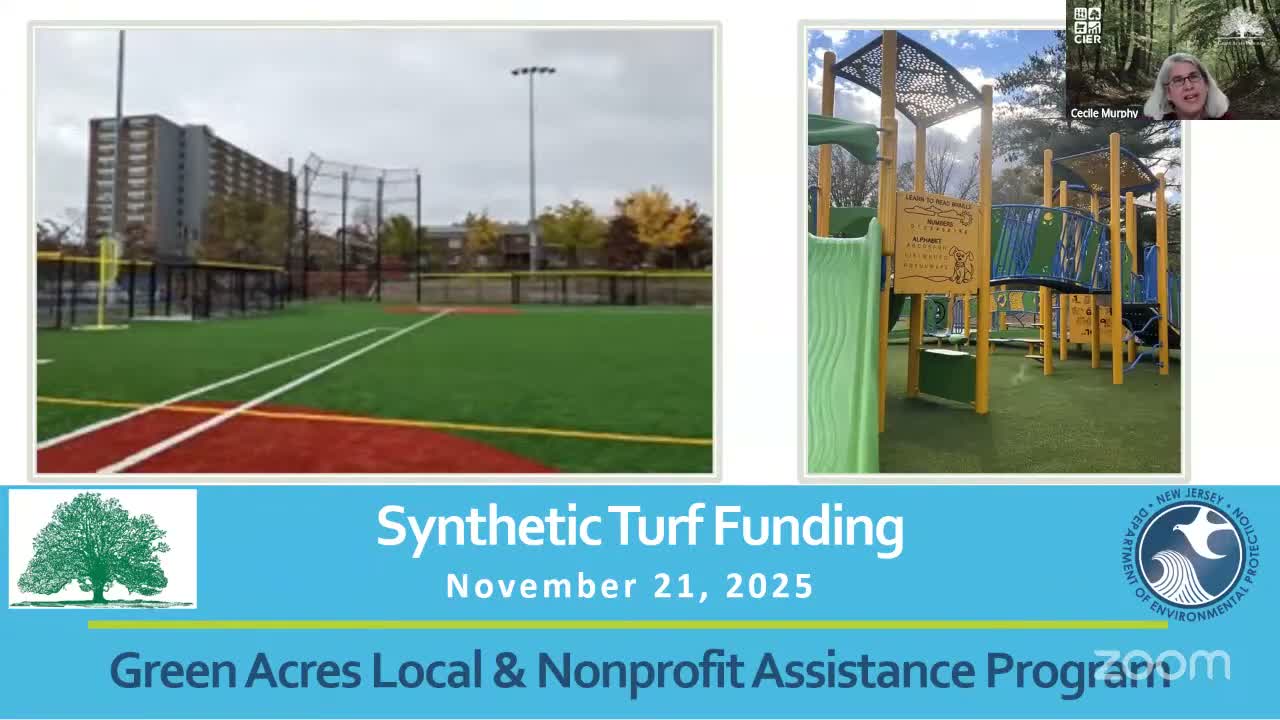
At the Pinelands Commission's Policy & Implementation Committee meeting on Nov. 21, DEP scientists and Green Acres officials briefed commissioners on a multi-part review of synthetic turf and on changes to how Green Acres will evaluate funding applications that propose artificial turf.
Cecile Murphy, chief of Green Acres' local assistance, said the program now "prefers natural turf" and has required an expanded synthetic-turf addendum to environmental impact statements since 2023. The addendum forces applicants to disclose infill type, fiber and backing composition, stormwater design for a 100-year event, projected maintenance and replacement budgets, and the name and contact information for any recycling facility the applicant proposes. "We disfavor, synthetic turf," Murphy said, while also noting the recreational benefits that can be important in densely populated communities.
Murphy told commissioners Green Acres asks applicants to supply a 20-year cost analysis because warranties on turf surfacing are typically 8'to'10 years and fields commonly require replacement in about a decade. She told the committee Green Acres sees replacement costs in practice "an average of 300 to $600,000" and that applicants often return later seeking funding for replacement.
DEP's Division of Science & Research (DSR) presented a draft literature synthesis and a summary of the federal Research Action Plan. Greg Respani, a human-health toxicologist with DSR, summarized lab and field studies that tested crumb rubber, turf fibers and field dust for metals, semi-volatile organics, volatile organics and a range of other compounds. "Overall, it seems, fairly inconclusive again when we consider the full life cycle assessments," Respani said, adding that much of the available research focuses on crumb rubber alone or on indoor facilities and that New Jersey'specific ecotoxicology data are limited.
DSR said its comparison used New Jersey DEP nonresidential soil remediation values to put measured concentrations into context and reported: metals and SVOCs were detected in many samples but generally did not exceed the state's nonresidential comparison values; VOCs rose in laboratory tests run at very high temperatures but did not exceed inhalation comparison values used by DSR; and a small biological-monitoring study detected changes in one urinary metabolite but otherwise found no consistent pre/post exposure differences among participants.
The scientists highlighted remaining uncertainties: limited ecotoxicology studies on aquatic impacts, sparse data on PFAS leaching from turf in real-world settings, constrained evidence about long-term microplastic fate and transport, and practical limits on recycling and end-of-life options. Respani and colleagues recommended site-specific design and mitigation (stormwater controls, perimeter features to limit off-site migration, and maintenance practices) and urged communities to do localized due diligence.
Commissioners and public commenters focused on disposal and recycling, PFAS, and heat and injury risks. Several speakers, including environmental advocates, said turf components and microplastics migrate off fields and into surrounding soils and waterways; DSR staff told the committee that while dispersion pathways have been documented, the ecotoxicology evidence base for New Jersey'specific impacts is limited and that monitoring and lifecycle studies would be valuable.
Green Acres emphasized that applicants must conduct public engagement and include mitigation in planning documents; Murphy said projects with weak due diligence or insufficient public notice have been disqualified in prior rounds. Green Acres staff also noted the program can fund conversions back to natural turf in some cases.
Next steps: DSR said the draft review is in final-draft stages and will be posted publicly when approved; Green Acres will apply the tightened addendum in the 2026 funding round. The commission did not adopt a policy action at the meeting; questions about solid-waste regulation and a New Jersey-specific ecotoxicology effort were left as follow-ups.
Cecile Murphy, chief of Green Acres' local assistance, said the program now "prefers natural turf" and has required an expanded synthetic-turf addendum to environmental impact statements since 2023. The addendum forces applicants to disclose infill type, fiber and backing composition, stormwater design for a 100-year event, projected maintenance and replacement budgets, and the name and contact information for any recycling facility the applicant proposes. "We disfavor, synthetic turf," Murphy said, while also noting the recreational benefits that can be important in densely populated communities.
Murphy told commissioners Green Acres asks applicants to supply a 20-year cost analysis because warranties on turf surfacing are typically 8'to'10 years and fields commonly require replacement in about a decade. She told the committee Green Acres sees replacement costs in practice "an average of 300 to $600,000" and that applicants often return later seeking funding for replacement.
DEP's Division of Science & Research (DSR) presented a draft literature synthesis and a summary of the federal Research Action Plan. Greg Respani, a human-health toxicologist with DSR, summarized lab and field studies that tested crumb rubber, turf fibers and field dust for metals, semi-volatile organics, volatile organics and a range of other compounds. "Overall, it seems, fairly inconclusive again when we consider the full life cycle assessments," Respani said, adding that much of the available research focuses on crumb rubber alone or on indoor facilities and that New Jersey'specific ecotoxicology data are limited.
DSR said its comparison used New Jersey DEP nonresidential soil remediation values to put measured concentrations into context and reported: metals and SVOCs were detected in many samples but generally did not exceed the state's nonresidential comparison values; VOCs rose in laboratory tests run at very high temperatures but did not exceed inhalation comparison values used by DSR; and a small biological-monitoring study detected changes in one urinary metabolite but otherwise found no consistent pre/post exposure differences among participants.
The scientists highlighted remaining uncertainties: limited ecotoxicology studies on aquatic impacts, sparse data on PFAS leaching from turf in real-world settings, constrained evidence about long-term microplastic fate and transport, and practical limits on recycling and end-of-life options. Respani and colleagues recommended site-specific design and mitigation (stormwater controls, perimeter features to limit off-site migration, and maintenance practices) and urged communities to do localized due diligence.
Commissioners and public commenters focused on disposal and recycling, PFAS, and heat and injury risks. Several speakers, including environmental advocates, said turf components and microplastics migrate off fields and into surrounding soils and waterways; DSR staff told the committee that while dispersion pathways have been documented, the ecotoxicology evidence base for New Jersey'specific impacts is limited and that monitoring and lifecycle studies would be valuable.
Green Acres emphasized that applicants must conduct public engagement and include mitigation in planning documents; Murphy said projects with weak due diligence or insufficient public notice have been disqualified in prior rounds. Green Acres staff also noted the program can fund conversions back to natural turf in some cases.
Next steps: DSR said the draft review is in final-draft stages and will be posted publicly when approved; Green Acres will apply the tightened addendum in the 2026 funding round. The commission did not adopt a policy action at the meeting; questions about solid-waste regulation and a New Jersey-specific ecotoxicology effort were left as follow-ups.
View the Full Meeting & All Its Details
This article offers just a summary. Unlock complete video, transcripts, and insights as a Founder Member.
✓
Watch full, unedited meeting videos
✓
Search every word spoken in unlimited transcripts
✓
AI summaries & real-time alerts (all government levels)
✓
Permanent access to expanding government content
30-day money-back guarantee
