Pinelands Commission debates accessible-trail amendment: 4-ft baseline, bump-outs and surfacing remain contested
November 22, 2025 | Pinelands Commission, State Departments and Agencies, Organizations, Executive, New Jersey
This article was created by AI summarizing key points discussed. AI makes mistakes, so for full details and context, please refer to the video of the full meeting. Please report any errors so we can fix them. Report an error »
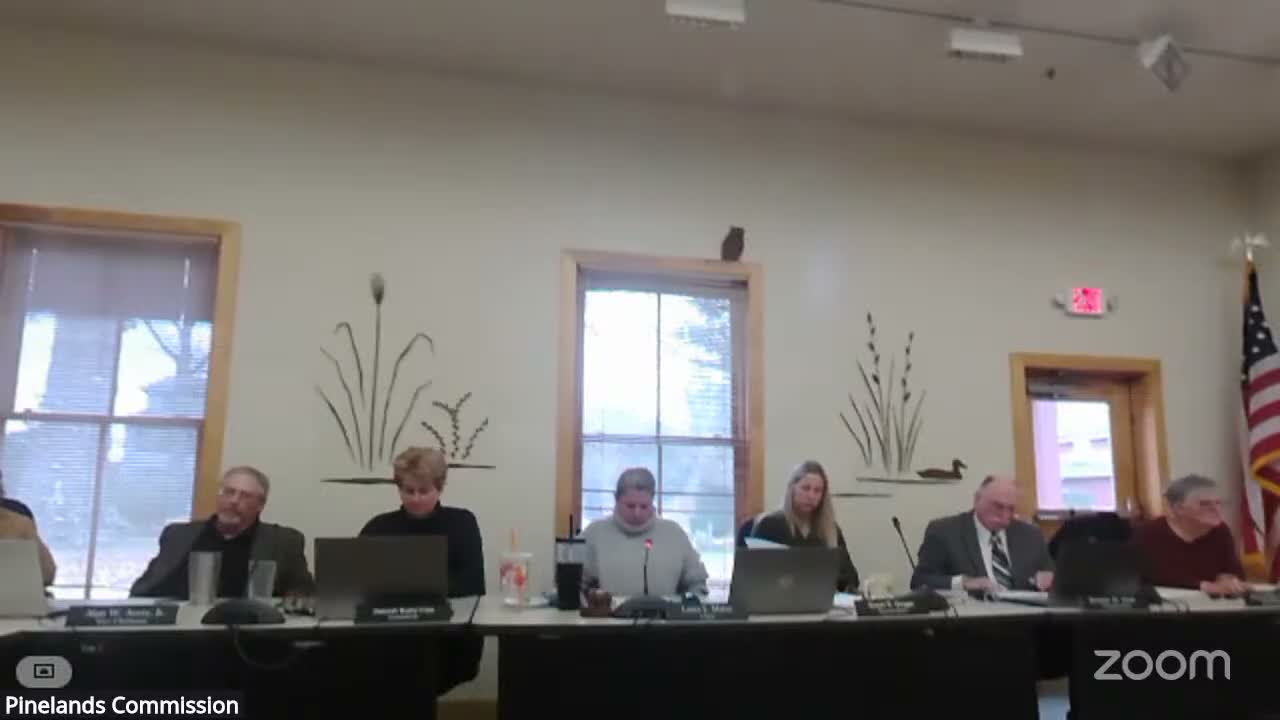
At the Nov. 21 Policy & Implementation Committee meeting, planning staff presented a proposed amendment to the Pinelands CMP to allow limited "accessible trails" in wetlands and wetland buffers when the improved trail sits within the footprint of an existing unimproved trail.
Katie Elliott, a planning specialist, said the draft language would define an "accessible trail" as an improved, firm, flat and stable surface that allows mobility-device access; it would limit an improved trail to a maximum width of 4 feet with periodic bump-outs for passing, cap the combined length of improved segments in wetlands/buffers at 1.5 miles and require boardwalks where the trail crosses standing water. "This would permit accessible trails in wetlands and wetlands buffers, provided that the proposed trail aligns with an existing unimproved trail," Elliott said.
Commissioners and attendees focused on practical and environmental trade-offs. Supporters urged modest widths and a streamlined rule to avoid the time-consuming MOA (memorandum of agreement) process while opponents and accessibility advocates urged flexibility for passing, scenic pullouts and transitions from parking to trailheads. Several commissioners said 4 feet could work for the narrow improvements staff envisioned but recommended regular bump-outs; others noted that 6 feet would allow side-by-side walking or passing of larger mobility devices.
Surfacing generated the strongest debate. Staff suggested allowing a range of materials, including pervious pavements, engineered mats and boardwalks, and said boardwalks would be required where standing water is present. Multiple speakers urged a prohibition on traditional asphalt in wetlands/buffers; staff asked whether a simple rule requiring pervious materials where feasible would be sufficient, while others urged an enumerated menu of acceptable surfaces to reduce subjective review burdens.
On fees, staff proposed using the existing linear-development fee schedule (per-acre disturbed land with a $250 minimum), but commissioners asked whether accessible-trail applications are less staff-intensive and might warrant a lower fee to encourage public projects and non-profit applicants.
Next steps: staff said they will fold the accessible-trail language into a broader amendments package early next year, bring a full draft back to the committee, and then seek commission authorization to publish a proposed rule and hold public hearings mid to late next year.
Katie Elliott, a planning specialist, said the draft language would define an "accessible trail" as an improved, firm, flat and stable surface that allows mobility-device access; it would limit an improved trail to a maximum width of 4 feet with periodic bump-outs for passing, cap the combined length of improved segments in wetlands/buffers at 1.5 miles and require boardwalks where the trail crosses standing water. "This would permit accessible trails in wetlands and wetlands buffers, provided that the proposed trail aligns with an existing unimproved trail," Elliott said.
Commissioners and attendees focused on practical and environmental trade-offs. Supporters urged modest widths and a streamlined rule to avoid the time-consuming MOA (memorandum of agreement) process while opponents and accessibility advocates urged flexibility for passing, scenic pullouts and transitions from parking to trailheads. Several commissioners said 4 feet could work for the narrow improvements staff envisioned but recommended regular bump-outs; others noted that 6 feet would allow side-by-side walking or passing of larger mobility devices.
Surfacing generated the strongest debate. Staff suggested allowing a range of materials, including pervious pavements, engineered mats and boardwalks, and said boardwalks would be required where standing water is present. Multiple speakers urged a prohibition on traditional asphalt in wetlands/buffers; staff asked whether a simple rule requiring pervious materials where feasible would be sufficient, while others urged an enumerated menu of acceptable surfaces to reduce subjective review burdens.
On fees, staff proposed using the existing linear-development fee schedule (per-acre disturbed land with a $250 minimum), but commissioners asked whether accessible-trail applications are less staff-intensive and might warrant a lower fee to encourage public projects and non-profit applicants.
Next steps: staff said they will fold the accessible-trail language into a broader amendments package early next year, bring a full draft back to the committee, and then seek commission authorization to publish a proposed rule and hold public hearings mid to late next year.
Don't Miss a Word: See the Full Meeting!
Go beyond summaries. Unlock every video, transcript, and key insight with a Founder Membership.
✓
Get instant access to full meeting videos
✓
Search and clip any phrase from complete transcripts
✓
Receive AI-powered summaries & custom alerts
✓
Enjoy lifetime, unrestricted access to government data
30-day money-back guarantee
