Senate appropriations panel gives 'do pass' to bill seeking SNAP waiver to exclude soft drinks
February 20, 2026 | 2026 Legislature SD, South Dakota
This article was created by AI summarizing key points discussed. AI makes mistakes, so for full details and context, please refer to the video of the full meeting. Please report any errors so we can fix them. Report an error »
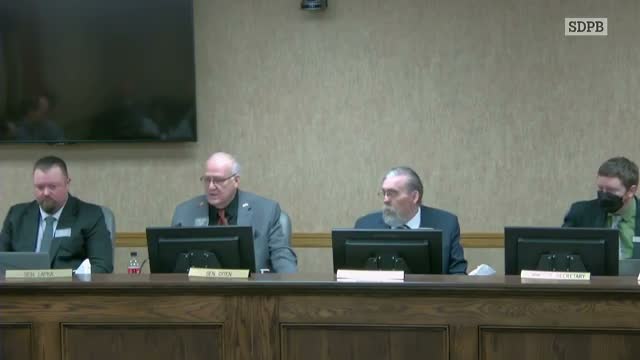
The Senate Appropriations Committee voted to recommend passage of House Bill 1056, a measure directing the Department of Social Services to submit a federal waiver to exclude soft drinks from purchases using Supplemental Nutrition Assistance Program benefits.
Representative Taylor Rayfeld, one of the bill's sponsors, framed the legislation as a fiscal and public-health step. "This bill simply aligns SNAP with standards that are already in place elsewhere," Rayfeld said, arguing that restrictions would reduce preventable chronic disease and long-term Medicaid liability. Proponents including medical and dental associations and early-childhood advocates said the policy would steer public nutrition dollars toward nutrient-rich foods and reduce dental and chronic-disease costs.
Opponents, led by representatives of the governor's office and retail and beverage industry groups, urged caution. Laura Ringling of the governor's office said, "On its face, this bill sounds like a good idea, but ultimately it creates a new and ongoing cost obligation to the state," citing state estimates of implementation costs and ongoing monitoring. Nathan Sanderson of the South Dakota Retailers Association warned that retailers need a precise, product-level list to operate SNAP exclusions at checkout: "We absolutely must have some kind of a list… We don't know." Steve Willard of the Soft Drink Bottlers Association said the bill's broad definition could sweep in many low- or zero-sugar products.
Committee members questioned both sides about evidence, fiscal assumptions and timeline. Officials said the bill would require a waiver submission by September, USDA review of roughly two months and an additional six months for implementation, suggesting an operational start in 2027 if approved. The governor's office and other witnesses described ongoing obligations for tracking purchases and health outcomes under state waivers and said multi-state experience shows program setup and maintenance can require staff, vendor contracts and participant education.
Fiscal figures discussed in the hearing included an LRC estimate of about $330,000 annually for implementation, while the governor's office cited higher estimates based on other states' experiences; proponents cited estimates they described as modest relative to Medicaid and dental spending. Senator Paul Muskemins, testifying on his own behalf as a retired dentist, called the cited $320,000 figure an affordable investment compared with state dental Medicaid costs.
After debate, Senator Howard moved a "do pass" recommendation on HB 1056; the motion passed in committee by reported tally of 6 yeas, 2 nays and 1 absent. The bill will be reported to the Senate floor for further consideration.
The committee record shows continued questions about the scope of excluded items, retailer implementation mechanics and whether state-level waivers or a federal rule change is the preferred long-term solution.
Representative Taylor Rayfeld, one of the bill's sponsors, framed the legislation as a fiscal and public-health step. "This bill simply aligns SNAP with standards that are already in place elsewhere," Rayfeld said, arguing that restrictions would reduce preventable chronic disease and long-term Medicaid liability. Proponents including medical and dental associations and early-childhood advocates said the policy would steer public nutrition dollars toward nutrient-rich foods and reduce dental and chronic-disease costs.
Opponents, led by representatives of the governor's office and retail and beverage industry groups, urged caution. Laura Ringling of the governor's office said, "On its face, this bill sounds like a good idea, but ultimately it creates a new and ongoing cost obligation to the state," citing state estimates of implementation costs and ongoing monitoring. Nathan Sanderson of the South Dakota Retailers Association warned that retailers need a precise, product-level list to operate SNAP exclusions at checkout: "We absolutely must have some kind of a list… We don't know." Steve Willard of the Soft Drink Bottlers Association said the bill's broad definition could sweep in many low- or zero-sugar products.
Committee members questioned both sides about evidence, fiscal assumptions and timeline. Officials said the bill would require a waiver submission by September, USDA review of roughly two months and an additional six months for implementation, suggesting an operational start in 2027 if approved. The governor's office and other witnesses described ongoing obligations for tracking purchases and health outcomes under state waivers and said multi-state experience shows program setup and maintenance can require staff, vendor contracts and participant education.
Fiscal figures discussed in the hearing included an LRC estimate of about $330,000 annually for implementation, while the governor's office cited higher estimates based on other states' experiences; proponents cited estimates they described as modest relative to Medicaid and dental spending. Senator Paul Muskemins, testifying on his own behalf as a retired dentist, called the cited $320,000 figure an affordable investment compared with state dental Medicaid costs.
After debate, Senator Howard moved a "do pass" recommendation on HB 1056; the motion passed in committee by reported tally of 6 yeas, 2 nays and 1 absent. The bill will be reported to the Senate floor for further consideration.
The committee record shows continued questions about the scope of excluded items, retailer implementation mechanics and whether state-level waivers or a federal rule change is the preferred long-term solution.
Don't Miss a Word: See the Full Meeting!
Go beyond summaries. Unlock every video, transcript, and key insight with a Founder Membership.
✓
Get instant access to full meeting videos
✓
Search and clip any phrase from complete transcripts
✓
Receive AI-powered summaries & custom alerts
✓
Enjoy lifetime, unrestricted access to government data
30-day money-back guarantee
