Governor Ferguson signs more than 50 bills on veterans, housing, ferries and public safety
May 17, 2025 | Governor's Office - Boards & Commissions, Executive, Washington
This article was created by AI summarizing key points discussed. AI makes mistakes, so for full details and context, please refer to the video of the full meeting. Please report any errors so we can fix them. Report an error »
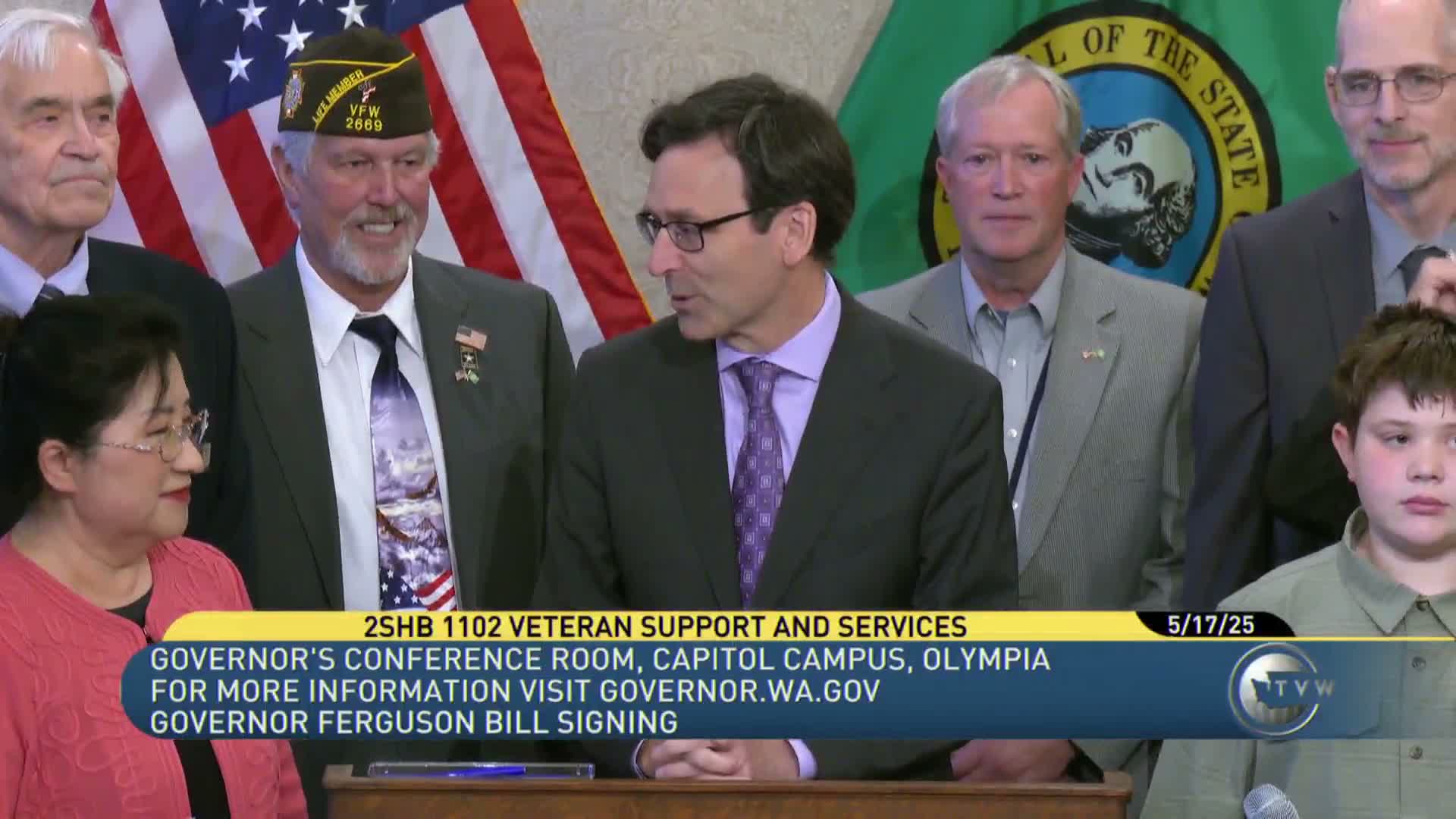
Governor Ferguson signed more than 50 bills during a ceremonial event in Olympia, saying the measures will expand services for veterans, improve transportation and advance public‑safety and housing goals.
"Reaching out proactively to ensure that all veterans receive the benefits they're entitled to is an important way to ensure we're centering the people in state government, especially our veterans," Governor Ferguson said as he opened the series of signings.
The bills touched a range of state functions. Among them: a law requiring the Department of Veterans Affairs to contact veterans after discharge and expanding eligibility for counties to apply for veteran service officers; a measure to allow special parking privileges for disabled veterans who use service animals; legislation directing the Office of Financial Management to compare ferry‑worker wages with similar positions during bargaining; and a change giving the Washington State Department of Transportation more flexibility to lease unused property for local community uses such as affordable housing and parks.
Several bills address safety and worker protections. Governor Ferguson signed an expansion of driver education that requires instruction for drivers up to age 21 and creates vouchers and instructor‑training programs to broaden access. He also signed a bill mandating timely investigations into workplace violence incidents in health‑care settings.
The governor signed policy changes across land use and finance: streamlined lot‑splitting procedures to speed affordable housing development, an extension of public facility district authority to receive sales‑tax distributions from 40 to 55 years, updated rules for public‑works bidding and a law allowing utilities to use bonds—subject to Washington Utilities and Transportation Commission approval—to spread disaster‑rebuilding costs over time.
On criminal justice, the governor signed reforms to the state's civil asset forfeiture law that standardize notice requirements and raise the legal standard from a preponderance of the evidence to clear and convincing evidence, changes officials said are intended to increase transparency and due process.
Bills were introduced by lawmakers from both parties and received public‑sector and community backing in many cases; the governor repeatedly thanked prime sponsors and attendees, and posed for photos with sponsors and constituents throughout the event.
Bills at a glance (selected):
- House Bill 112 — mandates post‑discharge outreach by the Department of Veterans Affairs and expands veteran service officer eligibility; signed into law.
- House Bill 1371 — special parking privileges for disabled veterans using service animals; signed into law.
- House Bill 1264 — requires OFM wage comparisons for ferry workers during bargaining; signed into law.
- House Bill 1733 — raises relocation assistance maximums for displaced farms/businesses and indexes them by 2% annually; signed into law.
- House Bill 1774 — expands WSDOT authority to lease surplus property for community uses; signed into law.
- House Bill 1878 — expands driver education up to age 21 and creates vouchers and instructor training; signed into law.
- Senate Bill 5595 — allows cities to designate shared streets and set 10 mph limits; signed into law.
- House Bill 1096 — streamlines lot splitting and concurrent permit processing; signed into law.
- House Bill 1162 — requires timely investigations into workplace violence in health care; signed into law.
- House Bill 1213 — employment protections for paid family and medical leave and expanded small‑business grants; signed into law.
- House Bill 1382 — updates the all‑payers claims database and allows the Health Care Authority to manage it; signed into law.
- House Bill 1440 — reforms civil asset forfeiture, raising the legal standard and standardizing notice; signed into law.
- House Bill 1573 — allows elected local officials flexibility on when to take oaths of office; signed into law.
- House Bill 1633 — transparency and licensing updates for high‑value public‑works bidding; signed into law.
- House Bill 1651 — creates teacher residency and apprenticeship pathways; signed into law.
- House Bill 1990 — allows utilities to use bonds for disaster rebuilding with WUTC oversight; signed into law.
The event concluded with the governor thanking participants, handing out commemorative pens to prime sponsors and taking photographs with legislators and community members. The signings take effect according to each bill's statutory effective dates.
"Reaching out proactively to ensure that all veterans receive the benefits they're entitled to is an important way to ensure we're centering the people in state government, especially our veterans," Governor Ferguson said as he opened the series of signings.
The bills touched a range of state functions. Among them: a law requiring the Department of Veterans Affairs to contact veterans after discharge and expanding eligibility for counties to apply for veteran service officers; a measure to allow special parking privileges for disabled veterans who use service animals; legislation directing the Office of Financial Management to compare ferry‑worker wages with similar positions during bargaining; and a change giving the Washington State Department of Transportation more flexibility to lease unused property for local community uses such as affordable housing and parks.
Several bills address safety and worker protections. Governor Ferguson signed an expansion of driver education that requires instruction for drivers up to age 21 and creates vouchers and instructor‑training programs to broaden access. He also signed a bill mandating timely investigations into workplace violence incidents in health‑care settings.
The governor signed policy changes across land use and finance: streamlined lot‑splitting procedures to speed affordable housing development, an extension of public facility district authority to receive sales‑tax distributions from 40 to 55 years, updated rules for public‑works bidding and a law allowing utilities to use bonds—subject to Washington Utilities and Transportation Commission approval—to spread disaster‑rebuilding costs over time.
On criminal justice, the governor signed reforms to the state's civil asset forfeiture law that standardize notice requirements and raise the legal standard from a preponderance of the evidence to clear and convincing evidence, changes officials said are intended to increase transparency and due process.
Bills were introduced by lawmakers from both parties and received public‑sector and community backing in many cases; the governor repeatedly thanked prime sponsors and attendees, and posed for photos with sponsors and constituents throughout the event.
Bills at a glance (selected):
- House Bill 112 — mandates post‑discharge outreach by the Department of Veterans Affairs and expands veteran service officer eligibility; signed into law.
- House Bill 1371 — special parking privileges for disabled veterans using service animals; signed into law.
- House Bill 1264 — requires OFM wage comparisons for ferry workers during bargaining; signed into law.
- House Bill 1733 — raises relocation assistance maximums for displaced farms/businesses and indexes them by 2% annually; signed into law.
- House Bill 1774 — expands WSDOT authority to lease surplus property for community uses; signed into law.
- House Bill 1878 — expands driver education up to age 21 and creates vouchers and instructor training; signed into law.
- Senate Bill 5595 — allows cities to designate shared streets and set 10 mph limits; signed into law.
- House Bill 1096 — streamlines lot splitting and concurrent permit processing; signed into law.
- House Bill 1162 — requires timely investigations into workplace violence in health care; signed into law.
- House Bill 1213 — employment protections for paid family and medical leave and expanded small‑business grants; signed into law.
- House Bill 1382 — updates the all‑payers claims database and allows the Health Care Authority to manage it; signed into law.
- House Bill 1440 — reforms civil asset forfeiture, raising the legal standard and standardizing notice; signed into law.
- House Bill 1573 — allows elected local officials flexibility on when to take oaths of office; signed into law.
- House Bill 1633 — transparency and licensing updates for high‑value public‑works bidding; signed into law.
- House Bill 1651 — creates teacher residency and apprenticeship pathways; signed into law.
- House Bill 1990 — allows utilities to use bonds for disaster rebuilding with WUTC oversight; signed into law.
The event concluded with the governor thanking participants, handing out commemorative pens to prime sponsors and taking photographs with legislators and community members. The signings take effect according to each bill's statutory effective dates.
View the Full Meeting & All Its Details
This article offers just a summary. Unlock complete video, transcripts, and insights as a Founder Member.
✓
Watch full, unedited meeting videos
✓
Search every word spoken in unlimited transcripts
✓
AI summaries & real-time alerts (all government levels)
✓
Permanent access to expanding government content
30-day money-back guarantee
