SBCC authorizes research and potential AG request after lengthy debate on whether RCW 35A.21.440 affects statewide energy-code enforcement
January 23, 2026 | Board Council Commission Agencies , Executive, Washington
This article was created by AI summarizing key points discussed. AI makes mistakes, so for full details and context, please refer to the video of the full meeting. Please report any errors so we can fix them. Report an error »
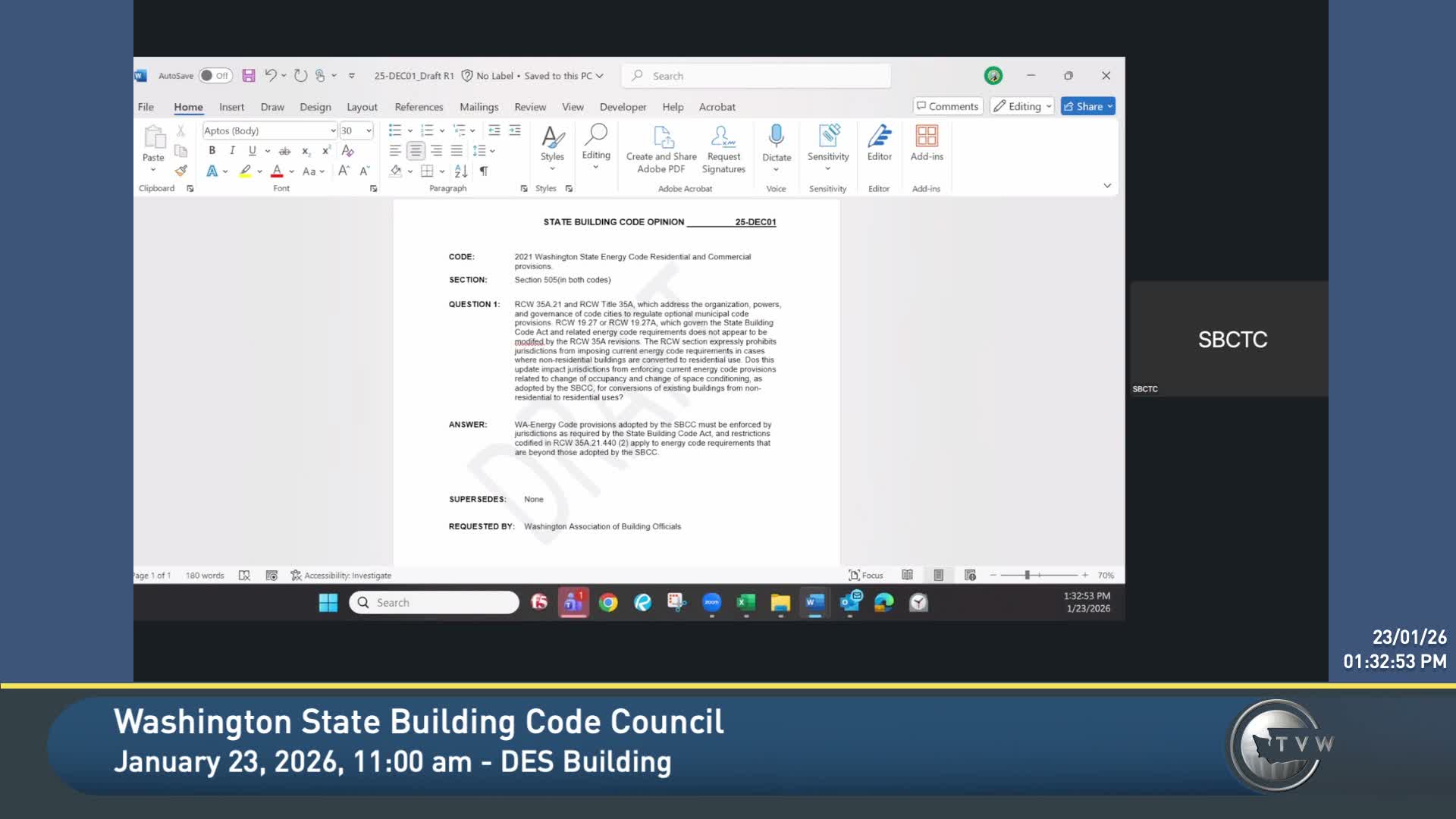
The Washington Association of Building Officials (WAVO) asked the State Building Code Council for guidance about RCW 35A.21.440 and related statutes, which the association reads as prohibiting local jurisdictions from imposing current energy-code requirements when converting existing buildings to residential use. WAVO sought clarity from the SBCC because jurisdictions and builders are uncertain whether that RCW restricts local enhanced energy ordinances or also limits enforcement of the statewide Washington State Energy Code.
Stakeholders, council members and staff debated the legal scope at length. Lisa Rosenow (Evergreen Technology Consulting) and Micah (WAVO) outlined industry confusion around three project types identified in the statute (unchanged portions of existing buildings, previously permitted conditioned space, and changed portions converted to dwelling units) and whether an alternative compliance path (including Clean Buildings standards) applies. Council counsel Derek advised the SBCC that while the council can offer nonbinding observations, formal statutory interpretation is generally outside the SBCC’s rule-focused role and that an Attorney General (AG) formal opinion is a recognized path for legal clarity (SEG 3461-3696).
After extended discussion, the council voted to authorize the chair, in collaboration with legal counsel, to research the statutory questions and, if appropriate, prepare a request to the Attorney General’s office for a formal opinion. The council also voted to table the staff opinion response and to revisit the matter once the legal research and potential AG request are prepared. Members stressed the need for timely clarity because jurisdictions may face inconsistent enforcement absent statewide guidance.
The council did not issue a substantive legal opinion on the statute at the meeting. Instead, it directed staff to pursue a formal legal route and to return to the full council with findings and any draft request for AG consideration.
Stakeholders, council members and staff debated the legal scope at length. Lisa Rosenow (Evergreen Technology Consulting) and Micah (WAVO) outlined industry confusion around three project types identified in the statute (unchanged portions of existing buildings, previously permitted conditioned space, and changed portions converted to dwelling units) and whether an alternative compliance path (including Clean Buildings standards) applies. Council counsel Derek advised the SBCC that while the council can offer nonbinding observations, formal statutory interpretation is generally outside the SBCC’s rule-focused role and that an Attorney General (AG) formal opinion is a recognized path for legal clarity (SEG 3461-3696).
After extended discussion, the council voted to authorize the chair, in collaboration with legal counsel, to research the statutory questions and, if appropriate, prepare a request to the Attorney General’s office for a formal opinion. The council also voted to table the staff opinion response and to revisit the matter once the legal research and potential AG request are prepared. Members stressed the need for timely clarity because jurisdictions may face inconsistent enforcement absent statewide guidance.
The council did not issue a substantive legal opinion on the statute at the meeting. Instead, it directed staff to pursue a formal legal route and to return to the full council with findings and any draft request for AG consideration.
View the Full Meeting & All Its Details
This article offers just a summary. Unlock complete video, transcripts, and insights as a Founder Member.
✓
Watch full, unedited meeting videos
✓
Search every word spoken in unlimited transcripts
✓
AI summaries & real-time alerts (all government levels)
✓
Permanent access to expanding government content
30-day money-back guarantee
