Vermont Senate Agriculture Committee hears farmers, towns split over limits on solar on prime soils
February 20, 2026 | Agriculture, SENATE, Committees, Legislative , Vermont
This article was created by AI summarizing key points discussed. AI makes mistakes, so for full details and context, please refer to the video of the full meeting. Please report any errors so we can fix them. Report an error »
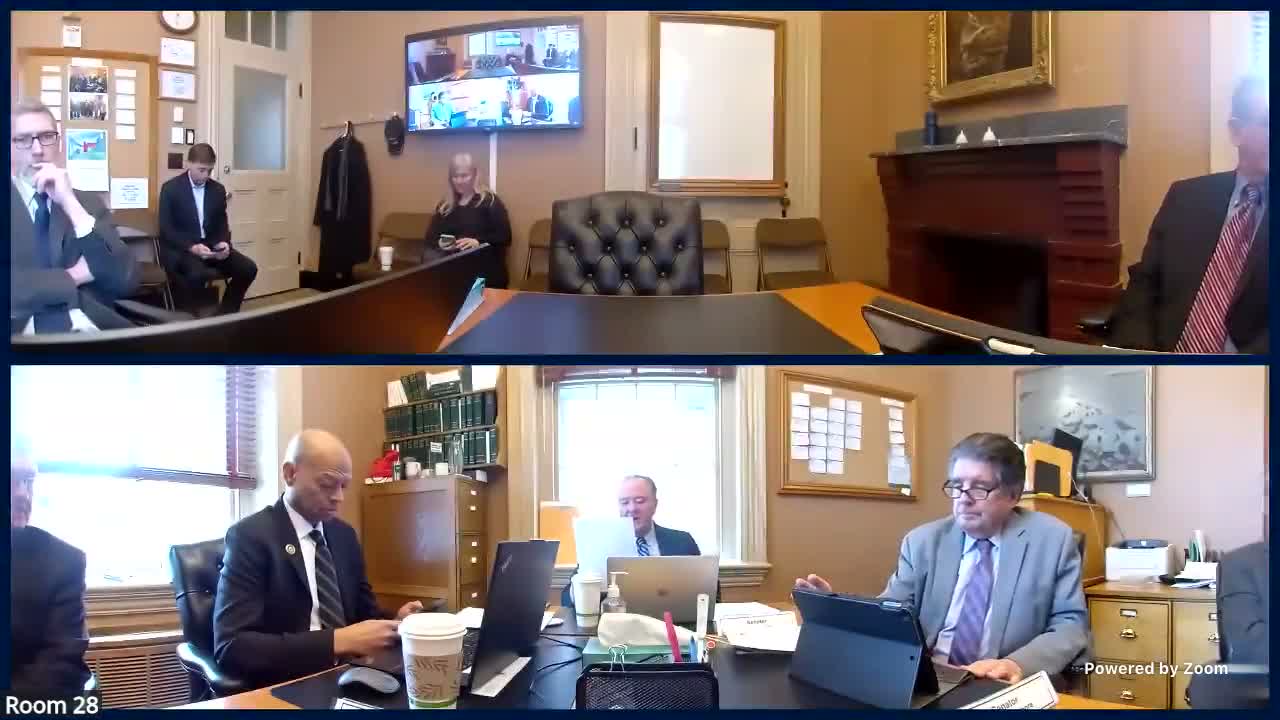
The Senate Agriculture Committee on S.3 (section 10) heard testimony Tuesday from Thomas Hand, co-founder of MHG Solar, and Jennifer Blay, selectboard chair of Lowell and a middle-school science teacher, on whether to restrict large-scale solar projects on land mapped as prime agricultural soils.
Hand told the committee his company has developed roughly 60 megawatts of operational solar in Vermont — "about 10% of all in-state solar" — and described lease agreements that he said provide vital income to farm families. "Today, his family has a steady income stream of more than $30,000 a year," Hand said of one example; he said another site would yield about $20,000 a year and a pending project would provide roughly $15,000 a year. He said those agreements typically run 25 years or more.
Hand argued S.3 as drafted would "effectively ban solar projects over a megawatt" by restricting projects that disturb more than five acres, and that the bill would therefore "directly harm farm families." He warned that outdated federal soil maps, issued decades ago, can label altered or contaminated land — for example, old gravel pits and remediated industrial sites — as "prime ag soil," forcing developers to treat unsuitable sites as if they were active cropland.
"This bill is a kick in the teeth to farmers across Vermont," Hand told the committee, arguing further that proposed per-project life-cycle carbon studies duplicate research already done by organizations such as NREL and would add cost that ultimately falls to ratepayers.
Members of the panel pushed back on some of Hand's assertions while expressing the committee's goal of preserving productive farmland. The committee chair said the panel intends to protect agricultural land and cited long-term losses tied to previous land-use changes. A member asked whether developers could reasonably site arrays on lands that are not prime soils; committee members asked Hand to provide additional data and examples the committee could use to refine statutory language.
Hand also addressed tax and permitting questions. He said land under a solar array is taxed at the same assessed value it had before the installation, that operators pay a uniform capacity tax (he cited roughly $4 per kilowatt) that flows to the state education fund, and that towns receive local property tax on the array. He said projects must post decommissioning funds obligating removal at end of life and estimated that physical removal could take a few weeks, although permitting often takes years; he recounted a project that required three years of permitting and about 10 weeks from on-site work to producing power.
Jennifer Blay described how a proposed 14,000-panel project near Lowell — farmland farmed since 1902 and adjacent to a school and neighborhood properties — has split the small community. She said the town tied a vote 86–86 on whether to spend funds to hire counsel to intervene at the Public Utility Commission and that local residents lacked resources to engage expert witnesses in the PUC process. Blay raised concerns about grassland habitat loss, soil compaction, proximity to Le Clerc Brook and potential impacts on source-water protection near the school, and said residents worried panels and fencing would change daily life and views.
Blay also said she lacked information about which specific solar panels would be used because developers typically select equipment after securing permits, which limited local review of technology and materials. She described a nearby bed-and-breakfast that closed amid the PUC process and said small towns face an imbalance when utility-scale developers bring repeat expert witnesses to PUC hearings.
The committee did not take a vote. The chair closed by thanking both witnesses and asking developers and towns to provide additional data and testimony the committee can use to evaluate definitions of "prime agricultural soils," stormwater and decommissioning requirements, and tax treatment. The panel said it will continue taking testimony and may work on language changes before crossover. Ending
Hand told the committee his company has developed roughly 60 megawatts of operational solar in Vermont — "about 10% of all in-state solar" — and described lease agreements that he said provide vital income to farm families. "Today, his family has a steady income stream of more than $30,000 a year," Hand said of one example; he said another site would yield about $20,000 a year and a pending project would provide roughly $15,000 a year. He said those agreements typically run 25 years or more.
Hand argued S.3 as drafted would "effectively ban solar projects over a megawatt" by restricting projects that disturb more than five acres, and that the bill would therefore "directly harm farm families." He warned that outdated federal soil maps, issued decades ago, can label altered or contaminated land — for example, old gravel pits and remediated industrial sites — as "prime ag soil," forcing developers to treat unsuitable sites as if they were active cropland.
"This bill is a kick in the teeth to farmers across Vermont," Hand told the committee, arguing further that proposed per-project life-cycle carbon studies duplicate research already done by organizations such as NREL and would add cost that ultimately falls to ratepayers.
Members of the panel pushed back on some of Hand's assertions while expressing the committee's goal of preserving productive farmland. The committee chair said the panel intends to protect agricultural land and cited long-term losses tied to previous land-use changes. A member asked whether developers could reasonably site arrays on lands that are not prime soils; committee members asked Hand to provide additional data and examples the committee could use to refine statutory language.
Hand also addressed tax and permitting questions. He said land under a solar array is taxed at the same assessed value it had before the installation, that operators pay a uniform capacity tax (he cited roughly $4 per kilowatt) that flows to the state education fund, and that towns receive local property tax on the array. He said projects must post decommissioning funds obligating removal at end of life and estimated that physical removal could take a few weeks, although permitting often takes years; he recounted a project that required three years of permitting and about 10 weeks from on-site work to producing power.
Jennifer Blay described how a proposed 14,000-panel project near Lowell — farmland farmed since 1902 and adjacent to a school and neighborhood properties — has split the small community. She said the town tied a vote 86–86 on whether to spend funds to hire counsel to intervene at the Public Utility Commission and that local residents lacked resources to engage expert witnesses in the PUC process. Blay raised concerns about grassland habitat loss, soil compaction, proximity to Le Clerc Brook and potential impacts on source-water protection near the school, and said residents worried panels and fencing would change daily life and views.
Blay also said she lacked information about which specific solar panels would be used because developers typically select equipment after securing permits, which limited local review of technology and materials. She described a nearby bed-and-breakfast that closed amid the PUC process and said small towns face an imbalance when utility-scale developers bring repeat expert witnesses to PUC hearings.
The committee did not take a vote. The chair closed by thanking both witnesses and asking developers and towns to provide additional data and testimony the committee can use to evaluate definitions of "prime agricultural soils," stormwater and decommissioning requirements, and tax treatment. The panel said it will continue taking testimony and may work on language changes before crossover. Ending
Don't Miss a Word: See the Full Meeting!
Go beyond summaries. Unlock every video, transcript, and key insight with a Founder Membership.
✓
Get instant access to full meeting videos
✓
Search and clip any phrase from complete transcripts
✓
Receive AI-powered summaries & custom alerts
✓
Enjoy lifetime, unrestricted access to government data
30-day money-back guarantee
