Blount County Commission adopts two‑year property reappraisal cycle after contested debate
February 20, 2026 | Blount County, Tennessee
This article was created by AI summarizing key points discussed. AI makes mistakes, so for full details and context, please refer to the video of the full meeting. Please report any errors so we can fix them. Report an error »
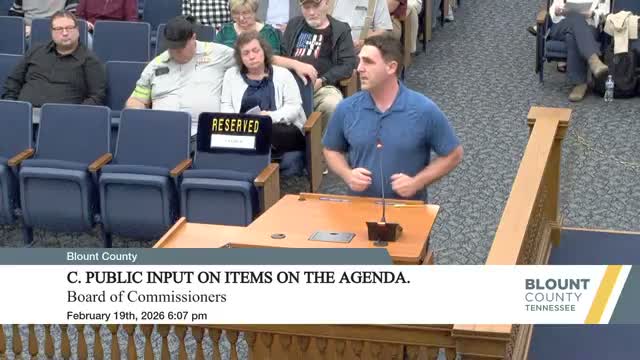
Blount County commissioners voted 17–3 with one abstention on Feb. 19, 2026, to adopt Resolution 262012, authorizing a continuous two‑year property reappraisal cycle. The motion, introduced by Commissioner French and seconded by Commissioner Reagan, follows weeks of public concern and more than an hour of debate at the commission meeting.
The measure's chief proponent, Property Assessor Todd Orr, told the commission he brought the change to protect veterans and elderly beneficiaries of state tax‑relief programs from reductions tied to a state‑run ‘‘ratio.’’ ‘‘Reappraisals are revenue neutral,’’ Orr said, adding that the county's office values properties and the certified tax rate is adjusted to cover the same budgeted revenue. Orr argued more frequent reappraisals smooth market swings and prevent the large, single‑cycle increases that alarmed residents in 2023: ‘‘If we do more frequent, we won't have those big jumps.’’ (Todd Orr)
Opposition came from both the public and several commissioners. During the public‑comment portion, speakers including Joel Quisenberry and Sam Kidd urged commissioners to reject reassessment every two years, saying retirees and residents on fixed incomes face real hardship if property tax bills rise. ‘‘When is enough enough?’’ an unidentified speaker asked during public comment. Carl Kulla, mayor of Rockford, told the commission, ‘‘Each appraisal cycle puts a tremendous burden on homeowners and businesses in Blount County.’’ (Carl Kulla)
Commissioners debated the operational and fiscal impacts of more frequent reappraisals, including whether the assessor's office has capacity to perform a two‑year cycle without added staff or costs, and whether appeals would become more frequent. Orr told the commission his office could implement the change and cited numbers he said reflected recent market shifts: the county reappraised in 2023 during a period of steep increases and, he said, overall county values rose sharply; doing reappraisals more often would, in his view, better match market movements.
A postponement motion (to delay action for one month) was moved by Commissioner Hannah but later withdrawn with unanimous consent; after further debate Commissioner Reagan successfully called for the question to close debate. The vote to adopt the resolution was 17 yes, 3 no and 1 abstention. The resolution requires approval by the State Board of Equalization to take effect; commissioners and the assessor noted state deadlines and filing windows may affect the timing of implementation.
What happens next: Following the approval, county staff must submit the reappraisal plan to the State Board of Equalization for review and approval; commissioners discussed an April state meeting and noted submission deadlines typically fall 30 days prior to the board meeting. Multiple commissioners said they wanted clearer public outreach to dispel misinformation and explain what a two‑year cycle would mean in practice.
Why it matters: Commissioners framed the change as a way to reduce sudden, large tax shifts by normalizing appraisal adjustments more frequently. Opponents argued the change shifts administrative burden to property owners and could disproportionately benefit some property classes while creating added work and appeals for others. The question now shifts to the state board's review and how the county will explain the change to residents.
Votes and formal action: The commission adopted Resolution 262012 (continuous two‑year reappraisal cycle) after debate; the motion was moved by Commissioner French, seconded by Commissioner Reagan, and carried 17–3 with one abstention. The resolution was read into the record at the Feb. 19 meeting and will require State Board of Equalization approval to be implemented.
Reporting note: Quotes and vote tallies are taken from the Feb. 19, 2026 commission meeting transcript and the public comment record. The commission's adoption does not itself change tax rates; the certified tax rate process and any budgetary decisions remain separate actions for the commission.
The measure's chief proponent, Property Assessor Todd Orr, told the commission he brought the change to protect veterans and elderly beneficiaries of state tax‑relief programs from reductions tied to a state‑run ‘‘ratio.’’ ‘‘Reappraisals are revenue neutral,’’ Orr said, adding that the county's office values properties and the certified tax rate is adjusted to cover the same budgeted revenue. Orr argued more frequent reappraisals smooth market swings and prevent the large, single‑cycle increases that alarmed residents in 2023: ‘‘If we do more frequent, we won't have those big jumps.’’ (Todd Orr)
Opposition came from both the public and several commissioners. During the public‑comment portion, speakers including Joel Quisenberry and Sam Kidd urged commissioners to reject reassessment every two years, saying retirees and residents on fixed incomes face real hardship if property tax bills rise. ‘‘When is enough enough?’’ an unidentified speaker asked during public comment. Carl Kulla, mayor of Rockford, told the commission, ‘‘Each appraisal cycle puts a tremendous burden on homeowners and businesses in Blount County.’’ (Carl Kulla)
Commissioners debated the operational and fiscal impacts of more frequent reappraisals, including whether the assessor's office has capacity to perform a two‑year cycle without added staff or costs, and whether appeals would become more frequent. Orr told the commission his office could implement the change and cited numbers he said reflected recent market shifts: the county reappraised in 2023 during a period of steep increases and, he said, overall county values rose sharply; doing reappraisals more often would, in his view, better match market movements.
A postponement motion (to delay action for one month) was moved by Commissioner Hannah but later withdrawn with unanimous consent; after further debate Commissioner Reagan successfully called for the question to close debate. The vote to adopt the resolution was 17 yes, 3 no and 1 abstention. The resolution requires approval by the State Board of Equalization to take effect; commissioners and the assessor noted state deadlines and filing windows may affect the timing of implementation.
What happens next: Following the approval, county staff must submit the reappraisal plan to the State Board of Equalization for review and approval; commissioners discussed an April state meeting and noted submission deadlines typically fall 30 days prior to the board meeting. Multiple commissioners said they wanted clearer public outreach to dispel misinformation and explain what a two‑year cycle would mean in practice.
Why it matters: Commissioners framed the change as a way to reduce sudden, large tax shifts by normalizing appraisal adjustments more frequently. Opponents argued the change shifts administrative burden to property owners and could disproportionately benefit some property classes while creating added work and appeals for others. The question now shifts to the state board's review and how the county will explain the change to residents.
Votes and formal action: The commission adopted Resolution 262012 (continuous two‑year reappraisal cycle) after debate; the motion was moved by Commissioner French, seconded by Commissioner Reagan, and carried 17–3 with one abstention. The resolution was read into the record at the Feb. 19 meeting and will require State Board of Equalization approval to be implemented.
Reporting note: Quotes and vote tallies are taken from the Feb. 19, 2026 commission meeting transcript and the public comment record. The commission's adoption does not itself change tax rates; the certified tax rate process and any budgetary decisions remain separate actions for the commission.
Don't Miss a Word: See the Full Meeting!
Go beyond summaries. Unlock every video, transcript, and key insight with a Founder Membership.
✓
Get instant access to full meeting videos
✓
Search and clip any phrase from complete transcripts
✓
Receive AI-powered summaries & custom alerts
✓
Enjoy lifetime, unrestricted access to government data
30-day money-back guarantee
