Panel hears calls for mandatory dementia training for homemaker and companion agency staff
February 20, 2026 | Aging, House of Representatives, Committees, Legislative, Connecticut
This article was created by AI summarizing key points discussed. AI makes mistakes, so for full details and context, please refer to the video of the full meeting. Please report any errors so we can fix them. Report an error »
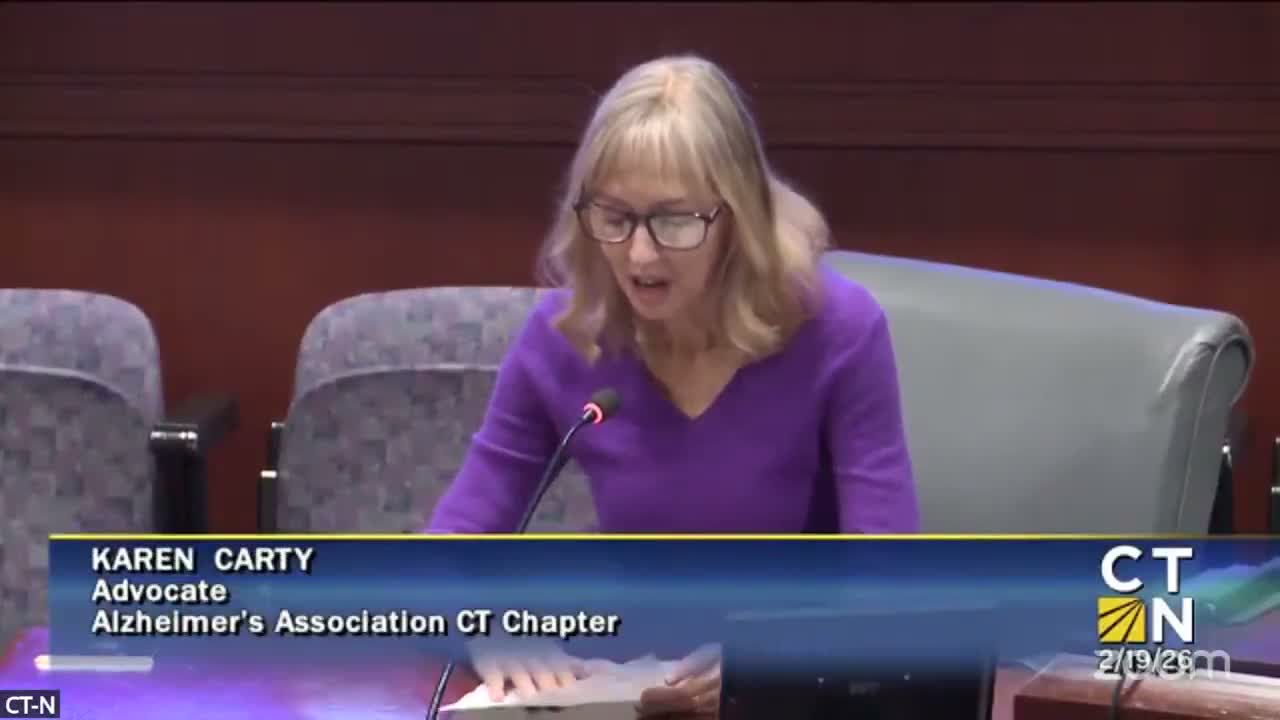
Supporters of House Bill 5143 told the committee that mandatory dementia training for homemaker and companion agency staff would improve safety and quality for people living with Alzheimer's disease and related dementias.
"This homemaker companion training is a necessary bridge to essential caregiving knowledge," said Karen Carty, an advocate and community educator with the Connecticut Alzheimer's Association, who described being unprepared to de‑escalate behaviors when her grandmother lived with dementia.
Witnesses gave examples of harm they linked to inadequate training: missed nutrition needs, unsafe food handling, and instances caregivers left vulnerable clients unattended. Maureen McIntyre of the Atwood Dementia Group said the task force that studied the issue recommended a minimum of 10 hours of initial paid training plus ongoing education as a measured response.
Provider groups expressed broad support for improving training but raised concerns about content and cost. Tracy Wodach, president and CEO of the Connecticut Association for Health Care at Home, warned that some proposed topics—CPR and first aid, for example—are medically oriented and could conflict with the nonmedical scope of homemaker companion agencies; she urged training aligned to nonmedical care, infection control, communication and dementia support, and highlighted the need for portability of training across employers. Marlene Ciccarella and other agency representatives urged the committee to consider Medicaid reimbursement and the administrative burden of tracking required hours.
The committee did not take a vote. Members asked agencies and advocates to work with committee staff on drafting language that balances quality, role‑appropriate training, portability and funding.
"This homemaker companion training is a necessary bridge to essential caregiving knowledge," said Karen Carty, an advocate and community educator with the Connecticut Alzheimer's Association, who described being unprepared to de‑escalate behaviors when her grandmother lived with dementia.
Witnesses gave examples of harm they linked to inadequate training: missed nutrition needs, unsafe food handling, and instances caregivers left vulnerable clients unattended. Maureen McIntyre of the Atwood Dementia Group said the task force that studied the issue recommended a minimum of 10 hours of initial paid training plus ongoing education as a measured response.
Provider groups expressed broad support for improving training but raised concerns about content and cost. Tracy Wodach, president and CEO of the Connecticut Association for Health Care at Home, warned that some proposed topics—CPR and first aid, for example—are medically oriented and could conflict with the nonmedical scope of homemaker companion agencies; she urged training aligned to nonmedical care, infection control, communication and dementia support, and highlighted the need for portability of training across employers. Marlene Ciccarella and other agency representatives urged the committee to consider Medicaid reimbursement and the administrative burden of tracking required hours.
The committee did not take a vote. Members asked agencies and advocates to work with committee staff on drafting language that balances quality, role‑appropriate training, portability and funding.
View the Full Meeting & All Its Details
This article offers just a summary. Unlock complete video, transcripts, and insights as a Founder Member.
✓
Watch full, unedited meeting videos
✓
Search every word spoken in unlimited transcripts
✓
AI summaries & real-time alerts (all government levels)
✓
Permanent access to expanding government content
30-day money-back guarantee
