Senate committee hears broad support and opposition to data‑center guardrails in HB 2515
February 20, 2026 | Legislative Sessions, Washington
This article was created by AI summarizing key points discussed. AI makes mistakes, so for full details and context, please refer to the video of the full meeting. Please report any errors so we can fix them. Report an error »
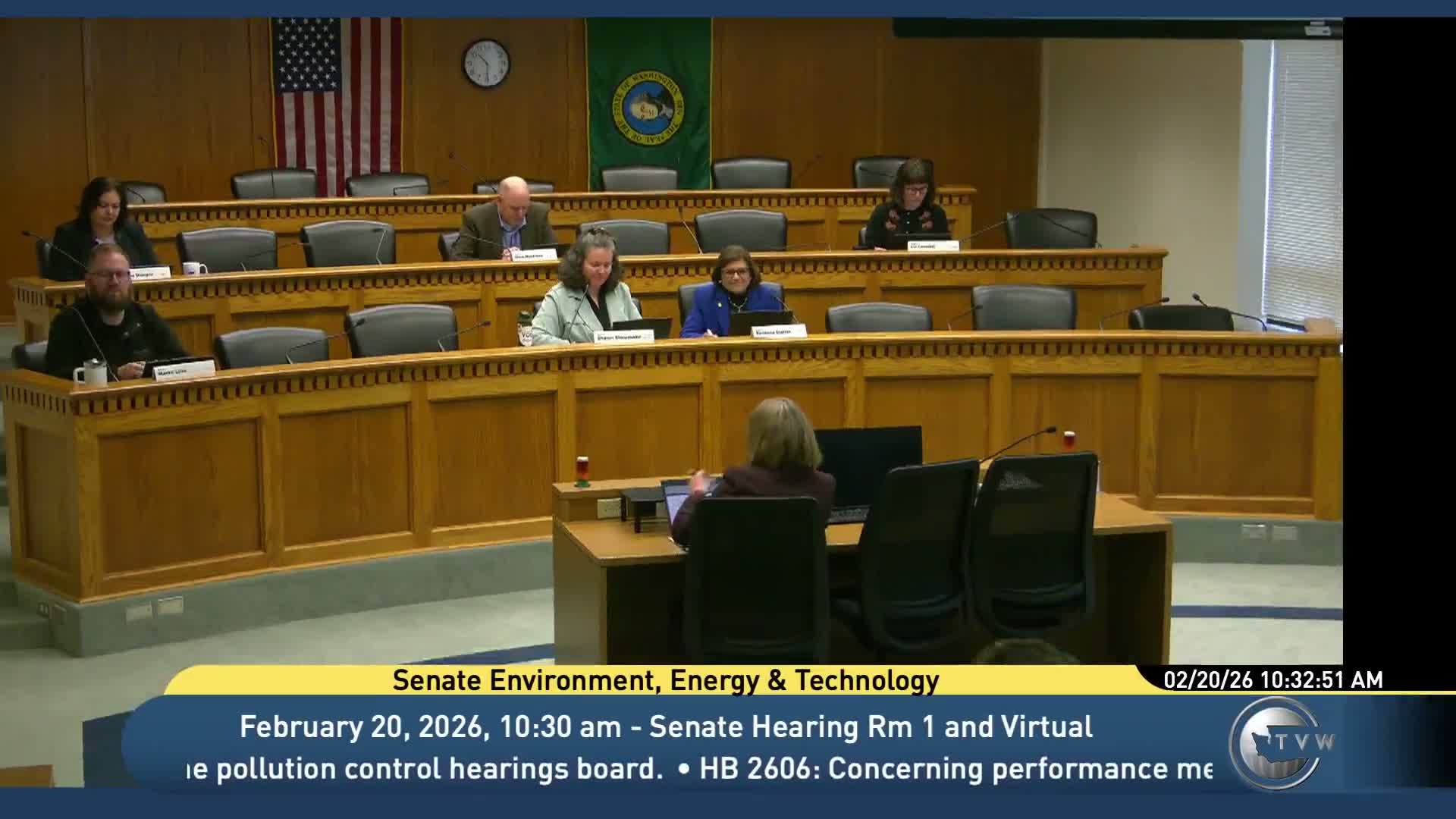
The Washington Senate Energy, Environment and Technology Committee on Thursday heard extensive testimony on Engrossed Second Substitute House Bill 2515, legislation that would set statewide standards for ‘‘emerging large energy use facilities’’—defined in the bill as facilities with a maximum aggregate contract demand of 20 megawatts or more, primarily engaged in data‑processing and related services.
Sponsor Rep. Beth Dolio framed the bill as an attempt to ‘‘do data centers right’’ by protecting ratepayers and avoiding stranded investments while allowing the state to reap construction and family‑wage jobs associated with new projects. For the record, she stated, “I am Beth Dolio.” She cited rapid industry growth and quoted industry ambitions, saying, according to a Sam Altman remark she quoted, “our vision is simple. We want to create a factory that can produce a gigawatt of new AI infrastructure every week.”
The bill would require every electric utility that serves a data center to make available a tariff or policy approved by the Utilities and Transportation Commission or a consumer‑owned utility’s governing body by Oct. 1, 2026. It would also require data centers to publish a sustainability report every three years and to report annual water and energy consumption, refrigerant use and annual air pollutant emissions to the Department of Ecology. The bill sets phased clean‑energy benchmarks (including an 80% new‑electricity requirement beginning in 2030 for facilities that begin operation or expand after July 1, 2026) and prohibits Ecology from distributing no‑cost allowances under the Climate Commitment Act to mitigate data‑center costs starting in 2028 for 2029 emissions.
Tribal leaders and environmental advocates urged restoring provisions removed on the House floor. Jared Takala of the Yakama Nation said the committee ‘‘should restore two important provisions that would help keep the lights on and protect salmon’’—specifically, the authority to curtail data‑center loads during regional emergencies and utility discretion to refuse service when reliability or affordability would be harmed. Ashton Picard of the Nez Perce Tribe and Lisa Gunuelas of the Confederated Tribes of the Umatilla Indian Reservation made similar pleas, tying curtailment authority to protections for treaty‑protected fisheries and warning that prior emergency operations killed large numbers of migrating salmon.
Earthjustice, the Columbia River Intertribal Fish Commission and other groups asked the Senate to strengthen reporting requirements in Section 4 to ensure facilities demonstrate they would not impair watershed conditions, stream flows, municipal supplies, or treaty fisheries.
State agencies offered technical support for the bill. Joel Creswell of the Department of Ecology told the committee the bill’s transparency provisions would allow Ecology to make more informed policy decisions and estimated the proposed change in allowance allocation would move at least 3,000,000 no‑cost allowances for data‑center load into emissions years ’27 and ’28. Austin Sharf of the Department of Commerce described the bill as flexible and technically sound, praising its provisions for ratepayer protections and resource forecasting.
Industry and some utilities urged changes to the bill’s approach. Representatives of Puget Sound Energy, Avista and several data‑center companies said the measure, as written, could increase costs for customers, pose confidentiality and implementation challenges, and risk harming local economies that have benefited from data‑center development. The Data Center Coalition and local ports warned that overly prescriptive requirements could jeopardize jobs and tax revenue and called for negotiated technical fixes.
Several witnesses from environmental and conservation organizations, including Climate Solutions, Sightline Institute and the Nature Conservancy, supported the bill’s affordability and transparency goals and urged restoration of curtailment and stronger clean‑energy timelines to prevent data centers from crowding out renewable capacity.
The committee suspended the public hearing early in the day, took executive actions on other bills, then reopened HB 2515 for a resumed public comment period. The hearing was set to continue on Feb. 5 (as noted by the committee). No final floor vote on HB 2515 was recorded during the session covered by the transcript.
Next steps: Committee staff and members indicated they will continue working on technical fixes and amendments; the bill’s hearing record remains open and the committee scheduled further consideration.
Sponsor Rep. Beth Dolio framed the bill as an attempt to ‘‘do data centers right’’ by protecting ratepayers and avoiding stranded investments while allowing the state to reap construction and family‑wage jobs associated with new projects. For the record, she stated, “I am Beth Dolio.” She cited rapid industry growth and quoted industry ambitions, saying, according to a Sam Altman remark she quoted, “our vision is simple. We want to create a factory that can produce a gigawatt of new AI infrastructure every week.”
The bill would require every electric utility that serves a data center to make available a tariff or policy approved by the Utilities and Transportation Commission or a consumer‑owned utility’s governing body by Oct. 1, 2026. It would also require data centers to publish a sustainability report every three years and to report annual water and energy consumption, refrigerant use and annual air pollutant emissions to the Department of Ecology. The bill sets phased clean‑energy benchmarks (including an 80% new‑electricity requirement beginning in 2030 for facilities that begin operation or expand after July 1, 2026) and prohibits Ecology from distributing no‑cost allowances under the Climate Commitment Act to mitigate data‑center costs starting in 2028 for 2029 emissions.
Tribal leaders and environmental advocates urged restoring provisions removed on the House floor. Jared Takala of the Yakama Nation said the committee ‘‘should restore two important provisions that would help keep the lights on and protect salmon’’—specifically, the authority to curtail data‑center loads during regional emergencies and utility discretion to refuse service when reliability or affordability would be harmed. Ashton Picard of the Nez Perce Tribe and Lisa Gunuelas of the Confederated Tribes of the Umatilla Indian Reservation made similar pleas, tying curtailment authority to protections for treaty‑protected fisheries and warning that prior emergency operations killed large numbers of migrating salmon.
Earthjustice, the Columbia River Intertribal Fish Commission and other groups asked the Senate to strengthen reporting requirements in Section 4 to ensure facilities demonstrate they would not impair watershed conditions, stream flows, municipal supplies, or treaty fisheries.
State agencies offered technical support for the bill. Joel Creswell of the Department of Ecology told the committee the bill’s transparency provisions would allow Ecology to make more informed policy decisions and estimated the proposed change in allowance allocation would move at least 3,000,000 no‑cost allowances for data‑center load into emissions years ’27 and ’28. Austin Sharf of the Department of Commerce described the bill as flexible and technically sound, praising its provisions for ratepayer protections and resource forecasting.
Industry and some utilities urged changes to the bill’s approach. Representatives of Puget Sound Energy, Avista and several data‑center companies said the measure, as written, could increase costs for customers, pose confidentiality and implementation challenges, and risk harming local economies that have benefited from data‑center development. The Data Center Coalition and local ports warned that overly prescriptive requirements could jeopardize jobs and tax revenue and called for negotiated technical fixes.
Several witnesses from environmental and conservation organizations, including Climate Solutions, Sightline Institute and the Nature Conservancy, supported the bill’s affordability and transparency goals and urged restoration of curtailment and stronger clean‑energy timelines to prevent data centers from crowding out renewable capacity.
The committee suspended the public hearing early in the day, took executive actions on other bills, then reopened HB 2515 for a resumed public comment period. The hearing was set to continue on Feb. 5 (as noted by the committee). No final floor vote on HB 2515 was recorded during the session covered by the transcript.
Next steps: Committee staff and members indicated they will continue working on technical fixes and amendments; the bill’s hearing record remains open and the committee scheduled further consideration.
Don't Miss a Word: See the Full Meeting!
Go beyond summaries. Unlock every video, transcript, and key insight with a Founder Membership.
✓
Get instant access to full meeting videos
✓
Search and clip any phrase from complete transcripts
✓
Receive AI-powered summaries & custom alerts
✓
Enjoy lifetime, unrestricted access to government data
30-day money-back guarantee
