Committee considers AI provenance bill requiring detection tools and disclosures for large providers
February 20, 2026 | Legislative Sessions, Washington
This article was created by AI summarizing key points discussed. AI makes mistakes, so for full details and context, please refer to the video of the full meeting. Please report any errors so we can fix them. Report an error »
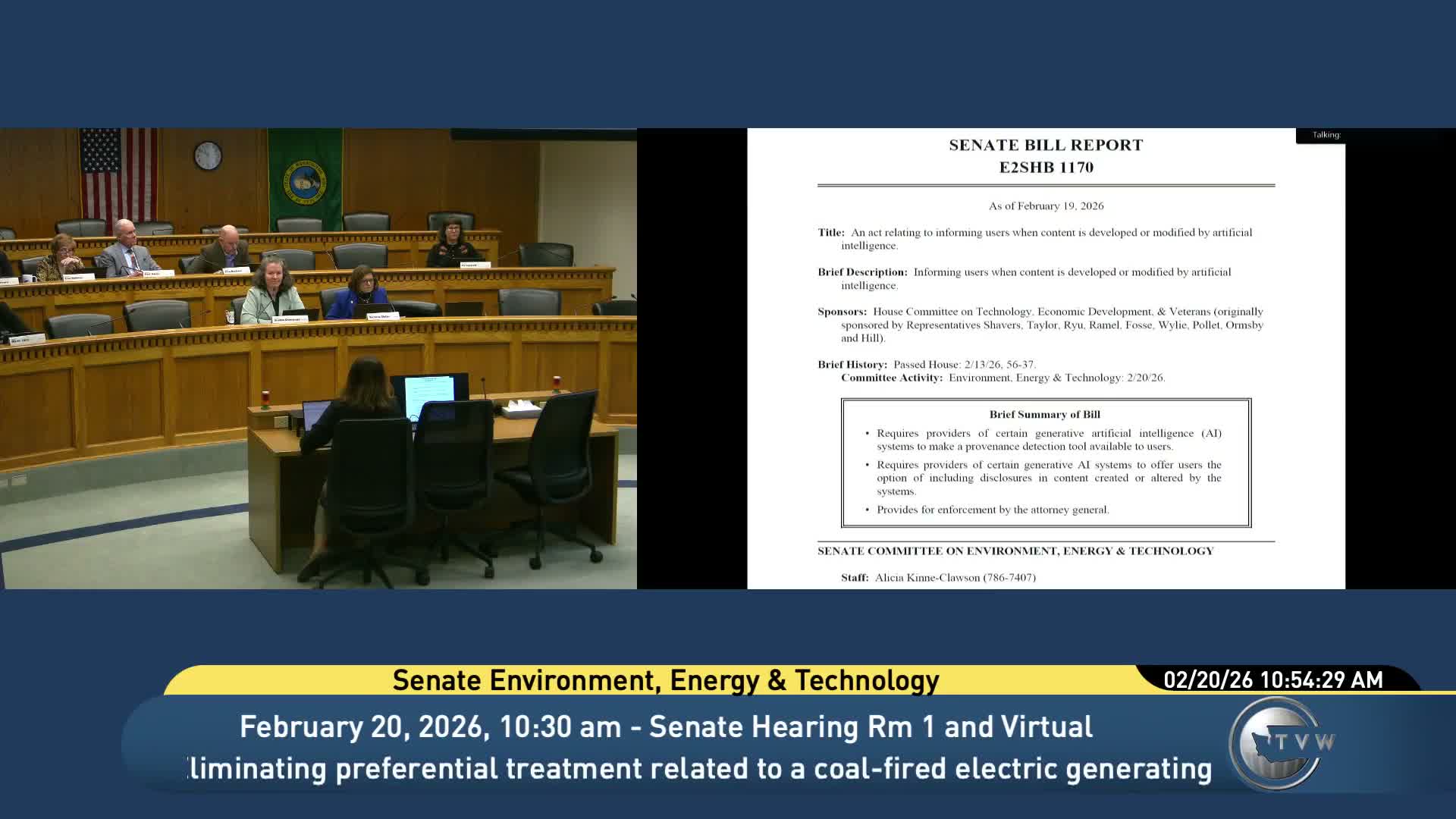
The committee received a staff briefing and public testimony on Engrossed Second Substitute House Bill 1170, a transparency and provenance bill aimed at generative AI content. Committee staff explained the bill applies to covered providers that use a high quantity of computing power to train generative models publicly accessible in Washington and that report gross revenues above $500 million annually; the bill excludes public entities and bridal nations (as noted in the briefing) and limits scope to images, video and audio.
Sponsor Clyde Shavers described the measure as targeted and narrow: he said it focuses on large AI developers and ‘‘is about ensuring Washingtonians have a right to know what is real and what is not real’’ for high‑risk media forms. He emphasized the bill does not target small creators or ordinary users and said many large providers already have similar tools.
The bill would require covered providers to make a provenance detection tool available so users can assess whether content was created or altered by the provider’s AI system, and to provide manifest and latent disclosure options and technical criteria for those disclosures. If a covered provider licenses its generative system to third parties, the provider must require licensees to maintain disclosure capabilities. Enforcement would be by the state attorney general under the consumer protection act; the draft contains no private right of action.
Supporters including the Washington State Labor Council and several consumer‑protection advocates argued the bill would protect workers and consumers from deepfakes, impersonation and fabricated evidence that can cause job loss or other harms. Danica Noble (Washington State Bar Association, speaking in a personal capacity) said disclosure focused on the largest providers is ‘‘the kind of thing we do in the physical world’’ to protect consumers.
Industry groups—the Washington Technology Industry Association and the Association of Washington Business—urged pause and additional technical work. They raised practical concerns about enforcement, narrowness of definitions, and the California experience, noting that related California legislation has prompted extensive stakeholder negotiations and implementation challenges.
Proponents of the bill disputed those feasibility concerns. Witnesses representing transparency coalitions said several large platforms have already implemented provenance labeling and that standards work has been underway for years.
The committee did not take final action on HB 1170 during the meeting and moved remaining testimony forward for later consideration.
Sponsor Clyde Shavers described the measure as targeted and narrow: he said it focuses on large AI developers and ‘‘is about ensuring Washingtonians have a right to know what is real and what is not real’’ for high‑risk media forms. He emphasized the bill does not target small creators or ordinary users and said many large providers already have similar tools.
The bill would require covered providers to make a provenance detection tool available so users can assess whether content was created or altered by the provider’s AI system, and to provide manifest and latent disclosure options and technical criteria for those disclosures. If a covered provider licenses its generative system to third parties, the provider must require licensees to maintain disclosure capabilities. Enforcement would be by the state attorney general under the consumer protection act; the draft contains no private right of action.
Supporters including the Washington State Labor Council and several consumer‑protection advocates argued the bill would protect workers and consumers from deepfakes, impersonation and fabricated evidence that can cause job loss or other harms. Danica Noble (Washington State Bar Association, speaking in a personal capacity) said disclosure focused on the largest providers is ‘‘the kind of thing we do in the physical world’’ to protect consumers.
Industry groups—the Washington Technology Industry Association and the Association of Washington Business—urged pause and additional technical work. They raised practical concerns about enforcement, narrowness of definitions, and the California experience, noting that related California legislation has prompted extensive stakeholder negotiations and implementation challenges.
Proponents of the bill disputed those feasibility concerns. Witnesses representing transparency coalitions said several large platforms have already implemented provenance labeling and that standards work has been underway for years.
The committee did not take final action on HB 1170 during the meeting and moved remaining testimony forward for later consideration.
View the Full Meeting & All Its Details
This article offers just a summary. Unlock complete video, transcripts, and insights as a Founder Member.
✓
Watch full, unedited meeting videos
✓
Search every word spoken in unlimited transcripts
✓
AI summaries & real-time alerts (all government levels)
✓
Permanent access to expanding government content
30-day money-back guarantee
