Environmental Justice Council member outlines HEAL Act origins and aims to embed equity across agencies
February 20, 2026 | Legislative Sessions, Washington
This article was created by AI summarizing key points discussed. AI makes mistakes, so for full details and context, please refer to the video of the full meeting. Please report any errors so we can fix them. Report an error »
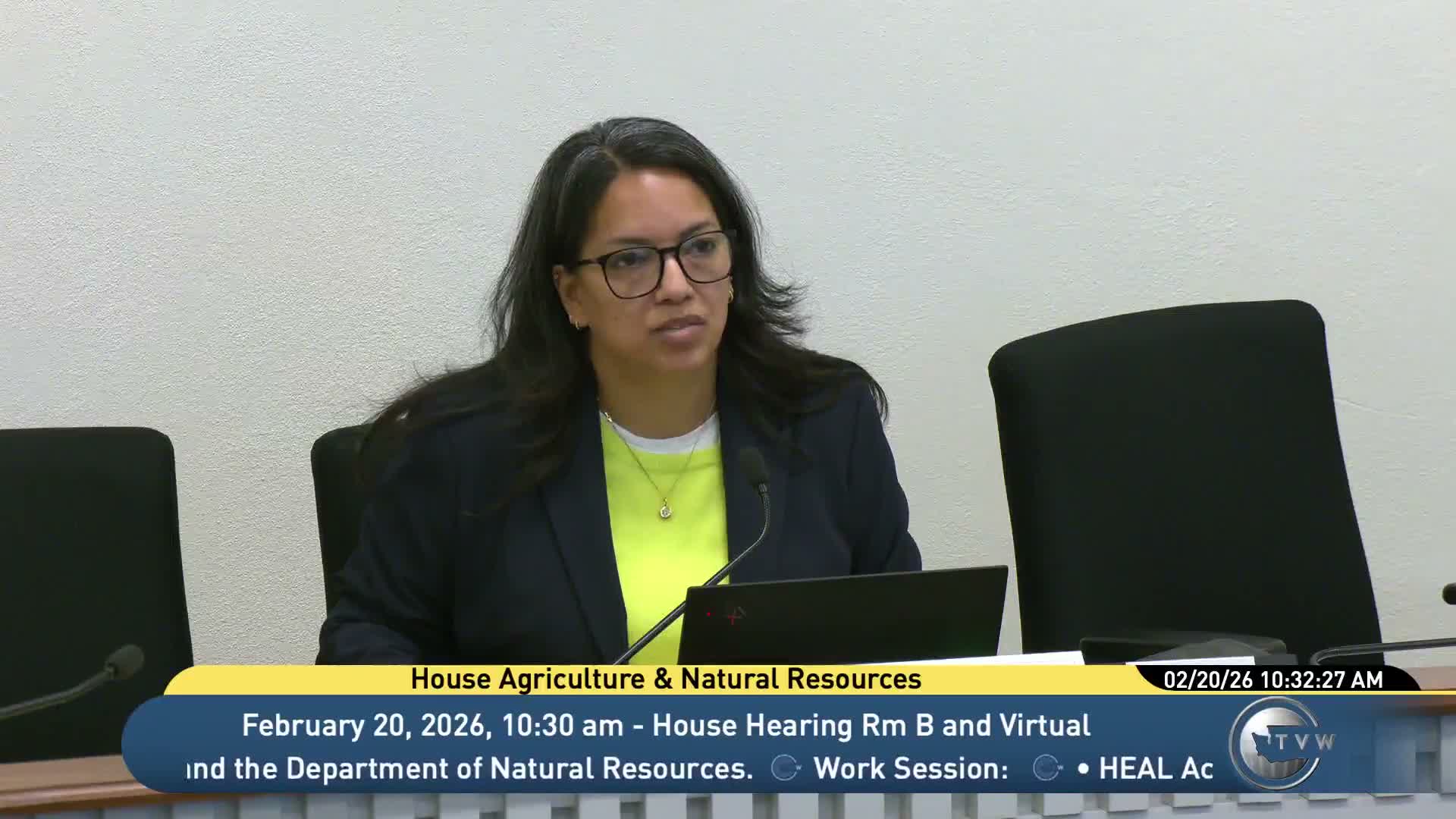
David Mendoza, a member at large of Washington’s Environmental Justice Council, told the House Agriculture and Natural Resources Committee on Feb. 20 that the Healthy Environments for All (HEAL) Act was designed to change the internal culture of state agencies so environmental justice is part of routine decision-making.
Mendoza, who said he helped develop the HEAL Act as a legislative advocate and now serves on the council, described the law’s core aims as reducing environmental health disparities and improving agency accountability through community engagement, tribal consultation and environmental justice assessments. “Zip code unfortunately determines destiny in too many communities,” Mendoza said when describing why the statute was created.
Mendoza summarized the council’s role: advising agencies, producing guidance on meaningful community engagement and co‑operating with an interagency work group that helps agencies adopt consistent practices. He said covered agencies include the Department of Agriculture, Commerce, Ecology, Health, the Department of Natural Resources, Transportation and the Puget Sound Partnership, with the Attorney General’s office having opted in voluntarily.
On assessments, Mendoza described environmental justice assessments as a combined quantitative and qualitative review that agencies must prepare for specified actions and that should document how community input altered a project or regulation. He said, as an example, that agencies often treat capital projects above roughly $10,000,000 and agency-request legislation as situations that trigger fuller assessments; later in the hearing Department of Natural Resources staff cited statutory thresholds of $12,000,000 for capital project grants and $15,000,000 for transportation project grants.
Mendoza also identified two practical constraints slowing implementation: limited volunteer capacity on the council itself and inconsistent formats among agency assessments that make cross-agency comparisons difficult. He said resources created by the Climate Commitment Act have helped hire staff but cautioned the CCA’s long-term funding faces projected shortfalls beginning in the late 2020s.
Committee members raised several follow‑up items, including whether the council should include more business representation and whether agencies have measured the added permitting time or cost associated with conducting EJ assessments. Mendoza said the council has not produced time‑or‑cost data and suggested agencies such as Ecology or Transportation may have more detailed information.
The committee’s work session then moved on to agency presentations from the Department of Agriculture and the Department of Natural Resources.
Mendoza, who said he helped develop the HEAL Act as a legislative advocate and now serves on the council, described the law’s core aims as reducing environmental health disparities and improving agency accountability through community engagement, tribal consultation and environmental justice assessments. “Zip code unfortunately determines destiny in too many communities,” Mendoza said when describing why the statute was created.
Mendoza summarized the council’s role: advising agencies, producing guidance on meaningful community engagement and co‑operating with an interagency work group that helps agencies adopt consistent practices. He said covered agencies include the Department of Agriculture, Commerce, Ecology, Health, the Department of Natural Resources, Transportation and the Puget Sound Partnership, with the Attorney General’s office having opted in voluntarily.
On assessments, Mendoza described environmental justice assessments as a combined quantitative and qualitative review that agencies must prepare for specified actions and that should document how community input altered a project or regulation. He said, as an example, that agencies often treat capital projects above roughly $10,000,000 and agency-request legislation as situations that trigger fuller assessments; later in the hearing Department of Natural Resources staff cited statutory thresholds of $12,000,000 for capital project grants and $15,000,000 for transportation project grants.
Mendoza also identified two practical constraints slowing implementation: limited volunteer capacity on the council itself and inconsistent formats among agency assessments that make cross-agency comparisons difficult. He said resources created by the Climate Commitment Act have helped hire staff but cautioned the CCA’s long-term funding faces projected shortfalls beginning in the late 2020s.
Committee members raised several follow‑up items, including whether the council should include more business representation and whether agencies have measured the added permitting time or cost associated with conducting EJ assessments. Mendoza said the council has not produced time‑or‑cost data and suggested agencies such as Ecology or Transportation may have more detailed information.
The committee’s work session then moved on to agency presentations from the Department of Agriculture and the Department of Natural Resources.
View the Full Meeting & All Its Details
This article offers just a summary. Unlock complete video, transcripts, and insights as a Founder Member.
✓
Watch full, unedited meeting videos
✓
Search every word spoken in unlimited transcripts
✓
AI summaries & real-time alerts (all government levels)
✓
Permanent access to expanding government content
30-day money-back guarantee
