WSDA says it has completed 11 environmental justice assessments but faces staffing limits for HEAL Act work
February 20, 2026 | Legislative Sessions, Washington
This article was created by AI summarizing key points discussed. AI makes mistakes, so for full details and context, please refer to the video of the full meeting. Please report any errors so we can fix them. Report an error »
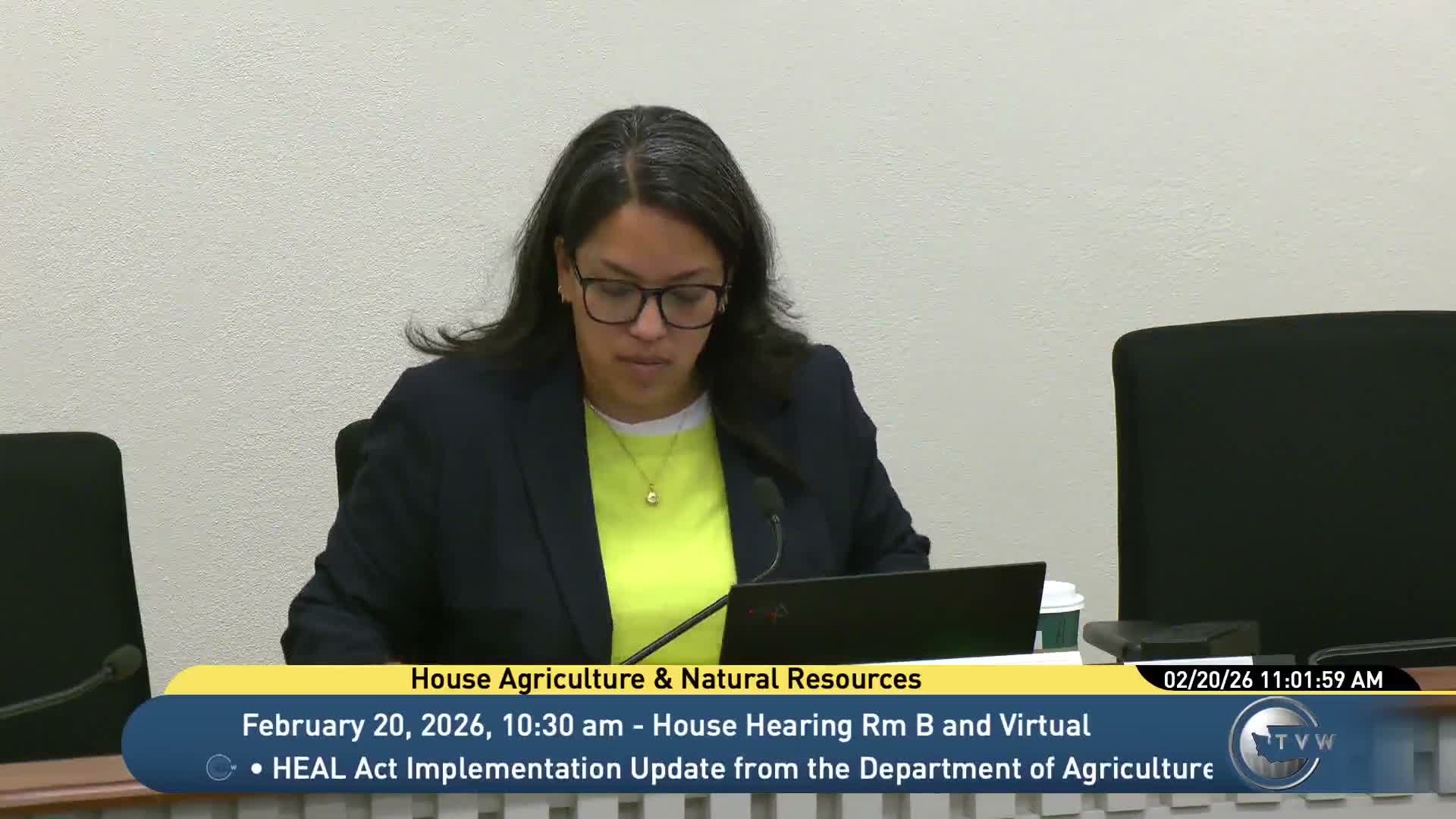
Nicole Johnson, director of equity and environmental justice at the Washington State Department of Agriculture, told the House Agriculture and Natural Resources Committee on Feb. 20 that WSDA has integrated environmental justice tools into regulatory programs and has completed 11 environmental justice assessments to date.
Johnson described examples of WSDA programs that intersect with environmental justice, including pesticide regulation (licensing and worker protections), the animal health program (disease surveillance and response), and weights-and-measures inspections that support economic fairness. She said EJ assessments are used for significant agency actions and include geographic scoping, mapping of affected lands, and community engagement.
Johnson told the committee that in the 2026 supplemental budget WSDA conducted an environmental justice assessment for a capital project that met the financial threshold for review. She said WSDA currently has six legislative rules under development and that four of them are undergoing EJ assessments. "To date, WSDA has completed 11 environmental justice assessments," Johnson said.
On implementation challenges, Johnson said the agency has limited staffing for HEAL responsibilities—about 1.5 full‑time equivalents—creating capacity and knowledge gaps that reduce the agency’s ability to provide consistent guidance across programs. She said the department recently hired a full‑time tribal consultant and is expanding translated materials and other engagement steps designed to improve community access.
Committee members asked whether WSDA performs EJ assessments only for actions under the agency’s direct purview or also for rulemaking conducted through boards on which WSDA serves. Johnson and committee members discussed agency practice and said the current understanding is that EJAs are conducted for internal agency actions, not for the independent boards’ rulemaking where WSDA serves as a voting member.
Johnson said WSDA uses the environmental health disparities map and program-specific data to identify overburdened communities and stressed the agency’s interest in earlier engagement during program design to provide more reliable data and better community input.
Johnson described examples of WSDA programs that intersect with environmental justice, including pesticide regulation (licensing and worker protections), the animal health program (disease surveillance and response), and weights-and-measures inspections that support economic fairness. She said EJ assessments are used for significant agency actions and include geographic scoping, mapping of affected lands, and community engagement.
Johnson told the committee that in the 2026 supplemental budget WSDA conducted an environmental justice assessment for a capital project that met the financial threshold for review. She said WSDA currently has six legislative rules under development and that four of them are undergoing EJ assessments. "To date, WSDA has completed 11 environmental justice assessments," Johnson said.
On implementation challenges, Johnson said the agency has limited staffing for HEAL responsibilities—about 1.5 full‑time equivalents—creating capacity and knowledge gaps that reduce the agency’s ability to provide consistent guidance across programs. She said the department recently hired a full‑time tribal consultant and is expanding translated materials and other engagement steps designed to improve community access.
Committee members asked whether WSDA performs EJ assessments only for actions under the agency’s direct purview or also for rulemaking conducted through boards on which WSDA serves. Johnson and committee members discussed agency practice and said the current understanding is that EJAs are conducted for internal agency actions, not for the independent boards’ rulemaking where WSDA serves as a voting member.
Johnson said WSDA uses the environmental health disparities map and program-specific data to identify overburdened communities and stressed the agency’s interest in earlier engagement during program design to provide more reliable data and better community input.
View the Full Meeting & All Its Details
This article offers just a summary. Unlock complete video, transcripts, and insights as a Founder Member.
✓
Watch full, unedited meeting videos
✓
Search every word spoken in unlimited transcripts
✓
AI summaries & real-time alerts (all government levels)
✓
Permanent access to expanding government content
30-day money-back guarantee
