DNR details HEAL implementation, $130 million in FY25 investments and mapping approach; committee presses on timber and timing of EJ assessments
February 20, 2026 | Legislative Sessions, Washington
This article was created by AI summarizing key points discussed. AI makes mistakes, so for full details and context, please refer to the video of the full meeting. Please report any errors so we can fix them. Report an error »
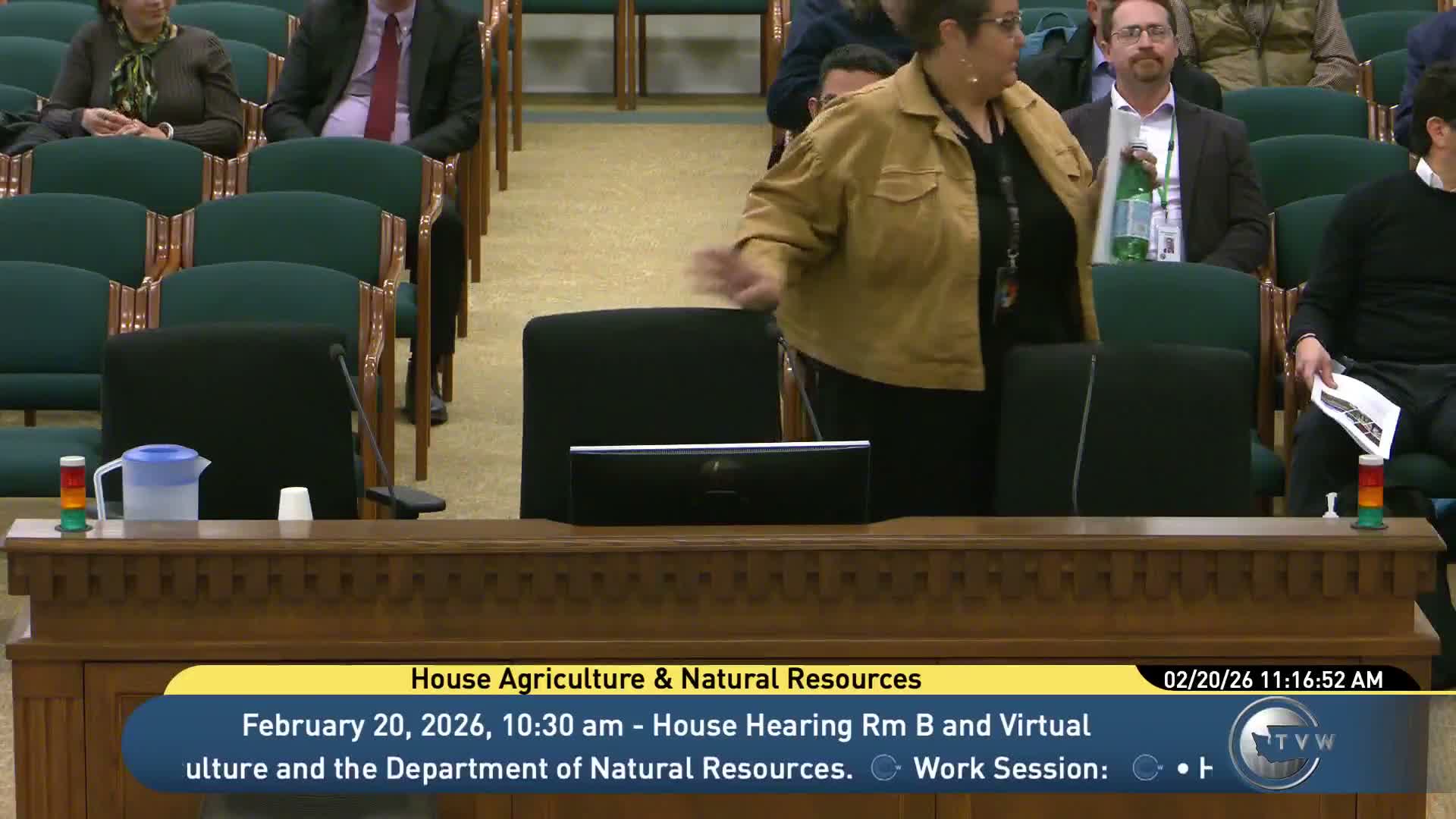
Jerry Rivera, director of the Office of Equity, Environmental Justice and Civil Rights at the Department of Natural Resources, and Corina Allen, an environmental justice adviser, presented the department’s HEAL Act implementation work to the House Agriculture and Natural Resources Committee on Feb. 20.
Rivera said DNR is integrating environmental justice into its 2025–29 strategic plan and moving toward earlier, co‑developed community engagement rather than top‑down outreach. He highlighted a new Community Access and Impact Plan (CAPE) designed to remove barriers to DNR services and improve participation by historically excluded communities.
Allen described how environmental justice assessments (EJAs) function and read the statutory triggers for covered agencies: development and adoption of significant legislative rules; new grant or loan programs that the agency is required to carry out by statute; capital project grants or loans meeting statutory thresholds (Allen cited $12,000,000) and transportation project grants or loans meeting a $15,000,000 threshold; agency-request legislation; and other actions deemed significant by the agency.
DNR said it had chosen to conduct EJAs for sustainable harvest calculations and is completing EJAs for several priorities including adding tribal representation to the Board of Natural Resources, timber efficiencies, ecosystem services, trust asset leasing, and firefighter-related proposals. Allen also noted two DNR actions that the HEAL Act explicitly excludes from required EJAs: the issuance of forest practices permits and the sale of timber from state lands.
Rivera told the committee that, for fiscal year 2025, DNR reported a total of $130,000,000 invested in overburdened communities and vulnerable populations across the state. When lawmakers asked how that overburdened‑community layer was built, Rivera said the map (created about two years earlier in consultation with the Office of Financial Management and the governor’s office) uses three major layers: the environmental health disparities map, federal data including the CIGEST tool, and tribal community data. He said the layer is being updated to reduce urban bias and better include rural communities.
During question-and-answer, members pressed DNR on inclusion of small forest landowners, how regional offices identify impacted communities, and how the OFM posting and notices process works for EJAs when agency-request legislation is filed. DNR staff said notice and posting practices can be confusing: agencies post notices to OFM’s EJ assessment notices page while completed assessments may appear on a separate dashboard and that timing pressures during legislative sessions can create challenges for community engagement.
Committee members requested follow-up on some items, including clarity about which agency-request bills have posted notices and where the public should look for active and completed EJAs. DNR offered to research specific postings and provide more information to the committee.
Rivera said DNR is integrating environmental justice into its 2025–29 strategic plan and moving toward earlier, co‑developed community engagement rather than top‑down outreach. He highlighted a new Community Access and Impact Plan (CAPE) designed to remove barriers to DNR services and improve participation by historically excluded communities.
Allen described how environmental justice assessments (EJAs) function and read the statutory triggers for covered agencies: development and adoption of significant legislative rules; new grant or loan programs that the agency is required to carry out by statute; capital project grants or loans meeting statutory thresholds (Allen cited $12,000,000) and transportation project grants or loans meeting a $15,000,000 threshold; agency-request legislation; and other actions deemed significant by the agency.
DNR said it had chosen to conduct EJAs for sustainable harvest calculations and is completing EJAs for several priorities including adding tribal representation to the Board of Natural Resources, timber efficiencies, ecosystem services, trust asset leasing, and firefighter-related proposals. Allen also noted two DNR actions that the HEAL Act explicitly excludes from required EJAs: the issuance of forest practices permits and the sale of timber from state lands.
Rivera told the committee that, for fiscal year 2025, DNR reported a total of $130,000,000 invested in overburdened communities and vulnerable populations across the state. When lawmakers asked how that overburdened‑community layer was built, Rivera said the map (created about two years earlier in consultation with the Office of Financial Management and the governor’s office) uses three major layers: the environmental health disparities map, federal data including the CIGEST tool, and tribal community data. He said the layer is being updated to reduce urban bias and better include rural communities.
During question-and-answer, members pressed DNR on inclusion of small forest landowners, how regional offices identify impacted communities, and how the OFM posting and notices process works for EJAs when agency-request legislation is filed. DNR staff said notice and posting practices can be confusing: agencies post notices to OFM’s EJ assessment notices page while completed assessments may appear on a separate dashboard and that timing pressures during legislative sessions can create challenges for community engagement.
Committee members requested follow-up on some items, including clarity about which agency-request bills have posted notices and where the public should look for active and completed EJAs. DNR offered to research specific postings and provide more information to the committee.
Don't Miss a Word: See the Full Meeting!
Go beyond summaries. Unlock every video, transcript, and key insight with a Founder Membership.
✓
Get instant access to full meeting videos
✓
Search and clip any phrase from complete transcripts
✓
Receive AI-powered summaries & custom alerts
✓
Enjoy lifetime, unrestricted access to government data
30-day money-back guarantee
