Committee hears expansion of personality-rights law to cover forged digital likenesses
February 20, 2026 | Legislative Sessions, Washington
This article was created by AI summarizing key points discussed. AI makes mistakes, so for full details and context, please refer to the video of the full meeting. Please report any errors so we can fix them. Report an error »
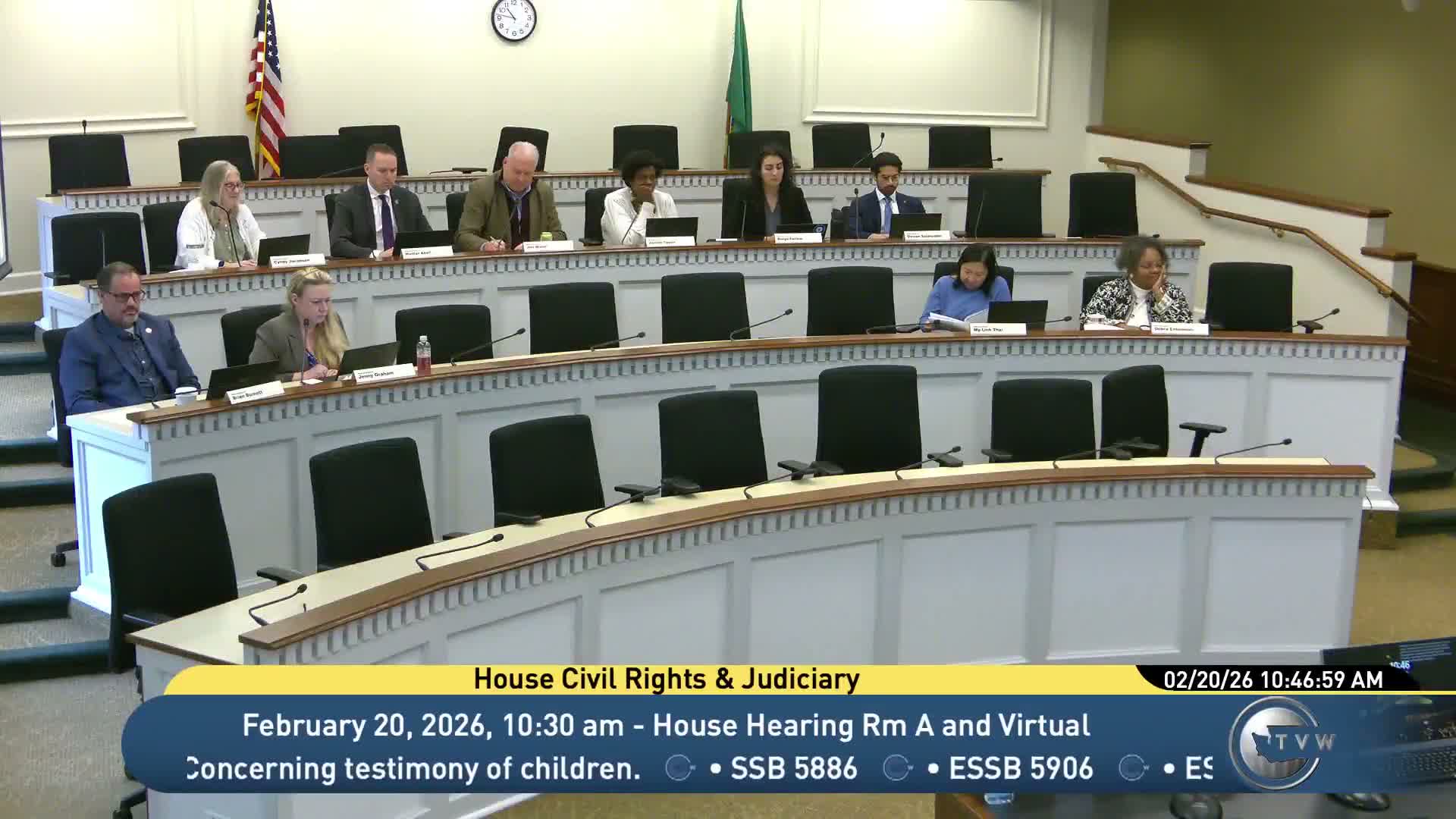
Substitute Senate Bill 5,886 was presented to the Civil Rights and Judiciary Committee as an update to Washington’s Personality Rights Act to address advances in AI and deepfake technologies.
Yelena Baker (committee staff) explained the bill would expand existing personality-rights protections—property rights in name, voice, signature, photograph or likeness—to include forged digital likenesses defined as audio or visual representations created or modified to be indistinguishable from a genuine recording and likely to deceive a reasonable person. The bill increases civil penalties for infringement and makes infringers liable for both the statutory civil penalty and actual damages; it also permits recovery of non-economic damages for forged digital likeness harms.
Senator Boehnke, sponsor of the measure, told the committee the proposal builds on prior state work to address ‘‘deepfakes’’ while trying to preserve fair use and commentary exceptions. He said notification and labeling were concerns but the bill attempts to balance consumer protections with continued innovation.
Student and higher-education representatives urged passage. Bhargav Iyer (Associated Students of Washington State University) and Brandon Elliott (UW Seattle) said students face risks from AI-generated impersonations and urged civil remedies that complement criminal statutes passed last session (House Bill 1205). Steve Wimmer (Nonpartisan Transparency Coalition), an AI-safety advocate, recommended the bill explicitly include transmitted and real-time use cases—such as live audio cloning over Zoom—and supported expansion to permit non-economic damages for victims of noncommercial harassment and extortion.
Committee members raised fair-use and satire concerns. Representative Walsh asked whether the bill would protect clearly derivative or satirical uses; Senator Boehnke said the drafters intended to preserve satire and commentary and that the measure starts with narrow additions to existing law to allow further deliberation.
There were no votes on SB 5,886 at this hearing. Witnesses and lawmakers requested technical edits to ensure exemptions for protected speech remain clear and to address rapidly evolving real-time cloning use cases.
Yelena Baker (committee staff) explained the bill would expand existing personality-rights protections—property rights in name, voice, signature, photograph or likeness—to include forged digital likenesses defined as audio or visual representations created or modified to be indistinguishable from a genuine recording and likely to deceive a reasonable person. The bill increases civil penalties for infringement and makes infringers liable for both the statutory civil penalty and actual damages; it also permits recovery of non-economic damages for forged digital likeness harms.
Senator Boehnke, sponsor of the measure, told the committee the proposal builds on prior state work to address ‘‘deepfakes’’ while trying to preserve fair use and commentary exceptions. He said notification and labeling were concerns but the bill attempts to balance consumer protections with continued innovation.
Student and higher-education representatives urged passage. Bhargav Iyer (Associated Students of Washington State University) and Brandon Elliott (UW Seattle) said students face risks from AI-generated impersonations and urged civil remedies that complement criminal statutes passed last session (House Bill 1205). Steve Wimmer (Nonpartisan Transparency Coalition), an AI-safety advocate, recommended the bill explicitly include transmitted and real-time use cases—such as live audio cloning over Zoom—and supported expansion to permit non-economic damages for victims of noncommercial harassment and extortion.
Committee members raised fair-use and satire concerns. Representative Walsh asked whether the bill would protect clearly derivative or satirical uses; Senator Boehnke said the drafters intended to preserve satire and commentary and that the measure starts with narrow additions to existing law to allow further deliberation.
There were no votes on SB 5,886 at this hearing. Witnesses and lawmakers requested technical edits to ensure exemptions for protected speech remain clear and to address rapidly evolving real-time cloning use cases.
View the Full Meeting & All Its Details
This article offers just a summary. Unlock complete video, transcripts, and insights as a Founder Member.
✓
Watch full, unedited meeting videos
✓
Search every word spoken in unlimited transcripts
✓
AI summaries & real-time alerts (all government levels)
✓
Permanent access to expanding government content
30-day money-back guarantee
