Task force to study tax credits for Connecticut's paid sick days law hears small-business concerns
December 14, 2024 | Labor and Public Employees, House of Representatives, Committees, Legislative, Connecticut
This article was created by AI summarizing key points discussed. AI makes mistakes, so for full details and context, please refer to the video of the full meeting. Please report any errors so we can fix them. Report an error »
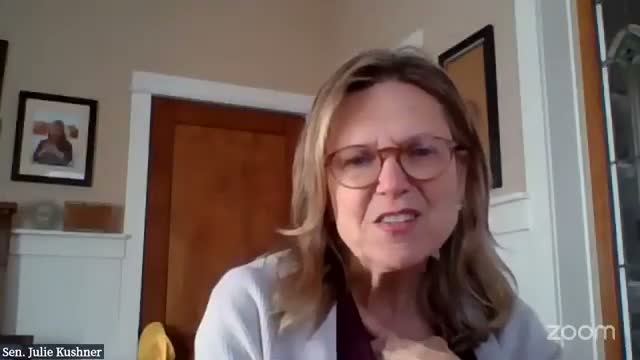
Sen. Julie Kushner convened the first meeting of a task force charged with studying how tax credits or other measures could offset costs to small employers created by Connecticut's recently enacted paid sick days law.
Kushner, who co-chairs the group with Rep. Manny Sanchez, said the statute phases in at least 40 hours of paid sick time for private-sector employees over the next three years and that the smallest employers (firms with five or fewer employees) are phased in later, with those provisions not taking effect until 2027. "Over the next three years, every employee employed in the private sector will have access to at least 40 hours of paid sick time," she said.
The senator emphasized the group's primary charge is to consider tax-credit options to lessen the burden on small firms, but she also said the forum is a place to surface other implementation concerns and that any statutory recommendations from the task force would go to the legislature.
Small-business participants urged careful study of operational impacts. Michelle Nicholson, a bakery and cafe owner in Hebron, said restaurants and other hospitality firms often rely on part-time and under-18 workers and can face immediate staffing and overtime costs when an employee calls out. "When you have a small business that has to have people in the door in order to operate, having somebody call out sick puts a financial strain on the business," she said, describing scenarios that can force managers to pay overtime or lose service capacity.
Fran Pastore, who leads the Women's Business Development Council in Connecticut and works with firms that typically have fewer than five employees, asked how the task force would identify pathways to protect the most vulnerable businesses and workers. Joe Orcolano of the Connecticut Small Business Development Center asked for a clear explanation of who would benefit from any tax credits and for a technical briefing on how tax credits would be administered.
Members suggested bringing in Department of Revenue Services staff or legislative fiscal experts and the Office of Legislative Research to present models used in other states. Kushner cautioned that tax credits are not automatic: "Getting tax credits for anything, as you know, the budget is very tight," she said, and the task force should gather evidence and options before the legislature would consider any changes.
Participants also sought clarity on coverage. Kushner said the law's language refers to self-employed individuals and applies to single-member LLCs that employ others; by contrast, a single-member LLC where the owner is the sole employee is not required to provide paid sick leave.
The task force made no formal decisions at the first meeting. Staff (named Cameron during the session) will reach out to schedule follow-up meetings; Kushner recommended longer or additional sessions to allow deeper review of the issues raised. Rep. Sanchez closed by thanking members and saying he looked forward to continuing the work.
Next steps: the task force will seek technical briefings from tax and research staff, solicit input from affected industries such as hospitality, and schedule further meetings to develop recommendations for the legislature.
Kushner, who co-chairs the group with Rep. Manny Sanchez, said the statute phases in at least 40 hours of paid sick time for private-sector employees over the next three years and that the smallest employers (firms with five or fewer employees) are phased in later, with those provisions not taking effect until 2027. "Over the next three years, every employee employed in the private sector will have access to at least 40 hours of paid sick time," she said.
The senator emphasized the group's primary charge is to consider tax-credit options to lessen the burden on small firms, but she also said the forum is a place to surface other implementation concerns and that any statutory recommendations from the task force would go to the legislature.
Small-business participants urged careful study of operational impacts. Michelle Nicholson, a bakery and cafe owner in Hebron, said restaurants and other hospitality firms often rely on part-time and under-18 workers and can face immediate staffing and overtime costs when an employee calls out. "When you have a small business that has to have people in the door in order to operate, having somebody call out sick puts a financial strain on the business," she said, describing scenarios that can force managers to pay overtime or lose service capacity.
Fran Pastore, who leads the Women's Business Development Council in Connecticut and works with firms that typically have fewer than five employees, asked how the task force would identify pathways to protect the most vulnerable businesses and workers. Joe Orcolano of the Connecticut Small Business Development Center asked for a clear explanation of who would benefit from any tax credits and for a technical briefing on how tax credits would be administered.
Members suggested bringing in Department of Revenue Services staff or legislative fiscal experts and the Office of Legislative Research to present models used in other states. Kushner cautioned that tax credits are not automatic: "Getting tax credits for anything, as you know, the budget is very tight," she said, and the task force should gather evidence and options before the legislature would consider any changes.
Participants also sought clarity on coverage. Kushner said the law's language refers to self-employed individuals and applies to single-member LLCs that employ others; by contrast, a single-member LLC where the owner is the sole employee is not required to provide paid sick leave.
The task force made no formal decisions at the first meeting. Staff (named Cameron during the session) will reach out to schedule follow-up meetings; Kushner recommended longer or additional sessions to allow deeper review of the issues raised. Rep. Sanchez closed by thanking members and saying he looked forward to continuing the work.
Next steps: the task force will seek technical briefings from tax and research staff, solicit input from affected industries such as hospitality, and schedule further meetings to develop recommendations for the legislature.
Don't Miss a Word: See the Full Meeting!
Go beyond summaries. Unlock every video, transcript, and key insight with a Founder Membership.
✓
Get instant access to full meeting videos
✓
Search and clip any phrase from complete transcripts
✓
Receive AI-powered summaries & custom alerts
✓
Enjoy lifetime, unrestricted access to government data
30-day money-back guarantee
