House Finance hears bill to tighten metrics for aerospace tax preferences
February 20, 2026 | Legislative Sessions, Washington
This article was created by AI summarizing key points discussed. AI makes mistakes, so for full details and context, please refer to the video of the full meeting. Please report any errors so we can fix them. Report an error »
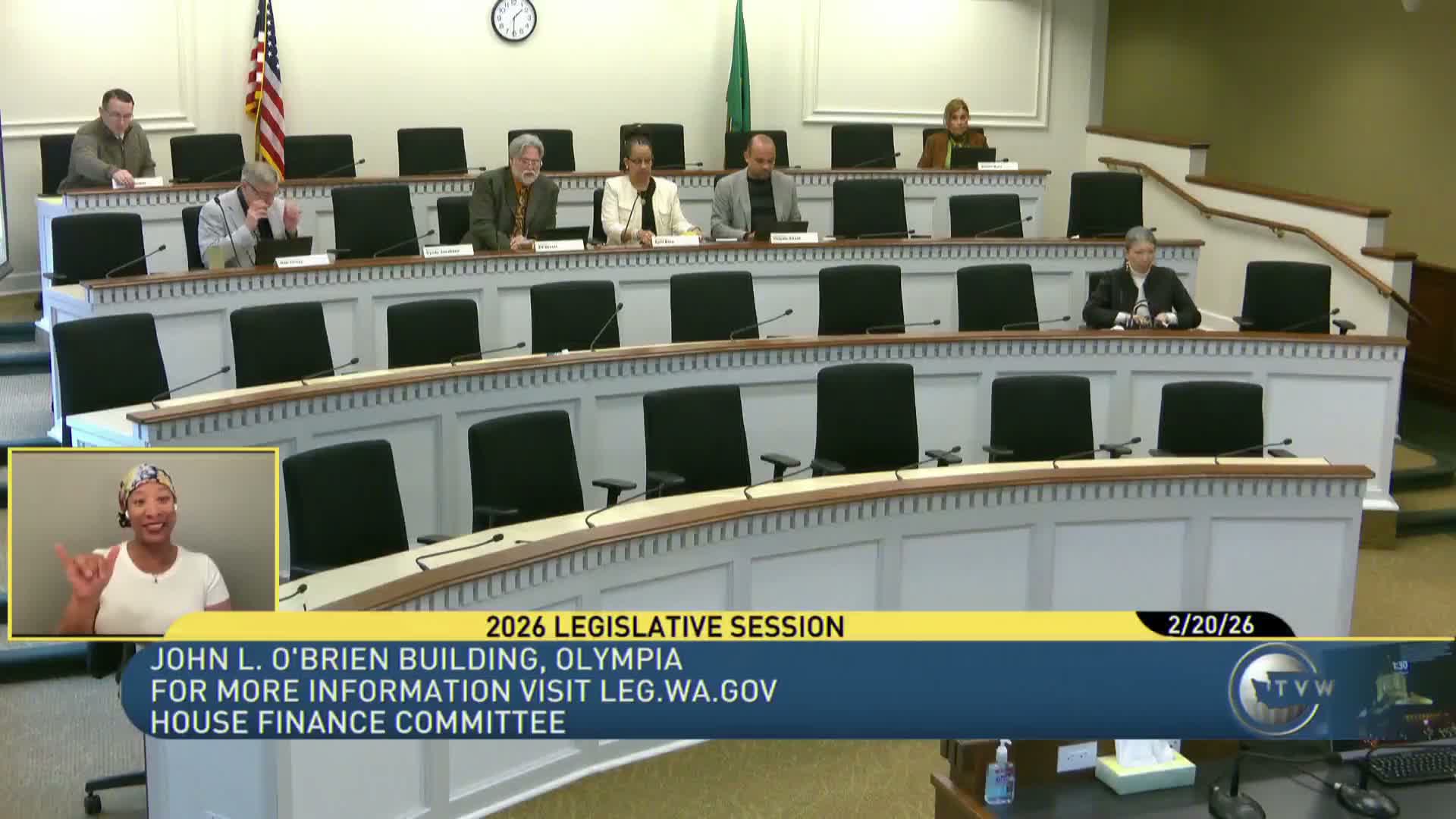
Representatives on the House Finance Committee heard testimony Friday on House Bill 2,730, which would change how the Joint Legislative Audit and Review Committee (JLARC) evaluates aerospace-related business and occupation tax preferences.
John Brzezinski, staff to the committee, told lawmakers that HB 2,730 would amend performance statements for nine existing aerospace tax preferences and require JLARC, beginning with its 2029 review, to assess Washington’s share of aerospace industry employment relative to other states using a rolling five-year average and, to the extent possible, to consider whether shifts in non-commercial aerospace sectors affected those employment figures. "House Bill 2,730 clarifies the metric for judging the effectiveness of aerospace tax preferences," Brzezinski said.
Sponsor Representative Street said the bill aims to provide JLARC with clearer, objective standards so legislators can judge whether tax incentives are meeting their job-creation and retention goals. "This bill is really just trying to help give them some metrics around which they can use for judging the effectiveness of this tax preference," Street said, adding that distinctions between defense and commercial aerospace and job-type shifts are important to avoid misleading conclusions about a preference’s effectiveness.
Union representatives and aerospace engineers urged support for the change. Brandon Anderson of SPEA said JLARC has been unable since 2014 to determine whether the package of preferences is meeting legislative job expectations and that the bill would give the oversight body clearer questions and data to analyze. "For more than a decade, JLARC has asked the legislature to provide clarity needed to properly evaluate job retention and growth," Anderson said. Donnie Donovan of District 751 and engineers Mimi Waltke and Daniel Peters testified that the bill would create a more consistent, data-driven framework and emphasized the real-world impacts of program changes and firm relocations on workers’ careers.
The measure does not impose new penalties on companies, Brzezinski noted, and JLARC expects the performance-statement changes to fit within its existing review schedule; the agency completed related reviews in 2014, 2019 and 2024 and has the next review scheduled for 2029. Committee members asked staff and the sponsor for clarifications on which specific preferences would be evaluated and how prior rate changes (including WTO-related adjustments) should be reconciled; both staff and the sponsor said they would follow up and work with JLARC to refine language.
The committee closed public testimony on HB 2,730 with no immediate vote recorded; sponsors and staff indicated willingness to address technical clarifications and data definitions before further action.
John Brzezinski, staff to the committee, told lawmakers that HB 2,730 would amend performance statements for nine existing aerospace tax preferences and require JLARC, beginning with its 2029 review, to assess Washington’s share of aerospace industry employment relative to other states using a rolling five-year average and, to the extent possible, to consider whether shifts in non-commercial aerospace sectors affected those employment figures. "House Bill 2,730 clarifies the metric for judging the effectiveness of aerospace tax preferences," Brzezinski said.
Sponsor Representative Street said the bill aims to provide JLARC with clearer, objective standards so legislators can judge whether tax incentives are meeting their job-creation and retention goals. "This bill is really just trying to help give them some metrics around which they can use for judging the effectiveness of this tax preference," Street said, adding that distinctions between defense and commercial aerospace and job-type shifts are important to avoid misleading conclusions about a preference’s effectiveness.
Union representatives and aerospace engineers urged support for the change. Brandon Anderson of SPEA said JLARC has been unable since 2014 to determine whether the package of preferences is meeting legislative job expectations and that the bill would give the oversight body clearer questions and data to analyze. "For more than a decade, JLARC has asked the legislature to provide clarity needed to properly evaluate job retention and growth," Anderson said. Donnie Donovan of District 751 and engineers Mimi Waltke and Daniel Peters testified that the bill would create a more consistent, data-driven framework and emphasized the real-world impacts of program changes and firm relocations on workers’ careers.
The measure does not impose new penalties on companies, Brzezinski noted, and JLARC expects the performance-statement changes to fit within its existing review schedule; the agency completed related reviews in 2014, 2019 and 2024 and has the next review scheduled for 2029. Committee members asked staff and the sponsor for clarifications on which specific preferences would be evaluated and how prior rate changes (including WTO-related adjustments) should be reconciled; both staff and the sponsor said they would follow up and work with JLARC to refine language.
The committee closed public testimony on HB 2,730 with no immediate vote recorded; sponsors and staff indicated willingness to address technical clarifications and data definitions before further action.
View the Full Meeting & All Its Details
This article offers just a summary. Unlock complete video, transcripts, and insights as a Founder Member.
✓
Watch full, unedited meeting videos
✓
Search every word spoken in unlimited transcripts
✓
AI summaries & real-time alerts (all government levels)
✓
Permanent access to expanding government content
30-day money-back guarantee
