Sponsor frames 1% B&O surtax on private detention operators; counties seek carve-outs for regional juvenile facility
February 20, 2026 | Legislative Sessions, Washington
This article was created by AI summarizing key points discussed. AI makes mistakes, so for full details and context, please refer to the video of the full meeting. Please report any errors so we can fix them. Report an error »
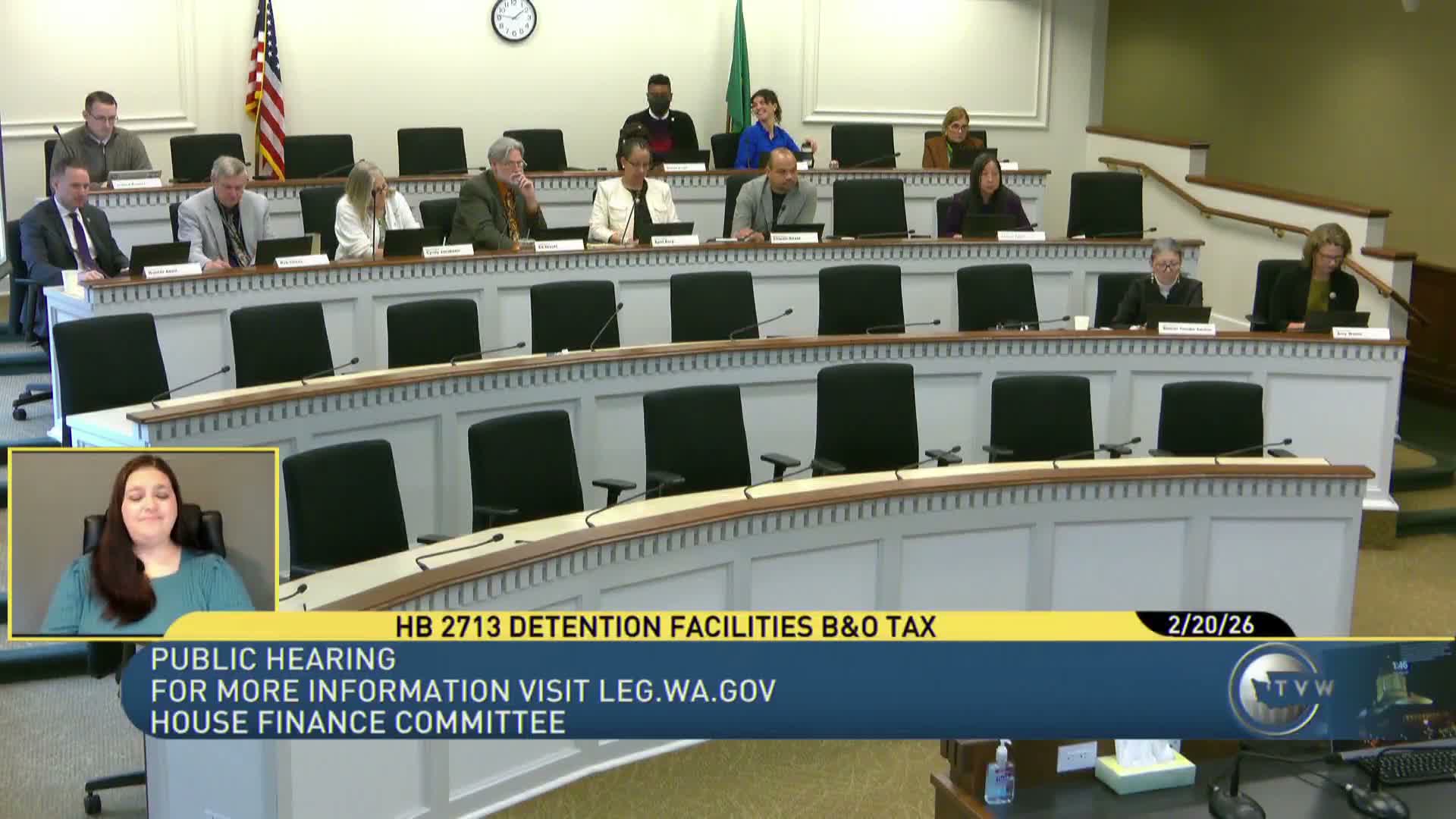
The House Finance Committee opened a public hearing Friday on House Bill 2,713, which would add a 1% surcharge to the Washington business and occupation (B&O) tax on operators of private detention facilities that have annual Washington gross receipts above $1,000,000, effective July 1, 2026.
Committee staff John Brzezinski summarized the bill and its fiscal-note context: "House bill 2,713 provides that beginning 07/01/2026, in addition to all other taxes imposed under Washington's B&O tax, persons must pay a 1% surcharge on Washington taxable income arising from operating a private detention facility if that person has annual Washington gross receipts in excess of $1,000,000." He added the Department of Revenue could not disclose fiscal impacts affecting fewer than three taxpayers and provided administrative-cost estimates in the fiscal note.
Sponsor Representative Sharon Tomiko Santos framed the measure as a response to harms she associates with for-profit private detention operators, citing the Northwest Detention Center in Tacoma and arguing that private operators "are profiting on human suffering." Santos said revenue from a surtax could support legal services and other assistance for detained immigrants and pledged to work on clarifying amendments. "If these entities are going to be allowed to operate within the boundaries of the state of Washington, let us access those, let us make sure that we are taxing them to help fund those services that will support families who are suffering today," she said.
Public testimony ranged from calls for stronger action to technical concerns about unintended consequences. John Burbank urged a more punitive surtax and cited figures alleging GEO Corporation earned $460 million in profits last year and that the state lent GEO $111 million over two decades; he referenced a 2017 attorney general lawsuit over inmate wages and called for the company to be forced out of the state.
County officials and representatives requested targeted clarifications or exemptions. Travis Stutton of the Association of Counties warned the bill, as written, could apply to Martin Hall, a fully secured juvenile detention facility in Medical Lake that is owned by the state, leased by a nine-county consortium and operated day-to-day by a nonprofit contractor. Lincoln County Commissioner Scott Hutsell, who chairs the consortium board, said the consortium and its nonprofit operator should not be subject to the surtax and urged the committee to amend the bill to carve out Martin Hall to avoid increasing juvenile rehabilitation costs for counties and tribes.
Sponsor Santos responded in the hearing that she did not intend to include nonprofits and said she had "intentionally tried to carve them out," offering to meet with stakeholders to resolve the identified issues.
No vote was taken; the committee closed the public hearing and adjourned. Committee members asked for follow-up language to clarify the definition of "private detention facility" and to examine whether intended exemptions (for nonprofits or county-governed regional facilities) are sufficient.
Committee staff John Brzezinski summarized the bill and its fiscal-note context: "House bill 2,713 provides that beginning 07/01/2026, in addition to all other taxes imposed under Washington's B&O tax, persons must pay a 1% surcharge on Washington taxable income arising from operating a private detention facility if that person has annual Washington gross receipts in excess of $1,000,000." He added the Department of Revenue could not disclose fiscal impacts affecting fewer than three taxpayers and provided administrative-cost estimates in the fiscal note.
Sponsor Representative Sharon Tomiko Santos framed the measure as a response to harms she associates with for-profit private detention operators, citing the Northwest Detention Center in Tacoma and arguing that private operators "are profiting on human suffering." Santos said revenue from a surtax could support legal services and other assistance for detained immigrants and pledged to work on clarifying amendments. "If these entities are going to be allowed to operate within the boundaries of the state of Washington, let us access those, let us make sure that we are taxing them to help fund those services that will support families who are suffering today," she said.
Public testimony ranged from calls for stronger action to technical concerns about unintended consequences. John Burbank urged a more punitive surtax and cited figures alleging GEO Corporation earned $460 million in profits last year and that the state lent GEO $111 million over two decades; he referenced a 2017 attorney general lawsuit over inmate wages and called for the company to be forced out of the state.
County officials and representatives requested targeted clarifications or exemptions. Travis Stutton of the Association of Counties warned the bill, as written, could apply to Martin Hall, a fully secured juvenile detention facility in Medical Lake that is owned by the state, leased by a nine-county consortium and operated day-to-day by a nonprofit contractor. Lincoln County Commissioner Scott Hutsell, who chairs the consortium board, said the consortium and its nonprofit operator should not be subject to the surtax and urged the committee to amend the bill to carve out Martin Hall to avoid increasing juvenile rehabilitation costs for counties and tribes.
Sponsor Santos responded in the hearing that she did not intend to include nonprofits and said she had "intentionally tried to carve them out," offering to meet with stakeholders to resolve the identified issues.
No vote was taken; the committee closed the public hearing and adjourned. Committee members asked for follow-up language to clarify the definition of "private detention facility" and to examine whether intended exemptions (for nonprofits or county-governed regional facilities) are sufficient.
View the Full Meeting & All Its Details
This article offers just a summary. Unlock complete video, transcripts, and insights as a Founder Member.
✓
Watch full, unedited meeting videos
✓
Search every word spoken in unlimited transcripts
✓
AI summaries & real-time alerts (all government levels)
✓
Permanent access to expanding government content
30-day money-back guarantee
