340B overhaul bill draws sharply divided testimony on transparency and costs
February 20, 2026 | Legislative Sessions, Washington
This article was created by AI summarizing key points discussed. AI makes mistakes, so for full details and context, please refer to the video of the full meeting. Please report any errors so we can fix them. Report an error »
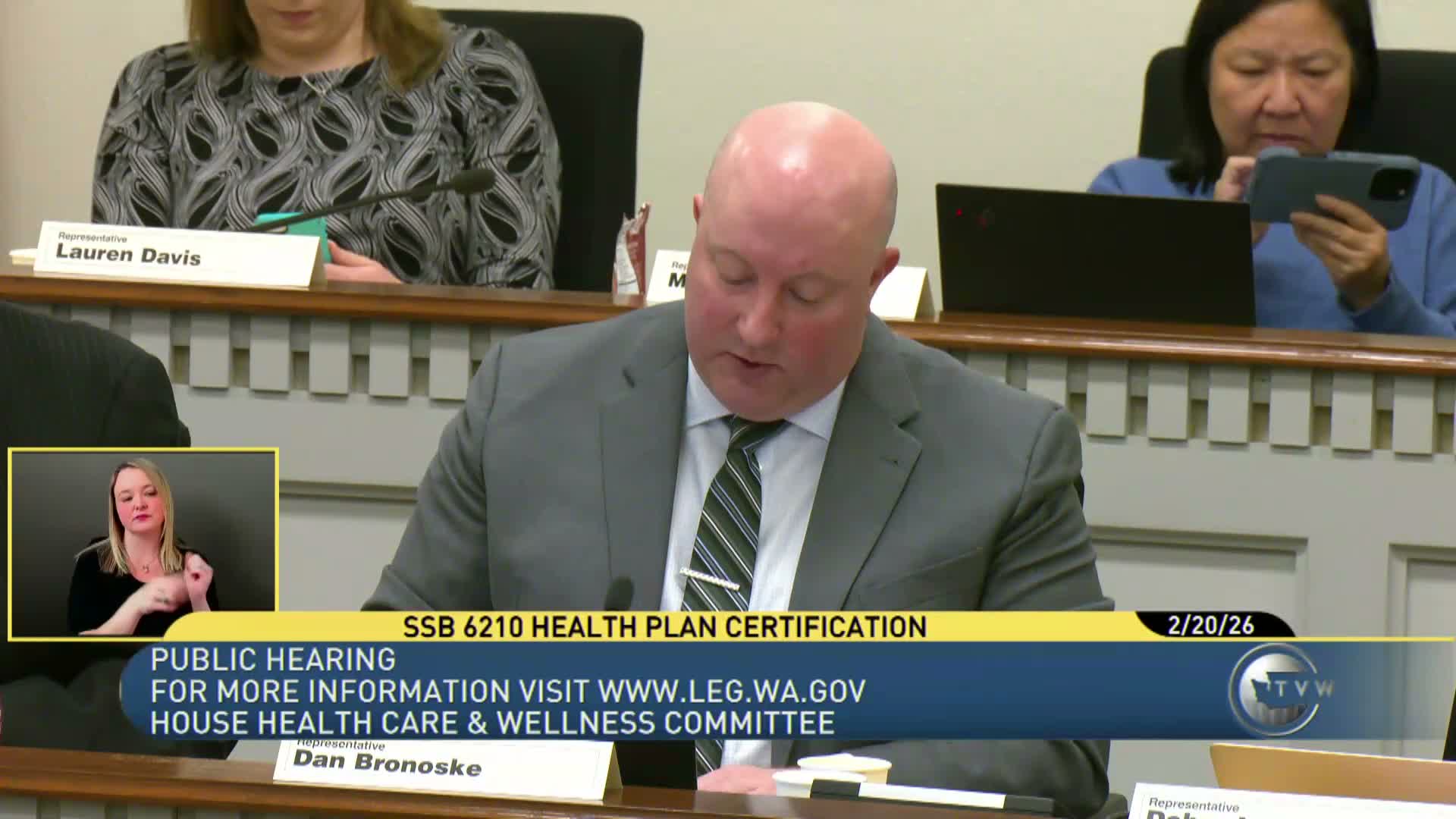
Committee staff summarized Second Substitute Senate Bill 59 81 as a measure to protect covered entities' access to 340B drug discounts, to require annual reporting from covered hospitals and manufacturers about costs, discounts and use of savings, and to prohibit manufacturers or agents from denying acquisition or requiring data submissions as a condition of participation.
Supporters — community health centers, rural hospitals and patient advocates — argued the 340B program funds services for vulnerable populations and that manufacturer restrictions and contract-pharmacy limits have siphoned savings away from the safety net. Lisa Nelson, chief pharmacy officer at UnityCare Northwest, recounted a patient whose co‑payment was eased by 340B savings; Lake Chelan Health's chief operations officer said 340B savings allowed the hospital to sustain services with a negative operating margin in 2024.
Opponents — including pharmaceutical manufacturers, industry trade groups and employer associations — warned that expanding 340B access raises premiums and shifts rebate value away from employers and Medicaid. Witnesses cited studies and figures (e.g., IQVIA, CBO, Health Capital Group) estimating hundreds of millions in state employer impacts and lost rebates. Pharma representatives said federal courts have upheld manufacturer ability to set conditions on contract pharmacies and that the bill risks litigation and undercuts federal reform efforts.
Several think tanks and patient advocates called for stronger transparency measures — and many witnesses urged clarifying how 340B revenues are used locally. Testimony overall was sharply divided: rural providers called the program a lifeline; manufacturers and employer groups warned of fiscal tradeoffs and called for tighter guardrails and federal reform.
The committee closed public testimony on SB 59 81 and moved to executive session. No final action on SB 59 81 was recorded in this meeting.
Supporters — community health centers, rural hospitals and patient advocates — argued the 340B program funds services for vulnerable populations and that manufacturer restrictions and contract-pharmacy limits have siphoned savings away from the safety net. Lisa Nelson, chief pharmacy officer at UnityCare Northwest, recounted a patient whose co‑payment was eased by 340B savings; Lake Chelan Health's chief operations officer said 340B savings allowed the hospital to sustain services with a negative operating margin in 2024.
Opponents — including pharmaceutical manufacturers, industry trade groups and employer associations — warned that expanding 340B access raises premiums and shifts rebate value away from employers and Medicaid. Witnesses cited studies and figures (e.g., IQVIA, CBO, Health Capital Group) estimating hundreds of millions in state employer impacts and lost rebates. Pharma representatives said federal courts have upheld manufacturer ability to set conditions on contract pharmacies and that the bill risks litigation and undercuts federal reform efforts.
Several think tanks and patient advocates called for stronger transparency measures — and many witnesses urged clarifying how 340B revenues are used locally. Testimony overall was sharply divided: rural providers called the program a lifeline; manufacturers and employer groups warned of fiscal tradeoffs and called for tighter guardrails and federal reform.
The committee closed public testimony on SB 59 81 and moved to executive session. No final action on SB 59 81 was recorded in this meeting.
Don't Miss a Word: See the Full Meeting!
Go beyond summaries. Unlock every video, transcript, and key insight with a Founder Membership.
✓
Get instant access to full meeting videos
✓
Search and clip any phrase from complete transcripts
✓
Receive AI-powered summaries & custom alerts
✓
Enjoy lifetime, unrestricted access to government data
30-day money-back guarantee
