City staff: 1,942 ADA transition findings complete; 1,632 remain as city advances signage, doors and City Hall work
February 20, 2026 | Santa Barbara City, Santa Barbara County, California
This article was created by AI summarizing key points discussed. AI makes mistakes, so for full details and context, please refer to the video of the full meeting. Please report any errors so we can fix them. Report an error »
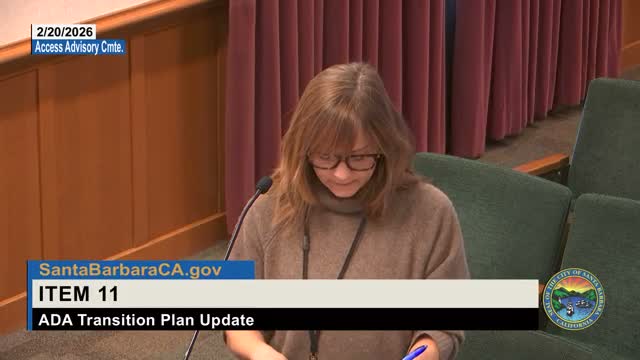
City staff told the Access Advisory Committee that work on the city's ADA transition plan is well under way but not finished, reporting 1,942 findings completed and 1,632 remaining.
Maya, an ADA transition staff member, said the city has completed interior signage at 630 Garden and is preparing City Hall signage and design work for the elevator and restroom upgrades. "As of today, we have 1,942 findings that are completed with 1,632 remaining findings," she said, noting roughly 260 of the outstanding items are technically difficult and will be deferred to larger capital projects.
The numbers matter because the remaining items include structural or complex tasks—widening doorways, parking-lot redesigns and other path-of-travel work—that typically require design, permitting and capital funding. Staff emphasized that some elements labeled "barrier removal" can be done under a narrower scope, while others will need comprehensive projects. "That project is fully barrier removal project," Maya said of the City Hall restroom-and-elevator work, adding the parking-lot redesign was out of scope for that contract.
Facilities Manager Megan Salas described new preventive maintenance measures for doors and accessibility hardware. "We have recently put into place a door preventative maintenance program that is responsible for twice a year maintenance on publicly accessible doors," Salas said. She told the committee a contractor had produced repair proposals, the city had approved work to install six column-mounted automatic door push plates and a door opener for this building, and staff would follow up on a missed contractor visit.
Salas also described a newly launched asset-management system, Cartograph, that will track each door and related maintenance tasks. "We have gone live with Cartograph this week... we can look at the full histories of it, see how often we have work orders on it," she said, calling the tool key to moving from reactive repairs to planned replacement.
Staff said sign packages for priority sites are moving forward and that 47 priority-site bid packages are in development; they offered to share the list by email and to convene an ad hoc if the committee wanted to reprioritize projects. Committee members pressed staff on timelines and budget: drawings for the City Hall elevator and restroom were expected later this year but funding had not been allocated in FY26 or FY27, leaving timing dependent on future appropriations or reprioritization.
Staff said some findings—such as widening a doorway or redesigning a parking lot—are best bundled with larger capital work, while simpler items such as stair-striping and signage can be completed more quickly. The committee asked staff to share the bid-package list and cost estimates to inform priorities and possible budget advocacy at upcoming public meetings.
The update closed with a reminder that work spans both capital projects and facilities maintenance: some tasks will be handled by the transition-plan capital work, others by the facilities maintenance program now scheduling preventative repairs.
The committee will receive the list of bid packages and the staff offered to arrange an ad hoc to review upcoming bid packages and priorities.
Maya, an ADA transition staff member, said the city has completed interior signage at 630 Garden and is preparing City Hall signage and design work for the elevator and restroom upgrades. "As of today, we have 1,942 findings that are completed with 1,632 remaining findings," she said, noting roughly 260 of the outstanding items are technically difficult and will be deferred to larger capital projects.
The numbers matter because the remaining items include structural or complex tasks—widening doorways, parking-lot redesigns and other path-of-travel work—that typically require design, permitting and capital funding. Staff emphasized that some elements labeled "barrier removal" can be done under a narrower scope, while others will need comprehensive projects. "That project is fully barrier removal project," Maya said of the City Hall restroom-and-elevator work, adding the parking-lot redesign was out of scope for that contract.
Facilities Manager Megan Salas described new preventive maintenance measures for doors and accessibility hardware. "We have recently put into place a door preventative maintenance program that is responsible for twice a year maintenance on publicly accessible doors," Salas said. She told the committee a contractor had produced repair proposals, the city had approved work to install six column-mounted automatic door push plates and a door opener for this building, and staff would follow up on a missed contractor visit.
Salas also described a newly launched asset-management system, Cartograph, that will track each door and related maintenance tasks. "We have gone live with Cartograph this week... we can look at the full histories of it, see how often we have work orders on it," she said, calling the tool key to moving from reactive repairs to planned replacement.
Staff said sign packages for priority sites are moving forward and that 47 priority-site bid packages are in development; they offered to share the list by email and to convene an ad hoc if the committee wanted to reprioritize projects. Committee members pressed staff on timelines and budget: drawings for the City Hall elevator and restroom were expected later this year but funding had not been allocated in FY26 or FY27, leaving timing dependent on future appropriations or reprioritization.
Staff said some findings—such as widening a doorway or redesigning a parking lot—are best bundled with larger capital work, while simpler items such as stair-striping and signage can be completed more quickly. The committee asked staff to share the bid-package list and cost estimates to inform priorities and possible budget advocacy at upcoming public meetings.
The update closed with a reminder that work spans both capital projects and facilities maintenance: some tasks will be handled by the transition-plan capital work, others by the facilities maintenance program now scheduling preventative repairs.
The committee will receive the list of bid packages and the staff offered to arrange an ad hoc to review upcoming bid packages and priorities.
Don't Miss a Word: See the Full Meeting!
Go beyond summaries. Unlock every video, transcript, and key insight with a Founder Membership.
✓
Get instant access to full meeting videos
✓
Search and clip any phrase from complete transcripts
✓
Receive AI-powered summaries & custom alerts
✓
Enjoy lifetime, unrestricted access to government data
30-day money-back guarantee
