Task force presents trauma-informed Missing and Murdered Indigenous Persons toolkit, templates and alert guidance
February 20, 2026 | Children, Youth, and Families, Department of, State Agencies, Executive, Washington
This article was created by AI summarizing key points discussed. AI makes mistakes, so for full details and context, please refer to the video of the full meeting. Please report any errors so we can fix them. Report an error »
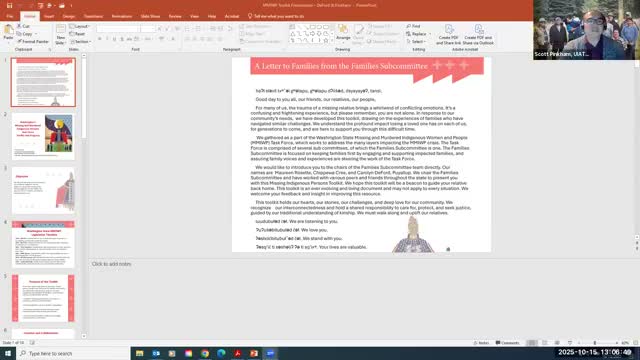
Carolyn and Scott Finkham presented a Missing and Murdered Indigenous Persons (MMIWP/MMIWR) toolkit during a virtual conference breakout session, describing practical templates, alert procedures and support resources for families and advocates.
The presenters said the toolkit was developed over a multi-year process beginning after 2018 legislation that directed the Washington State Patrol to prepare a statewide report. Scott Finkham said the project brought together families, tribal leaders, law enforcement liaisons and subject-matter experts and led to systems now in place or in development, including tribal liaisons with the Washington State Patrol, a missing indigenous persons alert system (MIPA), and an Attorney General cold case unit focused on indigenous cases.
The toolkit is framed as an immediately usable, trauma-informed guide. It contains step-by-step checklists, timeline and contact-log templates, media guidance, and sample alert copy to help families and advocates organize information quickly and consistently. A presenter said the intention was not to create an encyclopedia of MMIW history that might retraumatize users but to give clear actions families can take in a crisis, including how to document last-seen details, collect officer names and case numbers, and prepare materials law enforcement can use.
Presenters urged families to sign up for the Missing Indigenous Persons Alert (MIPA) and subscribe to alert lists so community members can be notified rapidly when a poster or alert is released. They described templates to produce standardized posters and suggested coordinating timing with law enforcement so agencies can staff tip lines and respond to incoming leads.
Advocacy and coordination were central themes: presenters said advocates can compile organized case files, connect families with Washington State Patrol tribal liaisons, the AGO cold case unit, and tribal victim services, and help tailor media messaging to reduce revictimization. They noted jurisdictional complexity—examples included reservation areas with multiple layers of authority—and recommended advocacy teams that include cultural supports (talking circles, elders) for long-term healing.
During a chat question about eligibility for services, an advocate who identified herself as an MMIWP advocate with the Pell Tribe Domestic Violence Program said eligibility varies by program and funding stream: "Some of our funding is limited to members of federally recognized tribes," she said, "but for my program, no, they don't need to be enrolled. They need to identify as Native American." The presenter added that services and the amount of support available therefore depend on the sponsoring program's rules.
Presenters also described examples of successful tips generated from social media and community posting and cautioned about what details not to share publicly so as not to jeopardize investigations. They said the toolkit will be shared with attendees (slides and templates) and that legislation mandates regular updates so the resource remains current.
The session closed with reminders to scan QR codes to access the toolkit and sign up for alerts, and conference logistics about follow-up materials and the next breakout sessions.
The presenters said the toolkit was developed over a multi-year process beginning after 2018 legislation that directed the Washington State Patrol to prepare a statewide report. Scott Finkham said the project brought together families, tribal leaders, law enforcement liaisons and subject-matter experts and led to systems now in place or in development, including tribal liaisons with the Washington State Patrol, a missing indigenous persons alert system (MIPA), and an Attorney General cold case unit focused on indigenous cases.
The toolkit is framed as an immediately usable, trauma-informed guide. It contains step-by-step checklists, timeline and contact-log templates, media guidance, and sample alert copy to help families and advocates organize information quickly and consistently. A presenter said the intention was not to create an encyclopedia of MMIW history that might retraumatize users but to give clear actions families can take in a crisis, including how to document last-seen details, collect officer names and case numbers, and prepare materials law enforcement can use.
Presenters urged families to sign up for the Missing Indigenous Persons Alert (MIPA) and subscribe to alert lists so community members can be notified rapidly when a poster or alert is released. They described templates to produce standardized posters and suggested coordinating timing with law enforcement so agencies can staff tip lines and respond to incoming leads.
Advocacy and coordination were central themes: presenters said advocates can compile organized case files, connect families with Washington State Patrol tribal liaisons, the AGO cold case unit, and tribal victim services, and help tailor media messaging to reduce revictimization. They noted jurisdictional complexity—examples included reservation areas with multiple layers of authority—and recommended advocacy teams that include cultural supports (talking circles, elders) for long-term healing.
During a chat question about eligibility for services, an advocate who identified herself as an MMIWP advocate with the Pell Tribe Domestic Violence Program said eligibility varies by program and funding stream: "Some of our funding is limited to members of federally recognized tribes," she said, "but for my program, no, they don't need to be enrolled. They need to identify as Native American." The presenter added that services and the amount of support available therefore depend on the sponsoring program's rules.
Presenters also described examples of successful tips generated from social media and community posting and cautioned about what details not to share publicly so as not to jeopardize investigations. They said the toolkit will be shared with attendees (slides and templates) and that legislation mandates regular updates so the resource remains current.
The session closed with reminders to scan QR codes to access the toolkit and sign up for alerts, and conference logistics about follow-up materials and the next breakout sessions.
View the Full Meeting & All Its Details
This article offers just a summary. Unlock complete video, transcripts, and insights as a Founder Member.
✓
Watch full, unedited meeting videos
✓
Search every word spoken in unlimited transcripts
✓
AI summaries & real-time alerts (all government levels)
✓
Permanent access to expanding government content
30-day money-back guarantee
