DEP outlines multi-year Wetland Program Plan, highlights 250-site tidal monitoring network and $15M in climate grants
March 29, 2025 | Pinelands Commission, State Departments and Agencies, Organizations, Executive, New Jersey
This article was created by AI summarizing key points discussed. AI makes mistakes, so for full details and context, please refer to the video of the full meeting. Please report any errors so we can fix them. Report an error »
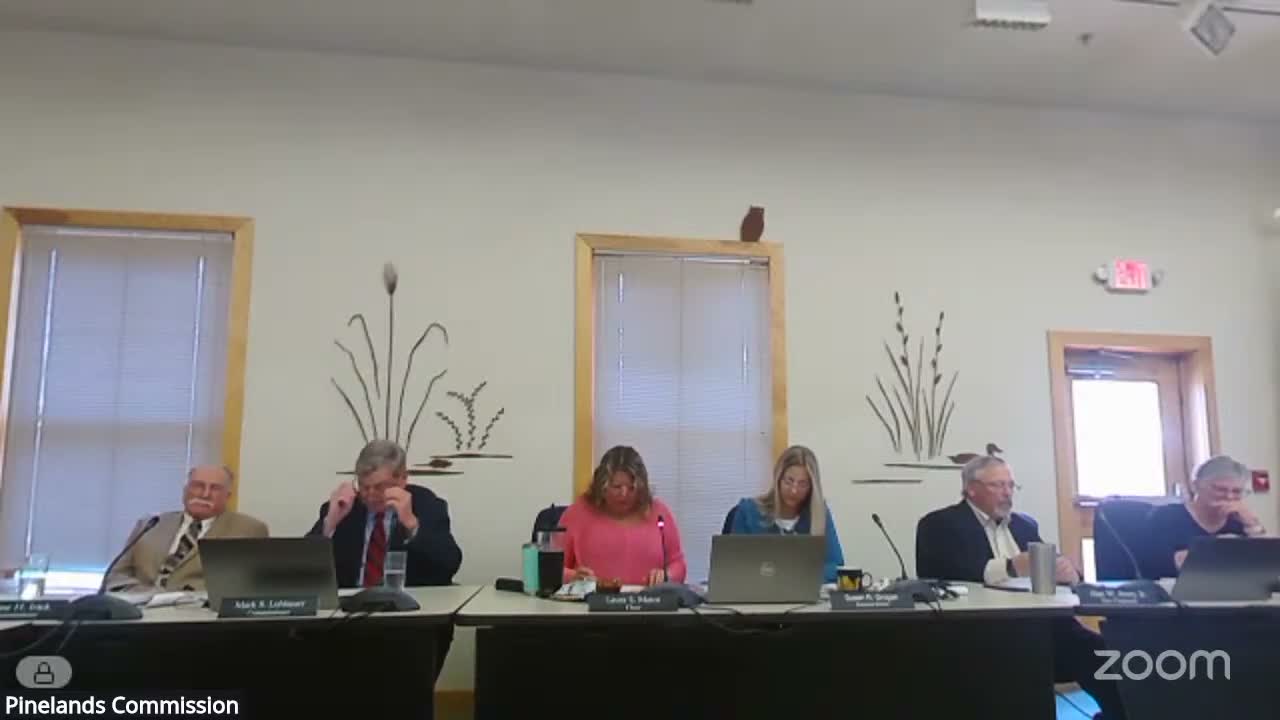
The commission heard a detailed briefing from the New Jersey Department of Environmental Protection on the state's Wetland Program Plan, a nonbinding multi-year framework produced in part to qualify for U.S. Environmental Protection Agency Wetland Program Development grants.
"The first and foremost reason that we have a wetland program plan, was to satisfy a U.S. EPA requirement for receiving wetland program development grants under the state and tribal track," said Matia Yobsen, chief of the Bureau of Environmental Assessment, who led the presentation. Yobsen described wetlands as covering roughly 18% of New Jersey and providing water-quality improvement, wildlife habitat, flood mitigation and other ecosystem services.
The plan is organized around seven core elements: monitoring and assessment; regulation; restoration and protection; wetland-specific water-quality standards; adaptation, resilience and mitigation; public outreach and education; and environmental justice. Yobsen said the current iteration expanded participation to include the Highlands and Pinelands commissions and the New Jersey Sports and Exposition Authority and drew contributions from 27 scientists across 17 DEP programs.
Monitoring and assessment drew particular attention. Yobsen described the New Jersey tidal wetlands monitoring network as having 250 long-term sites with about 10 years of data and said the department would publish a standardized-methods database and website imminently. The presenter acknowledged gaps in freshwater, non-tidal monitoring and described efforts to build partnerships and repeatable methods for inland wetlands.
On regulation, Yobsen pointed to electronic permit submission and pending draft regulatory changes as tools to improve wetland protection. For restoration, she cited state-funded projects and site-specific restoration planning and monitoring. On water-quality standards, she noted work under the Clean Water Act to establish wetland benchmarks by type and a functional data layer being developed in a Watershed NJ planning tool.
Yobsen highlighted climate-focused efforts under core element 5 and said the Natural Climate Solutions grant program, funded with Regional Greenhouse Gas Initiative dollars, has supported about $15,000,000 in wetland restoration and carbon-focused projects. "We're using RGGI funding; the department developed the natural climate solutions grant program, and that has funded so far $15,000,000 worth of tidal wetland restoration projects," she said.
The presentation also covered outreach and environmental justice objectives, including prioritizing overburdened communities in project selection; Yobsen cited Kramer Hill Waterfront Park in Camden as a local example.
Committee members and DEP staff exchanged questions on mapping accuracy, volunteer and partner roles in monitoring, the need to expand freshwater monitoring capacity and methods for measuring carbon flux in inland wetlands. Yobsen described a new Rowan University pilot measuring carbon dioxide, methane and nitrous oxide fluxes at forested wetland sites; field data collection will run about two years with interim results expected next summer and final reporting thereafter.
The session closed with a call to continue developing partnerships and funding strategies to move items on the plan's extensive wish list into implementation when resources permit.
"The first and foremost reason that we have a wetland program plan, was to satisfy a U.S. EPA requirement for receiving wetland program development grants under the state and tribal track," said Matia Yobsen, chief of the Bureau of Environmental Assessment, who led the presentation. Yobsen described wetlands as covering roughly 18% of New Jersey and providing water-quality improvement, wildlife habitat, flood mitigation and other ecosystem services.
The plan is organized around seven core elements: monitoring and assessment; regulation; restoration and protection; wetland-specific water-quality standards; adaptation, resilience and mitigation; public outreach and education; and environmental justice. Yobsen said the current iteration expanded participation to include the Highlands and Pinelands commissions and the New Jersey Sports and Exposition Authority and drew contributions from 27 scientists across 17 DEP programs.
Monitoring and assessment drew particular attention. Yobsen described the New Jersey tidal wetlands monitoring network as having 250 long-term sites with about 10 years of data and said the department would publish a standardized-methods database and website imminently. The presenter acknowledged gaps in freshwater, non-tidal monitoring and described efforts to build partnerships and repeatable methods for inland wetlands.
On regulation, Yobsen pointed to electronic permit submission and pending draft regulatory changes as tools to improve wetland protection. For restoration, she cited state-funded projects and site-specific restoration planning and monitoring. On water-quality standards, she noted work under the Clean Water Act to establish wetland benchmarks by type and a functional data layer being developed in a Watershed NJ planning tool.
Yobsen highlighted climate-focused efforts under core element 5 and said the Natural Climate Solutions grant program, funded with Regional Greenhouse Gas Initiative dollars, has supported about $15,000,000 in wetland restoration and carbon-focused projects. "We're using RGGI funding; the department developed the natural climate solutions grant program, and that has funded so far $15,000,000 worth of tidal wetland restoration projects," she said.
The presentation also covered outreach and environmental justice objectives, including prioritizing overburdened communities in project selection; Yobsen cited Kramer Hill Waterfront Park in Camden as a local example.
Committee members and DEP staff exchanged questions on mapping accuracy, volunteer and partner roles in monitoring, the need to expand freshwater monitoring capacity and methods for measuring carbon flux in inland wetlands. Yobsen described a new Rowan University pilot measuring carbon dioxide, methane and nitrous oxide fluxes at forested wetland sites; field data collection will run about two years with interim results expected next summer and final reporting thereafter.
The session closed with a call to continue developing partnerships and funding strategies to move items on the plan's extensive wish list into implementation when resources permit.
Don't Miss a Word: See the Full Meeting!
Go beyond summaries. Unlock every video, transcript, and key insight with a Founder Membership.
✓
Get instant access to full meeting videos
✓
Search and clip any phrase from complete transcripts
✓
Receive AI-powered summaries & custom alerts
✓
Enjoy lifetime, unrestricted access to government data
30-day money-back guarantee
