Pinelands Commission certifies Hamilton Township redevelopment plan allowing limited cannabis cultivation and processing in a previously developed area
December 14, 2024 | Pinelands Commission, State Departments and Agencies, Organizations, Executive, New Jersey
This article was created by AI summarizing key points discussed. AI makes mistakes, so for full details and context, please refer to the video of the full meeting. Please report any errors so we can fix them. Report an error »
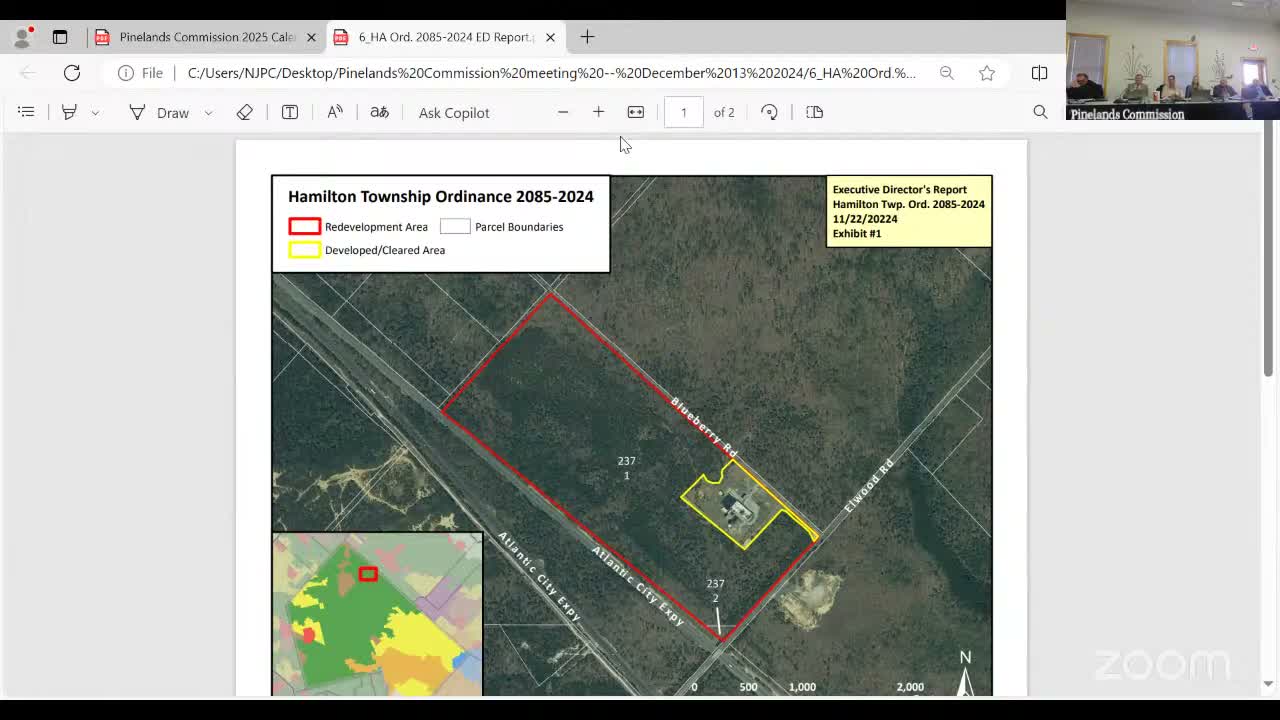
The Pinelands Commission on December 21 certified a Hamilton Township redevelopment plan that would allow reuse of a former dye-manufacturing site as a Class 1 cannabis cultivation facility, while limiting processing, drying and packaging activities to a previously developed 10-acre portion of the 105-acre property.
Staff presented a draft resolution and supporting report describing the site as a 105-acre redevelopment area with an existing, now-vacant industrial building (about 31,000 square feet) and said the township adopted the ordinance (referred to in materials as ordinance 20 85 dash 20 24) in September. Under the township plan, the site would be rezoned to an ‘open lane district’ permitting the cultivation use and—using CMP municipal flexibility provisions—allow a narrow set of ag-products-processing activities that the state’s Class 1 cannabis license may require, such as indoor drying, curing, processing and packaging.
Why it matters: staff and commissioners framed the certification as a limited use of municipal flexibility in the Pinelands Comprehensive Management Plan (CMP), intended to re‑use an abandoned industrial building without expanding cleared footprints across the forest area. Staff emphasized that development approvals are still required for any construction and that remediation and environmental standards must be met before development proceeds.
Commissioners asked about contamination and cleanup. Staff told the commission that soil and groundwater remediation has been underway at the site since the 1990s under DEP oversight; the redevelopment applicant is aware of ongoing remediation requirements and would need to complete additional environmental work and a full development application before construction could begin. As one commissioner summarized at the meeting, “We’re not approving development here today; we’re only asking the commission to approve a redevelopment plan,” reflecting that certification does not substitute for project-level environmental reviews.
The commission took a voice vote and certified the township’s redevelopment plan; the meeting record shows verbal “Aye” responses with no recorded opposition. Staff noted that any subsequent development applications must comply with CMP standards and applicable DEP remediation requirements.
What’s next: staff will process any future development application for consistency with CMP standards and the property’s remediation status. Documents related to the certified ordinance will be posted when available and the township and applicant must complete necessary DEP remediation steps and commission-level development reviews before any construction or operation.
Sources: staff presentation and commission discussion.
Staff presented a draft resolution and supporting report describing the site as a 105-acre redevelopment area with an existing, now-vacant industrial building (about 31,000 square feet) and said the township adopted the ordinance (referred to in materials as ordinance 20 85 dash 20 24) in September. Under the township plan, the site would be rezoned to an ‘open lane district’ permitting the cultivation use and—using CMP municipal flexibility provisions—allow a narrow set of ag-products-processing activities that the state’s Class 1 cannabis license may require, such as indoor drying, curing, processing and packaging.
Why it matters: staff and commissioners framed the certification as a limited use of municipal flexibility in the Pinelands Comprehensive Management Plan (CMP), intended to re‑use an abandoned industrial building without expanding cleared footprints across the forest area. Staff emphasized that development approvals are still required for any construction and that remediation and environmental standards must be met before development proceeds.
Commissioners asked about contamination and cleanup. Staff told the commission that soil and groundwater remediation has been underway at the site since the 1990s under DEP oversight; the redevelopment applicant is aware of ongoing remediation requirements and would need to complete additional environmental work and a full development application before construction could begin. As one commissioner summarized at the meeting, “We’re not approving development here today; we’re only asking the commission to approve a redevelopment plan,” reflecting that certification does not substitute for project-level environmental reviews.
The commission took a voice vote and certified the township’s redevelopment plan; the meeting record shows verbal “Aye” responses with no recorded opposition. Staff noted that any subsequent development applications must comply with CMP standards and applicable DEP remediation requirements.
What’s next: staff will process any future development application for consistency with CMP standards and the property’s remediation status. Documents related to the certified ordinance will be posted when available and the township and applicant must complete necessary DEP remediation steps and commission-level development reviews before any construction or operation.
Sources: staff presentation and commission discussion.
Don't Miss a Word: See the Full Meeting!
Go beyond summaries. Unlock every video, transcript, and key insight with a Founder Membership.
✓
Get instant access to full meeting videos
✓
Search and clip any phrase from complete transcripts
✓
Receive AI-powered summaries & custom alerts
✓
Enjoy lifetime, unrestricted access to government data
30-day money-back guarantee
