Committee advances concept for commercial vacancy fee aimed at revitalizing downtowns amid objections
February 07, 2026 | Planning and Development, House of Representatives, Committees, Legislative, Connecticut
This article was created by AI summarizing key points discussed. AI makes mistakes, so for full details and context, please refer to the video of the full meeting. Please report any errors so we can fix them. Report an error »
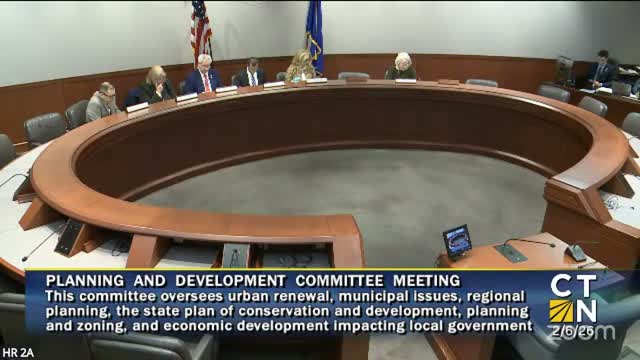
The Planning and Development Committee advanced Concept 4, a proposal authorizing municipalities to impose a commercial vacancy fee intended to incentivize re‑occupancy of long‑vacant commercial properties in downtown corridors.
Senator Gordon expressed reservations about taxing private property when owners are not violating health, safety or building codes, saying the question touches on property rights and private hardship: "it is their personal private property," he said. Representative Anthony Dubitsky said the fee, as he understands it, would "whack" owners for vacancies and could amount to a tax on those unable to afford repairs to rent out space.
The chair responded that the concept is narrowly intended to improve downtown main streets and would include provisions to avoid penalizing owners who can demonstrate active efforts to lease space or use short-term pop-ups. "If the owner can prove that they are trying to use the space ... there would be absolutely no vacancy fee penalty," the chair said.
Representative Haynes described a municipal redevelopment example in East Haddam Village to illustrate how local redevelopment delays can leave landlords unable to fill spaces and said a vacancy fee would be unfair to such landlords. Senator Rahman said he supported hearing the concept as a discussion item.
The committee took a roll-call vote to raise the concept for public hearing; the transcript records multiple yea and nay entries. The proposal will be drafted, and any final structure, exemptions and thresholds will depend on language produced and public testimony.
Senator Gordon expressed reservations about taxing private property when owners are not violating health, safety or building codes, saying the question touches on property rights and private hardship: "it is their personal private property," he said. Representative Anthony Dubitsky said the fee, as he understands it, would "whack" owners for vacancies and could amount to a tax on those unable to afford repairs to rent out space.
The chair responded that the concept is narrowly intended to improve downtown main streets and would include provisions to avoid penalizing owners who can demonstrate active efforts to lease space or use short-term pop-ups. "If the owner can prove that they are trying to use the space ... there would be absolutely no vacancy fee penalty," the chair said.
Representative Haynes described a municipal redevelopment example in East Haddam Village to illustrate how local redevelopment delays can leave landlords unable to fill spaces and said a vacancy fee would be unfair to such landlords. Senator Rahman said he supported hearing the concept as a discussion item.
The committee took a roll-call vote to raise the concept for public hearing; the transcript records multiple yea and nay entries. The proposal will be drafted, and any final structure, exemptions and thresholds will depend on language produced and public testimony.
Don't Miss a Word: See the Full Meeting!
Go beyond summaries. Unlock every video, transcript, and key insight with a Founder Membership.
✓
Get instant access to full meeting videos
✓
Search and clip any phrase from complete transcripts
✓
Receive AI-powered summaries & custom alerts
✓
Enjoy lifetime, unrestricted access to government data
30-day money-back guarantee
