Developer outlines Skybox data center plans for San Angelo, addresses water, noise and power concerns
February 20, 2026 | San Angelo, Tom Green County, Texas
This article was created by AI summarizing key points discussed. AI makes mistakes, so for full details and context, please refer to the video of the full meeting. Please report any errors so we can fix them. Report an error »
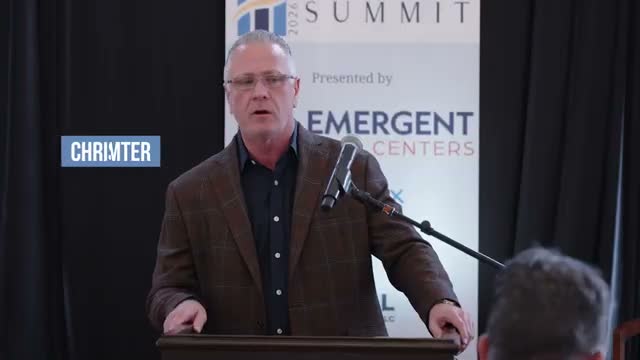
Emergent, the developer behind the proposed Skybox data center campus, told San Angelo leaders and residents on Saturday that the project would rely on closed‑loop cooling, produce limited exterior noise with modern equipment, and require significant grid upgrades before full buildout.
Mayor Tom Thompson opened the briefing and said the city has resolved zoning matters and is now focused on resource and community impacts. "My name is Tom Thompson, the mayor of the city of San Angelo," he said, and asked the developer to explain expected water usage and other impacts.
Representatives described the technical approach and community commitments. An Emergent representative said the company uses closed‑loop systems rather than open evaporative cooling: "Our 4 and a half million square feet will use about equal to what 12 homes uses annually." The developer added that closed‑loop systems require only occasional topping off and, in some cases, off‑site water trucks to fill initial makeup, and said modern dry‑cooler technology has reduced industry water demand compared with legacy designs.
On noise and backup power, Mayor Thompson asked for context and the developer provided decibel estimates and testing practices. The company said modern rooftop units commonly emit 55–60 dB and estimated that with all plant equipment running exterior levels could be "maybe between 65 and 70" dB; Mike Coleman, Emergent’s chief technical officer, said backup generators are typically run about "30 minutes a month" for testing, adding that permitted air‑quality run hours also limit operations.
Energy availability and transmission emerged as a central constraint. Jeremiah Collins, senior vice president for energy acquisition, described transmission as the most difficult infrastructure to fix, noting much of the grid is aging and that upgrades — coordinated with AEP and ERCOT — are necessary to deliver the large, continuous power loads data centers require. Collins said reliable 8,760‑hour‑a‑year power is essential for tenants and that transmission projects, not on‑site generation, present the longest lead times.
City leaders and the developer also discussed economic and workforce impacts. Mayor Thompson cited current municipal tax revenues and said construction activity could substantially boost sales and property tax receipts during buildout. Coleman said the largest near‑term employment impact is construction, estimating thousands of daily site workers during peak phases, while steady operations require a smaller but highly skilled electrical and mechanical technical workforce.
On the business model, Emergent described building a powered shell — walls, roof, transformers and the power capacity to support tenants — then leasing space to customers who specify IT equipment and density. "We're the owners, we're the builders, we're the operators," the developer said. The company said it often does speculative development but is typically in customer conversations by the time construction begins.
Mayor Thompson closed by saying the city will use a 380 agreement to record mutual obligations and protections and that the project now awaits moves from AEP and ERCOT before proceeding. He invited Emergent to return for additional public sessions to answer further technical and community questions.
Next steps: the developer and city will schedule follow‑up sessions and continue coordination with AEP and ERCOT on interconnection and transmission capacity. No formal votes or agreements were concluded at the briefing.
Mayor Tom Thompson opened the briefing and said the city has resolved zoning matters and is now focused on resource and community impacts. "My name is Tom Thompson, the mayor of the city of San Angelo," he said, and asked the developer to explain expected water usage and other impacts.
Representatives described the technical approach and community commitments. An Emergent representative said the company uses closed‑loop systems rather than open evaporative cooling: "Our 4 and a half million square feet will use about equal to what 12 homes uses annually." The developer added that closed‑loop systems require only occasional topping off and, in some cases, off‑site water trucks to fill initial makeup, and said modern dry‑cooler technology has reduced industry water demand compared with legacy designs.
On noise and backup power, Mayor Thompson asked for context and the developer provided decibel estimates and testing practices. The company said modern rooftop units commonly emit 55–60 dB and estimated that with all plant equipment running exterior levels could be "maybe between 65 and 70" dB; Mike Coleman, Emergent’s chief technical officer, said backup generators are typically run about "30 minutes a month" for testing, adding that permitted air‑quality run hours also limit operations.
Energy availability and transmission emerged as a central constraint. Jeremiah Collins, senior vice president for energy acquisition, described transmission as the most difficult infrastructure to fix, noting much of the grid is aging and that upgrades — coordinated with AEP and ERCOT — are necessary to deliver the large, continuous power loads data centers require. Collins said reliable 8,760‑hour‑a‑year power is essential for tenants and that transmission projects, not on‑site generation, present the longest lead times.
City leaders and the developer also discussed economic and workforce impacts. Mayor Thompson cited current municipal tax revenues and said construction activity could substantially boost sales and property tax receipts during buildout. Coleman said the largest near‑term employment impact is construction, estimating thousands of daily site workers during peak phases, while steady operations require a smaller but highly skilled electrical and mechanical technical workforce.
On the business model, Emergent described building a powered shell — walls, roof, transformers and the power capacity to support tenants — then leasing space to customers who specify IT equipment and density. "We're the owners, we're the builders, we're the operators," the developer said. The company said it often does speculative development but is typically in customer conversations by the time construction begins.
Mayor Thompson closed by saying the city will use a 380 agreement to record mutual obligations and protections and that the project now awaits moves from AEP and ERCOT before proceeding. He invited Emergent to return for additional public sessions to answer further technical and community questions.
Next steps: the developer and city will schedule follow‑up sessions and continue coordination with AEP and ERCOT on interconnection and transmission capacity. No formal votes or agreements were concluded at the briefing.
Don't Miss a Word: See the Full Meeting!
Go beyond summaries. Unlock every video, transcript, and key insight with a Founder Membership.
✓
Get instant access to full meeting videos
✓
Search and clip any phrase from complete transcripts
✓
Receive AI-powered summaries & custom alerts
✓
Enjoy lifetime, unrestricted access to government data
30-day money-back guarantee
