Public Works Board transfers $112,542 and awards $4.87 million to eight preconstruction projects
February 20, 2026 | Board Council Commission Agencies , Executive, Washington
This article was created by AI summarizing key points discussed. AI makes mistakes, so for full details and context, please refer to the video of the full meeting. Please report any errors so we can fix them. Report an error »
The Public Works Board voted Feb. 20 to transfer $112,542.49 from its emergency program to the preconstruction program and to approve conditional awards totaling $4,869,060 to eight preconstruction applications.
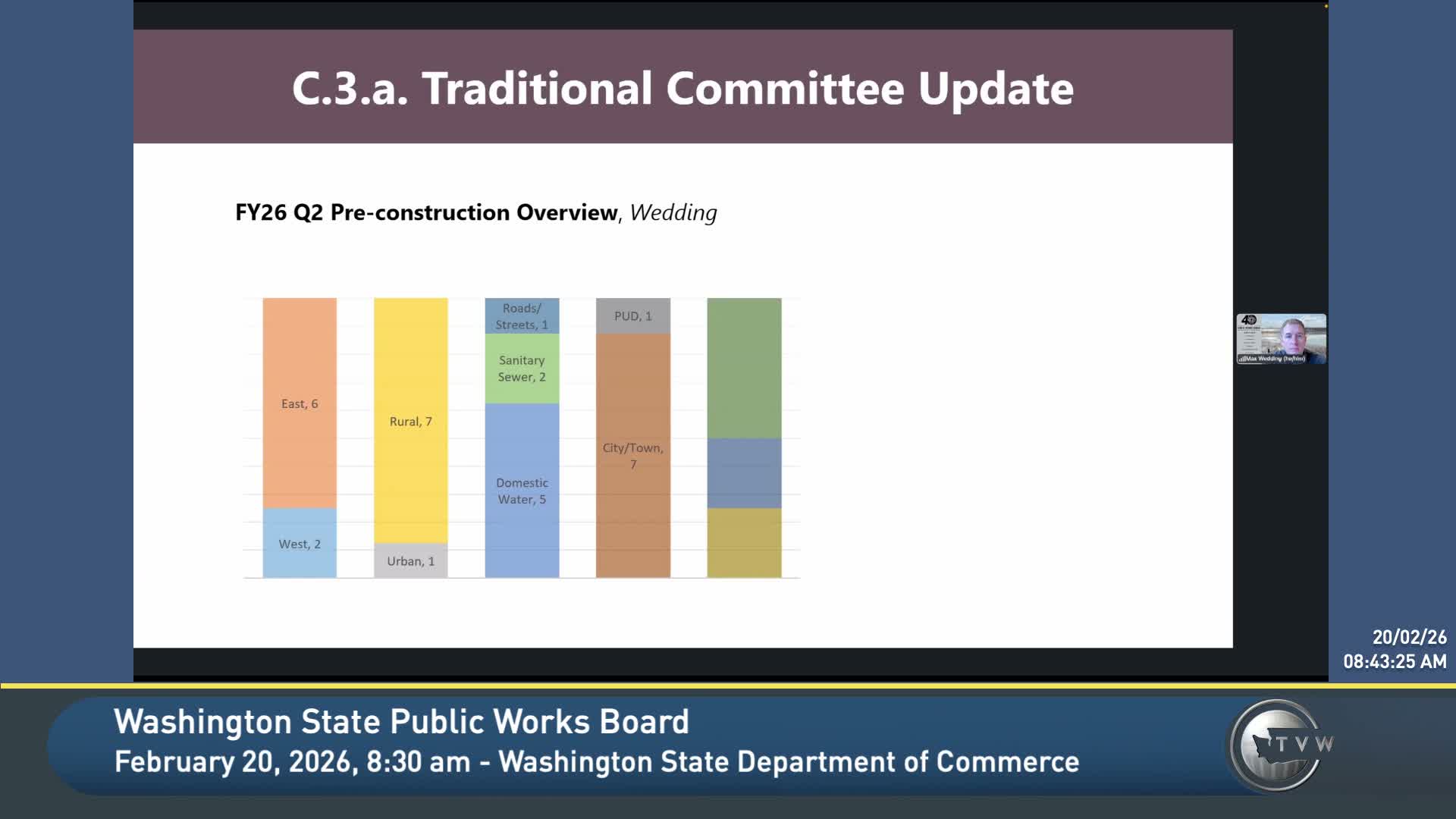
Max Wedding, programs manager for the board, told members that 11 preconstruction applications were submitted for this round, one application was found ineligible and two applicants had already received state revolving fund awards; staff recommended funding eight projects that met the minimum scoring threshold. "Out of those 11 applications, we're recommending 8 for award today," Wedding said during his presentation.
Member Justin Clary moved to transfer $112,542.49 from the emergency program to the preconstruction program; Micky Harnois seconded and the motion passed by voice vote. Later, the board voted to award $4,869,060 to the eight qualifying preconstruction applications after a staff recommendation; the motion was moved by Sharon Trask and seconded by Matt Zera Kaur.
Members and staff described the geographic spread of the awards and noted that most awards will serve Eastside jurisdictions and small domestic‑water systems. Wedding said the recommended awards bring fiscal‑year 2026 preconstruction awards to just under $8 million compared with an allocation of about $7.5 million for the cycle; he warned that funds shown today will largely exhaust the dedicated preconstruction allocation for FY26 but that two additional application windows remain, with the next application deadline on Feb. 27.
Several board members urged continued attention to equity in the funding process. Commissioner Laura Petsoe flagged what she called an "anomaly" in the hardship scoring: she said Wenatchee was listed as 'distressed' while nearby Entiat appeared as 'nondistressed' and asked that the hardship policy be reviewed at the May retreat. Vice Chair Gary Rowe raised broader concerns that statutory caps on assistance could prevent distressed communities from accessing grants, and he asked that the Traditional Committee examine whether the cap should be adjusted for preconstruction or emergency projects to improve access for severely distressed jurisdictions. "My concern is that the cap we've put on...has put on the funding for grama...is impacting those communities that are distressed," Rowe said.
Staff said the board has encouraged jurisdictions to continue applying even if the current preconstruction allocation appears depleted, so the board can better assess demand for additional resources and consider reallocations.
The board took the actions by voice vote and did not record a roll‑call tally for each member on the motions. The awards are conditional and were presented as part of today's agenda; staff noted projects already funded by other programs (SRF) will not receive duplicate funding from the board at this time.
Max Wedding, programs manager for the board, told members that 11 preconstruction applications were submitted for this round, one application was found ineligible and two applicants had already received state revolving fund awards; staff recommended funding eight projects that met the minimum scoring threshold. "Out of those 11 applications, we're recommending 8 for award today," Wedding said during his presentation.
Member Justin Clary moved to transfer $112,542.49 from the emergency program to the preconstruction program; Micky Harnois seconded and the motion passed by voice vote. Later, the board voted to award $4,869,060 to the eight qualifying preconstruction applications after a staff recommendation; the motion was moved by Sharon Trask and seconded by Matt Zera Kaur.
Members and staff described the geographic spread of the awards and noted that most awards will serve Eastside jurisdictions and small domestic‑water systems. Wedding said the recommended awards bring fiscal‑year 2026 preconstruction awards to just under $8 million compared with an allocation of about $7.5 million for the cycle; he warned that funds shown today will largely exhaust the dedicated preconstruction allocation for FY26 but that two additional application windows remain, with the next application deadline on Feb. 27.
Several board members urged continued attention to equity in the funding process. Commissioner Laura Petsoe flagged what she called an "anomaly" in the hardship scoring: she said Wenatchee was listed as 'distressed' while nearby Entiat appeared as 'nondistressed' and asked that the hardship policy be reviewed at the May retreat. Vice Chair Gary Rowe raised broader concerns that statutory caps on assistance could prevent distressed communities from accessing grants, and he asked that the Traditional Committee examine whether the cap should be adjusted for preconstruction or emergency projects to improve access for severely distressed jurisdictions. "My concern is that the cap we've put on...has put on the funding for grama...is impacting those communities that are distressed," Rowe said.
Staff said the board has encouraged jurisdictions to continue applying even if the current preconstruction allocation appears depleted, so the board can better assess demand for additional resources and consider reallocations.
The board took the actions by voice vote and did not record a roll‑call tally for each member on the motions. The awards are conditional and were presented as part of today's agenda; staff noted projects already funded by other programs (SRF) will not receive duplicate funding from the board at this time.
View the Full Meeting & All Its Details
This article offers just a summary. Unlock complete video, transcripts, and insights as a Founder Member.
✓
Watch full, unedited meeting videos
✓
Search every word spoken in unlimited transcripts
✓
AI summaries & real-time alerts (all government levels)
✓
Permanent access to expanding government content
30-day money-back guarantee
