Palos Park plan commission recommends village adopt comprehensive development code update with conditions
February 20, 2026 | Palos Park, Cook County, Illinois
This article was created by AI summarizing key points discussed. AI makes mistakes, so for full details and context, please refer to the video of the full meeting. Please report any errors so we can fix them. Report an error »
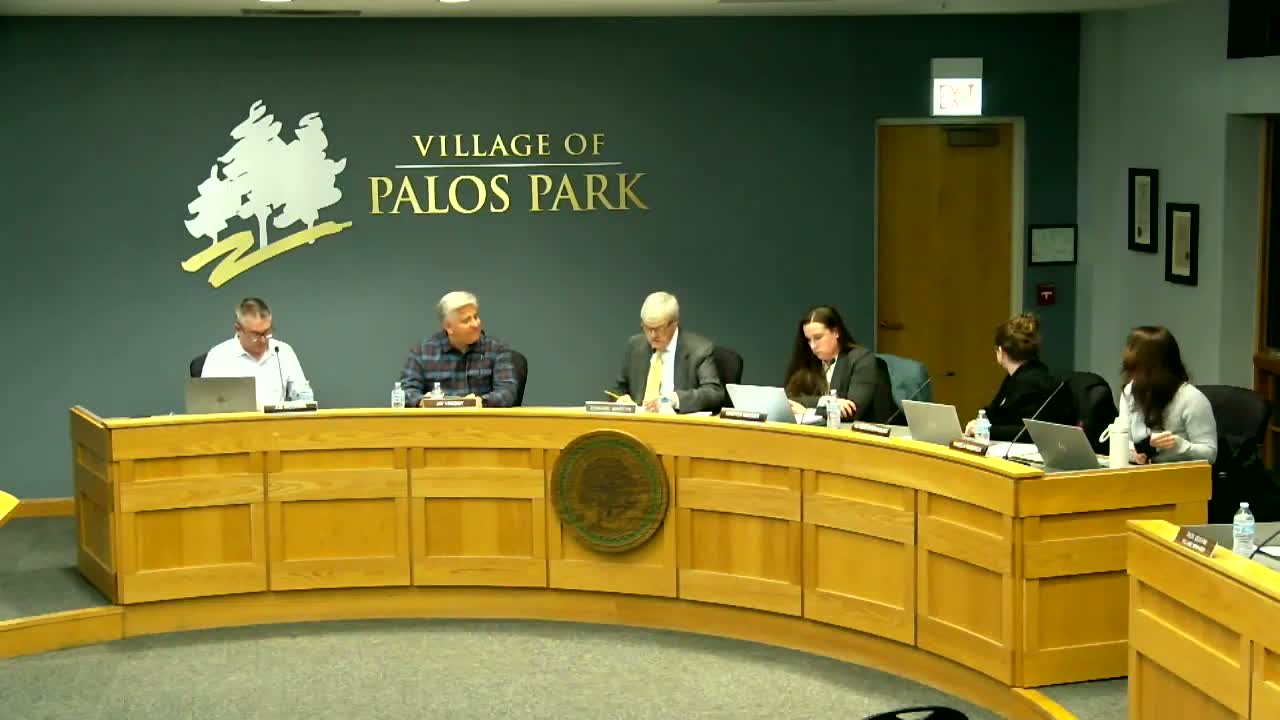
The Palos Park Plan Commission voted unanimously to recommend that the Village Council approve the January 2026 draft of a comprehensive development code update, conditioning the recommendation on revisions discussed at a continued public hearing and the consultant's memo. Commissioners approved the motion after public testimony on parking, legacy-lot standards, cemetery definitions and other policy questions.
The commission's recommendation covers a package of text changes to Part 12 of the village code and accompanying zoning-map edits. Staff read seven specific edits to be incorporated before the council review: clarifying that an integrated sculpture-and-fountain counts as a single front-yard feature; aligning legacy-lot interior side setbacks with R-1 standards (minimum 15 feet); increasing the cap for legacy-lot front-setback averaging to 50 feet and stating that new residential subdivisions without averaging would have a 50-foot front setback minimum; requiring two offset rows of shrubs to screen parking lots located across from residential uses; reverting certain map edits to restore existing M-1 (limited manufacturing) areas; and amending the cemetery definition to exclude crematoriums. The motion to recommend approval was made, seconded and carried by roll call with all commissioners voting yes.
During the hearing, the village consultant outlined additional draft edits: restoring the dwelling-unit total-floor-area measurement omitted from an earlier draft, clarifying accessory-structure thresholds for 600 square feet, keeping current M-1 standards in the redline draft, removing some uses from particular districts (for example daycare and social-service-center uses in some districts), splitting preschool and nursery definitions, updating parking and loading requirements, and adding a limited residential minimum dwelling-unit floor area of 1,500 square feet for legacy lots in the draft.
Residents and committee members pressed the commission on process and impacts. Lisa Gibbs, who identified herself as a member of the zoning board, thanked the commission for several revisions but urged a more methodical, page-by-page comparison between the existing code and the new draft. "We were provided no language comparison between the current code we were operating under and this first draft," Gibbs said, adding that the document's size (164 pages in the redline) made a comprehensive review difficult. Gibbs also raised recurring parking problems around the Palos Islamic Center, telling the commission, "Every single week it's happening," and urging clearer protections for nearby residents.
Several speakers, including attorney Ronette Lille McCarthy, asked the commission to explain why new uses such as "amusement facility, indoor/outdoor" were added and in which districts they would be allowed. The village consultant responded that the drafting process began in 2023 and included a technical report and internal iterations, and said the draft was intended to reflect Palos Park needs rather than be a generic template. "It was not done in a boiler plate," the consultant told the room, adding that edits (including limiting roof-mounted turbines to institutional properties) were made as the process progressed.
On parking, staff and the village attorney repeatedly clarified the distinction between zoning requirements and operational/enforcement issues: zoning sets the required on-site parking for future uses and standards for how parking must be located; overflow or privately arranged off-site parking is generally an enforcement or private agreement issue, not a zoning-code issue. The commission and staff noted that existing approvals and past determinations remain grandfathered and cannot be retroactively altered by the code rewrite.
Commissioners emphasized that the recommendation to council incorporates the changes agreed to at the hearing and the consultant's memo and asked staff to prepare a clear public-facing summary showing what is new versus what remains from the existing code. The case will move to the Village Council for final consideration under the normal ordinance/adoption process.
Meeting participants and staff identified several technical figures during the hearing: the draft's proposed legacy-lot minimum dwelling size of 1,500 square feet (versus the present 2,200-square-foot standard cited by commenters); a referenced rebuild-permit application window of 18 months for certain nonconforming two-family and single-family lots (previously one year); landscape-planting recommendations noting standard shrub install heights of about 18 inches versus taller plantings that yield earlier screening; and the consultant's note that some townhouse/multifamily standards permit off-site parking located up to 300 feet from a principal building, while nonresidential uses generally must provide parking on the same lot.
The commission closed the public hearing, made the recommendation to the Village Council (motion read into the record and seconded), and recorded a unanimous roll-call vote in favor. The meeting adjourned after the vote.
The January 2026 draft, the consultant's memo (dated 01/13/2026) and the packeted motion language will be forwarded to the Village Council; staff said they will prepare clear comparison materials and incorporate the agreed edits before council consideration.
The commission's recommendation covers a package of text changes to Part 12 of the village code and accompanying zoning-map edits. Staff read seven specific edits to be incorporated before the council review: clarifying that an integrated sculpture-and-fountain counts as a single front-yard feature; aligning legacy-lot interior side setbacks with R-1 standards (minimum 15 feet); increasing the cap for legacy-lot front-setback averaging to 50 feet and stating that new residential subdivisions without averaging would have a 50-foot front setback minimum; requiring two offset rows of shrubs to screen parking lots located across from residential uses; reverting certain map edits to restore existing M-1 (limited manufacturing) areas; and amending the cemetery definition to exclude crematoriums. The motion to recommend approval was made, seconded and carried by roll call with all commissioners voting yes.
During the hearing, the village consultant outlined additional draft edits: restoring the dwelling-unit total-floor-area measurement omitted from an earlier draft, clarifying accessory-structure thresholds for 600 square feet, keeping current M-1 standards in the redline draft, removing some uses from particular districts (for example daycare and social-service-center uses in some districts), splitting preschool and nursery definitions, updating parking and loading requirements, and adding a limited residential minimum dwelling-unit floor area of 1,500 square feet for legacy lots in the draft.
Residents and committee members pressed the commission on process and impacts. Lisa Gibbs, who identified herself as a member of the zoning board, thanked the commission for several revisions but urged a more methodical, page-by-page comparison between the existing code and the new draft. "We were provided no language comparison between the current code we were operating under and this first draft," Gibbs said, adding that the document's size (164 pages in the redline) made a comprehensive review difficult. Gibbs also raised recurring parking problems around the Palos Islamic Center, telling the commission, "Every single week it's happening," and urging clearer protections for nearby residents.
Several speakers, including attorney Ronette Lille McCarthy, asked the commission to explain why new uses such as "amusement facility, indoor/outdoor" were added and in which districts they would be allowed. The village consultant responded that the drafting process began in 2023 and included a technical report and internal iterations, and said the draft was intended to reflect Palos Park needs rather than be a generic template. "It was not done in a boiler plate," the consultant told the room, adding that edits (including limiting roof-mounted turbines to institutional properties) were made as the process progressed.
On parking, staff and the village attorney repeatedly clarified the distinction between zoning requirements and operational/enforcement issues: zoning sets the required on-site parking for future uses and standards for how parking must be located; overflow or privately arranged off-site parking is generally an enforcement or private agreement issue, not a zoning-code issue. The commission and staff noted that existing approvals and past determinations remain grandfathered and cannot be retroactively altered by the code rewrite.
Commissioners emphasized that the recommendation to council incorporates the changes agreed to at the hearing and the consultant's memo and asked staff to prepare a clear public-facing summary showing what is new versus what remains from the existing code. The case will move to the Village Council for final consideration under the normal ordinance/adoption process.
Meeting participants and staff identified several technical figures during the hearing: the draft's proposed legacy-lot minimum dwelling size of 1,500 square feet (versus the present 2,200-square-foot standard cited by commenters); a referenced rebuild-permit application window of 18 months for certain nonconforming two-family and single-family lots (previously one year); landscape-planting recommendations noting standard shrub install heights of about 18 inches versus taller plantings that yield earlier screening; and the consultant's note that some townhouse/multifamily standards permit off-site parking located up to 300 feet from a principal building, while nonresidential uses generally must provide parking on the same lot.
The commission closed the public hearing, made the recommendation to the Village Council (motion read into the record and seconded), and recorded a unanimous roll-call vote in favor. The meeting adjourned after the vote.
The January 2026 draft, the consultant's memo (dated 01/13/2026) and the packeted motion language will be forwarded to the Village Council; staff said they will prepare clear comparison materials and incorporate the agreed edits before council consideration.
View the Full Meeting & All Its Details
This article offers just a summary. Unlock complete video, transcripts, and insights as a Founder Member.
✓
Watch full, unedited meeting videos
✓
Search every word spoken in unlimited transcripts
✓
AI summaries & real-time alerts (all government levels)
✓
Permanent access to expanding government content
30-day money-back guarantee
