Committee defers bill that would let planning-review experience qualify applicants to sit for engineering exam
February 20, 2026 | House Committee on Education, House of Representatives, Legislative , Hawaii
This article was created by AI summarizing key points discussed. AI makes mistakes, so for full details and context, please refer to the video of the full meeting. Please report any errors so we can fix them. Report an error »
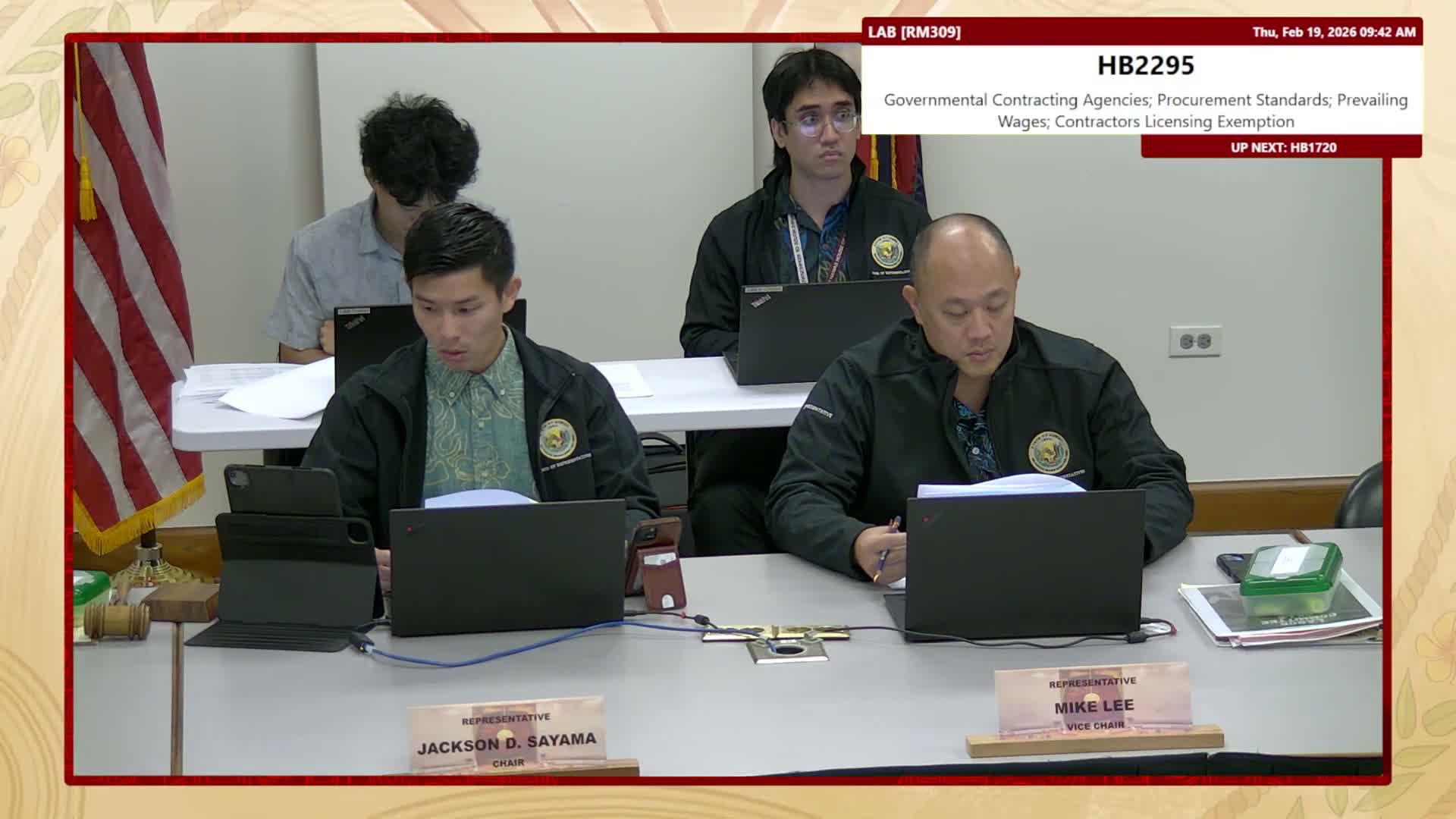
The House Committee on Labor deferred HB 1720 on Feb. 19 after extensive testimony and follow-up questioning about whether planning-review work performed by municipal permitting staff should count toward professional-engineer licensure.
Supporters from the City and County of Honolulu’s Department of Planning and Permitting told the committee that DPP engineers regularly perform plan review for projects such as affordable housing and face severe recruitment and retention challenges. A DPP representative said the change "qualifies as experience" and would allow those employees "to sit for the exam," arguing the measure would speed project reviews and help address a staffing crisis.
Opponents included the American Council of Engineering Companies and the state board that licenses engineers, architects, surveyors and landscape architects. Sandy Wong of ACEC told the committee the group provided written testimony in opposition and warned the bill "will lower the standards for licensing of engineers" and could jeopardize interstate reciprocity. Eli Lane, executive officer for the licensing board, described the board’s standard licensure pillars—education, experience and exam—and said plan review has historically been accepted only as partial experience, not as a full substitute for hands-on design and supervision experience.
Committee members pressed both sides on the practical differences in experience. Lane explained that applicants without engineering degrees may rely on a 12-year experience pathway emphasizing hands-on design and supervision; DPP representatives argued plan-review experience is a distinct but qualifying form of practice that should at least allow employees to sit for the professional exam even if they must still meet other licensing requirements.
After the exchange the committee deferred the bill, with the chair noting concerns about scope and whether planning-review qualifications meet the professional standard, and urging agencies to continue recruitment and retention efforts.
The bill was discussed in testimony beginning in the morning hearing and the committee recorded the defer motion during decision making.
Supporters from the City and County of Honolulu’s Department of Planning and Permitting told the committee that DPP engineers regularly perform plan review for projects such as affordable housing and face severe recruitment and retention challenges. A DPP representative said the change "qualifies as experience" and would allow those employees "to sit for the exam," arguing the measure would speed project reviews and help address a staffing crisis.
Opponents included the American Council of Engineering Companies and the state board that licenses engineers, architects, surveyors and landscape architects. Sandy Wong of ACEC told the committee the group provided written testimony in opposition and warned the bill "will lower the standards for licensing of engineers" and could jeopardize interstate reciprocity. Eli Lane, executive officer for the licensing board, described the board’s standard licensure pillars—education, experience and exam—and said plan review has historically been accepted only as partial experience, not as a full substitute for hands-on design and supervision experience.
Committee members pressed both sides on the practical differences in experience. Lane explained that applicants without engineering degrees may rely on a 12-year experience pathway emphasizing hands-on design and supervision; DPP representatives argued plan-review experience is a distinct but qualifying form of practice that should at least allow employees to sit for the professional exam even if they must still meet other licensing requirements.
After the exchange the committee deferred the bill, with the chair noting concerns about scope and whether planning-review qualifications meet the professional standard, and urging agencies to continue recruitment and retention efforts.
The bill was discussed in testimony beginning in the morning hearing and the committee recorded the defer motion during decision making.
Don't Miss a Word: See the Full Meeting!
Go beyond summaries. Unlock every video, transcript, and key insight with a Founder Membership.
✓
Get instant access to full meeting videos
✓
Search and clip any phrase from complete transcripts
✓
Receive AI-powered summaries & custom alerts
✓
Enjoy lifetime, unrestricted access to government data
30-day money-back guarantee
