House Judiciary Committee hears testimony on H.385 to create forced‑debt protections for survivors
February 20, 2026 | Judiciary, HOUSE OF REPRESENTATIVES, Committees, Legislative , Vermont
This article was created by AI summarizing key points discussed. AI makes mistakes, so for full details and context, please refer to the video of the full meeting. Please report any errors so we can fix them. Report an error »
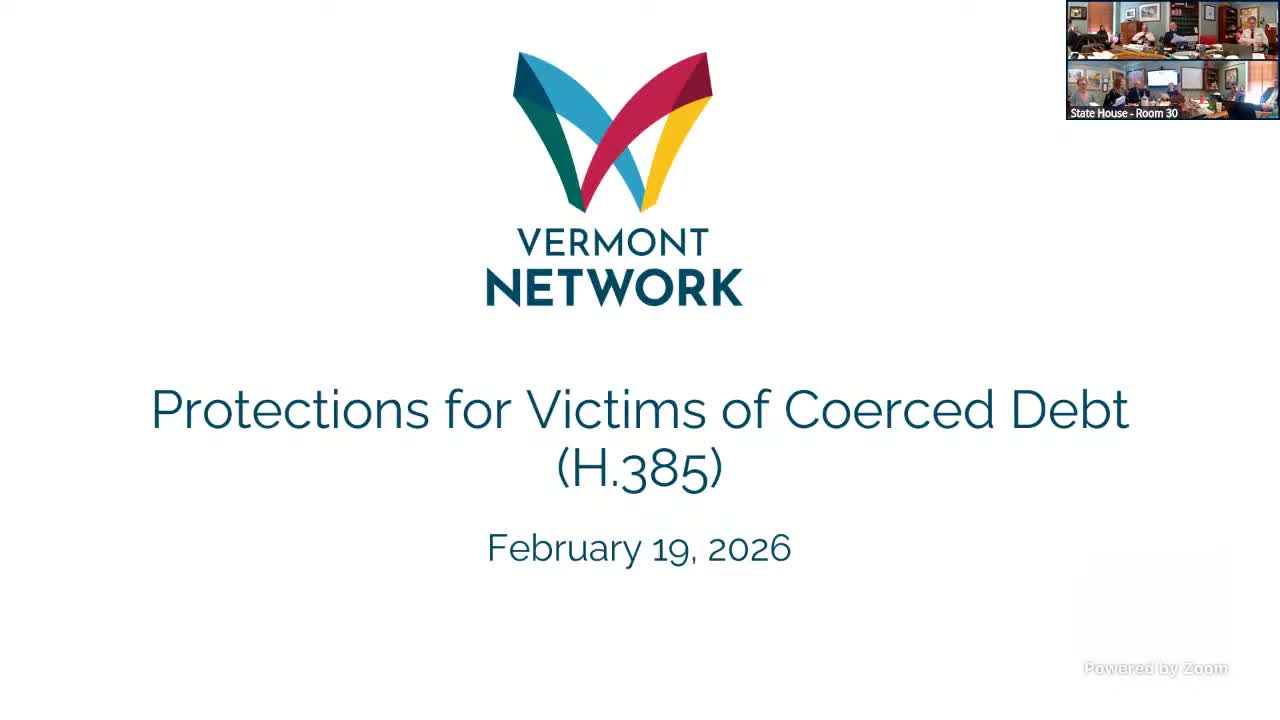
Arlie Glisserman, policy director at the Vermont Network Against Domestic and Sexual Violence, told the House Judiciary Committee on Feb. 19 that H.385 aims to give survivors clearer, accessible relief from what the bill calls coerced or ‘forced’ debt. "We need comprehensive, clear, and accessible protections for victims of forced debt," Glisserman said, arguing the harm often stems from intimate‑partner abuse rather than the stranger‑based fraud addressed by existing laws.
Glisserman described how financial abuse—restricted access to accounts, coerced cosigning and use of a survivor’s credit—can trap people in unsafe housing and limit employment and education prospects. She gave two detailed examples: a survivor who was coerced to cosign an auto loan and later found her credit so damaged she could not secure housing repairs or move to safety, and another who estimated more than $15,000 in coerced credit‑card debt, requiring high‑cost borrowing to cover basic needs.
The witness outlined the bill’s proposed relief process: public notice and screening, a written statement describing the forced debt and supporting documentation (credit reports, police reports or third‑party certification), and a built‑in avenue for creditors to challenge claims in court. Glisserman stressed the statute’s design seeks to avoid forcing survivors to file suit to obtain relief and noted lessons learned from other states: "Even the most accessible forced‑debt relief process is realistically not going to be accessible for many survivors. For the survivors who can access it, it can be transformative." She cited a recent pilot in the Dallas–Fort Worth region that logged 111 referrals, 38 potential forced‑debt cases and services for 19 survivors; most forced debts in that pilot were in the $3,000–$4,000 range.
Committee members pressed drafters on language in the draft (page 17, lines 5–8) that uses the word "discovered" as a trigger for creditor action if a perpetrator’s identity becomes known. Members asked whether that wording would permit creditors to actively investigate or "go find" an identified perpetrator after a court process ends, and whether the bill should bar such searches where a court has withheld identifying information for safety. Glisserman said the intent is that creditor remedies apply only when a victim volunteers a perpetrator’s name or a court orders disclosure; she asked drafters to consider clarifying amendments if the committee shares safety concerns.
Tom, identified as a chief superior judge, testified on judicial implications and urged the committee to clarify definitions and procedural standards. He warned the bill, as written, could sweep pending collection actions into the coerced‑debt category and recommended explicitly excluding "pending actions" or otherwise defining the boundary so the statute does not unintentionally interfere with ongoing litigation. The judge also said a statutory provision that courts "take reasonable and appropriate measures to protect the debtor" provides no standards and will likely create litigation over judicial authority and the proper balancing of safety and public access to records.
On timing and limitations, the judge discussed the statute‑of‑limitations question tied to the word "discovered," noting that "discovered" is a recognized legal phrase for limitation triggers and suggesting definitional clarity—such as using a creditor’s written acknowledgment or a court’s definitive order as an affirmative start date—would reduce future disputes. He also raised confidentiality and public‑records concerns if identifying information is sealed, asking whether creditor searches (including online or data‑aggregation techniques) would constitute improper disclosure.
Members and witnesses identified several drafting decisions for follow‑up: whether courts should be given explicit guidance or standards for what protective measures to order; whether the statute should limit a creditor’s ability to locate a perpetrator outside court processes; and how to define and document qualified third‑party professionals who can certify forced‑debt statements (witnesses said local crisis‑work organizations would generally qualify).
The committee scheduled additional follow‑up with other witnesses, including Chris Delia, and agreed to reconvene the next morning to continue consideration of H.385. The hearing adjourned until the following day.
Glisserman described how financial abuse—restricted access to accounts, coerced cosigning and use of a survivor’s credit—can trap people in unsafe housing and limit employment and education prospects. She gave two detailed examples: a survivor who was coerced to cosign an auto loan and later found her credit so damaged she could not secure housing repairs or move to safety, and another who estimated more than $15,000 in coerced credit‑card debt, requiring high‑cost borrowing to cover basic needs.
The witness outlined the bill’s proposed relief process: public notice and screening, a written statement describing the forced debt and supporting documentation (credit reports, police reports or third‑party certification), and a built‑in avenue for creditors to challenge claims in court. Glisserman stressed the statute’s design seeks to avoid forcing survivors to file suit to obtain relief and noted lessons learned from other states: "Even the most accessible forced‑debt relief process is realistically not going to be accessible for many survivors. For the survivors who can access it, it can be transformative." She cited a recent pilot in the Dallas–Fort Worth region that logged 111 referrals, 38 potential forced‑debt cases and services for 19 survivors; most forced debts in that pilot were in the $3,000–$4,000 range.
Committee members pressed drafters on language in the draft (page 17, lines 5–8) that uses the word "discovered" as a trigger for creditor action if a perpetrator’s identity becomes known. Members asked whether that wording would permit creditors to actively investigate or "go find" an identified perpetrator after a court process ends, and whether the bill should bar such searches where a court has withheld identifying information for safety. Glisserman said the intent is that creditor remedies apply only when a victim volunteers a perpetrator’s name or a court orders disclosure; she asked drafters to consider clarifying amendments if the committee shares safety concerns.
Tom, identified as a chief superior judge, testified on judicial implications and urged the committee to clarify definitions and procedural standards. He warned the bill, as written, could sweep pending collection actions into the coerced‑debt category and recommended explicitly excluding "pending actions" or otherwise defining the boundary so the statute does not unintentionally interfere with ongoing litigation. The judge also said a statutory provision that courts "take reasonable and appropriate measures to protect the debtor" provides no standards and will likely create litigation over judicial authority and the proper balancing of safety and public access to records.
On timing and limitations, the judge discussed the statute‑of‑limitations question tied to the word "discovered," noting that "discovered" is a recognized legal phrase for limitation triggers and suggesting definitional clarity—such as using a creditor’s written acknowledgment or a court’s definitive order as an affirmative start date—would reduce future disputes. He also raised confidentiality and public‑records concerns if identifying information is sealed, asking whether creditor searches (including online or data‑aggregation techniques) would constitute improper disclosure.
Members and witnesses identified several drafting decisions for follow‑up: whether courts should be given explicit guidance or standards for what protective measures to order; whether the statute should limit a creditor’s ability to locate a perpetrator outside court processes; and how to define and document qualified third‑party professionals who can certify forced‑debt statements (witnesses said local crisis‑work organizations would generally qualify).
The committee scheduled additional follow‑up with other witnesses, including Chris Delia, and agreed to reconvene the next morning to continue consideration of H.385. The hearing adjourned until the following day.
View the Full Meeting & All Its Details
This article offers just a summary. Unlock complete video, transcripts, and insights as a Founder Member.
✓
Watch full, unedited meeting videos
✓
Search every word spoken in unlimited transcripts
✓
AI summaries & real-time alerts (all government levels)
✓
Permanent access to expanding government content
30-day money-back guarantee
