Pleasanton council accepts midyear budget update as long‑term forecast shows recurring $6M–$10M shortfalls
February 18, 2026 | Pleasanton , Alameda County, California
This article was created by AI summarizing key points discussed. AI makes mistakes, so for full details and context, please refer to the video of the full meeting. Please report any errors so we can fix them. Report an error »
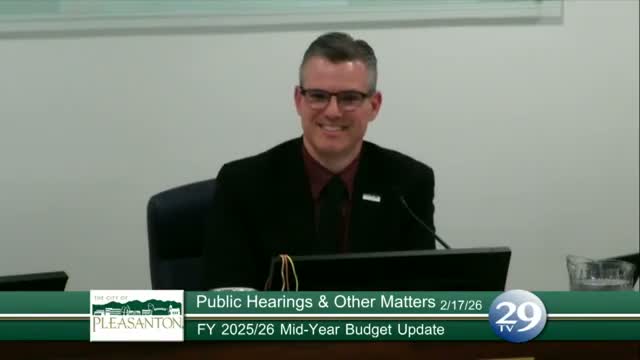
Pleasanton — The City Council on Feb. 17 accepted a midyear update to the fiscal year 2025–26 budget and a 10‑year financial forecast that projects a slim surplus this year but recurring structural shortfalls in the near term.
Susan, a city finance staff member presenting the report, told the council that “the general fund is projected to have a small surplus of a 23,000 at the end of the fiscal year.” The presentation showed revenues and expenditures edging lower than previous projections and identified drivers including lower property‑tax receipts (largely tied to assessment appeals), weaker sales tax, and changing development timing.
Councilmembers and staff focused on longer‑term pressures. Staff projected operating deficits beyond fiscal year 2027 of about $6 million to $10 million annually under the baseline scenario. The presentation also reiterated results from the city’s asset‑management work: the consultant estimated roughly $63 million per year of replacement needs for support assets, while Pleasanton’s current contributions and restricted funds total about $19 million, leaving an annual funding gap staff described as $44 million.
Why it matters: The forecast frames policy choices the council faces as it balances service levels, infrastructure needs and ratepayer impacts. Staff presented four scenarios — baseline, recession, hotel tax increase (TOT), and a development‑revenue scenario — and cautioned that the development scenario is “very optimistic” because project timing is uncertain and one‑time revenues can be volatile.
Council members pressed staff on assumptions and next steps. Topics included the treatment of one‑time revenues, how property‑tax appeals affect estimates, and pension cost projections tied to CalPERS. Staff said the planned $1,000,000 withdrawal from the pension trust fund is no longer needed this budget year because of expenditure savings and a higher contribution from the capital reserve; they also noted pension obligations will continue to fluctuate with CalPERS investment performance.
The council approved the midyear update and the proposed budget amendments by roll call vote. Staff said they will return in the coming months with a pension strategy, a broader engagement plan for the FY2027–29 budget cycle and additional detail on funding options for the city’s asset‑management plan.
What’s next: Staff plans to present the pension strategy and a budget engagement plan to the council in March and April and to continue work on the asset‑management funding plan and organizational assessment. The council may consider revenue measures such as a hotel tax in future actions.
Susan, a city finance staff member presenting the report, told the council that “the general fund is projected to have a small surplus of a 23,000 at the end of the fiscal year.” The presentation showed revenues and expenditures edging lower than previous projections and identified drivers including lower property‑tax receipts (largely tied to assessment appeals), weaker sales tax, and changing development timing.
Councilmembers and staff focused on longer‑term pressures. Staff projected operating deficits beyond fiscal year 2027 of about $6 million to $10 million annually under the baseline scenario. The presentation also reiterated results from the city’s asset‑management work: the consultant estimated roughly $63 million per year of replacement needs for support assets, while Pleasanton’s current contributions and restricted funds total about $19 million, leaving an annual funding gap staff described as $44 million.
Why it matters: The forecast frames policy choices the council faces as it balances service levels, infrastructure needs and ratepayer impacts. Staff presented four scenarios — baseline, recession, hotel tax increase (TOT), and a development‑revenue scenario — and cautioned that the development scenario is “very optimistic” because project timing is uncertain and one‑time revenues can be volatile.
Council members pressed staff on assumptions and next steps. Topics included the treatment of one‑time revenues, how property‑tax appeals affect estimates, and pension cost projections tied to CalPERS. Staff said the planned $1,000,000 withdrawal from the pension trust fund is no longer needed this budget year because of expenditure savings and a higher contribution from the capital reserve; they also noted pension obligations will continue to fluctuate with CalPERS investment performance.
The council approved the midyear update and the proposed budget amendments by roll call vote. Staff said they will return in the coming months with a pension strategy, a broader engagement plan for the FY2027–29 budget cycle and additional detail on funding options for the city’s asset‑management plan.
What’s next: Staff plans to present the pension strategy and a budget engagement plan to the council in March and April and to continue work on the asset‑management funding plan and organizational assessment. The council may consider revenue measures such as a hotel tax in future actions.
View the Full Meeting & All Its Details
This article offers just a summary. Unlock complete video, transcripts, and insights as a Founder Member.
✓
Watch full, unedited meeting videos
✓
Search every word spoken in unlimited transcripts
✓
AI summaries & real-time alerts (all government levels)
✓
Permanent access to expanding government content
30-day money-back guarantee
