Senate committee advances coral reef resilience bill after debate over mandates and metrics
February 14, 2026 | Senate, Legislative , Hawaii
This article was created by AI summarizing key points discussed. AI makes mistakes, so for full details and context, please refer to the video of the full meeting. Please report any errors so we can fix them. Report an error »
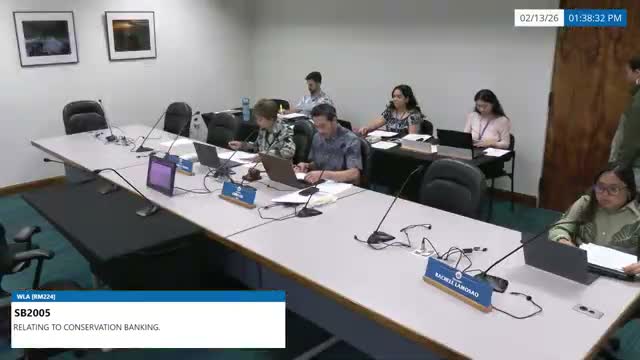
Chair of the Senate Committee on Water, Land, Culture and the Arts on Monday moved SB 3201 — a bill to formalize science-based performance metrics for coral-reef resilience — forward with amendments after extensive testimony from state scientists, conservation groups and retired federal researchers.
Proponents including Angela Melody Young of CARES said the measure would move reef management from general goals to "legally binding science-based performance metrics," and cited targets in the bill text for at least 80% of natural biomass and 25% live coral cover. Randall Kosaki, a recently retired NOAA research coordinator, said his research and that of colleagues shows "a precipitous decline in our coral reef resources" and warned a major bleaching event is overdue.
DAR administrator Bridal Nielsen told the committee the department "appreciate[s] the intent of this bill, but do offer some comments," and cautioned that some key drivers of coral health — such as large-scale climate and emissions changes and other stressors outside DAR’s jurisdiction — make strict statutory thresholds difficult to mandate. During Q&A, members and witnesses identified a drafting error: the bill as written appeared to require restoration to specific percentages by 2027; staff clarified and the committee agreed to amend the language so DAR must instead develop a plan by the stated deadline rather than immediately reach the metrics.
Committee amendments adopted at decision-making blanked out the fixed percentage goals and fixed the timing language in section 5 to require DAR to develop actionable plans, not to achieve all benchmarks by the near-term date. The chair said the intent is to allow DAR flexibility to implement site-specific monitoring, restoration and community-based actions while reporting plans and progress to the Legislature.
The committee vote recorded the measure as passed with amendments and will send the revised bill to the next committee (Ways and Means or the appropriate next stop). The committee also discussed pilot restoration projects, monitoring approaches (fish biomass, coral cover, water quality and community monitoring) and the need to pair restoration with watershed and water-quality improvements.
The next procedural step is committee reporting with the adopted amendments and referral to the next committee for fiscal or further policy consideration.
Proponents including Angela Melody Young of CARES said the measure would move reef management from general goals to "legally binding science-based performance metrics," and cited targets in the bill text for at least 80% of natural biomass and 25% live coral cover. Randall Kosaki, a recently retired NOAA research coordinator, said his research and that of colleagues shows "a precipitous decline in our coral reef resources" and warned a major bleaching event is overdue.
DAR administrator Bridal Nielsen told the committee the department "appreciate[s] the intent of this bill, but do offer some comments," and cautioned that some key drivers of coral health — such as large-scale climate and emissions changes and other stressors outside DAR’s jurisdiction — make strict statutory thresholds difficult to mandate. During Q&A, members and witnesses identified a drafting error: the bill as written appeared to require restoration to specific percentages by 2027; staff clarified and the committee agreed to amend the language so DAR must instead develop a plan by the stated deadline rather than immediately reach the metrics.
Committee amendments adopted at decision-making blanked out the fixed percentage goals and fixed the timing language in section 5 to require DAR to develop actionable plans, not to achieve all benchmarks by the near-term date. The chair said the intent is to allow DAR flexibility to implement site-specific monitoring, restoration and community-based actions while reporting plans and progress to the Legislature.
The committee vote recorded the measure as passed with amendments and will send the revised bill to the next committee (Ways and Means or the appropriate next stop). The committee also discussed pilot restoration projects, monitoring approaches (fish biomass, coral cover, water quality and community monitoring) and the need to pair restoration with watershed and water-quality improvements.
The next procedural step is committee reporting with the adopted amendments and referral to the next committee for fiscal or further policy consideration.
View the Full Meeting & All Its Details
This article offers just a summary. Unlock complete video, transcripts, and insights as a Founder Member.
✓
Watch full, unedited meeting videos
✓
Search every word spoken in unlimited transcripts
✓
AI summaries & real-time alerts (all government levels)
✓
Permanent access to expanding government content
30-day money-back guarantee
