Judiciary committee advances a slate of bills, passes several with amendments and defers a handful for more work
February 14, 2026 | Senate, Legislative , Hawaii
This article was created by AI summarizing key points discussed. AI makes mistakes, so for full details and context, please refer to the video of the full meeting. Please report any errors so we can fix them. Report an error »
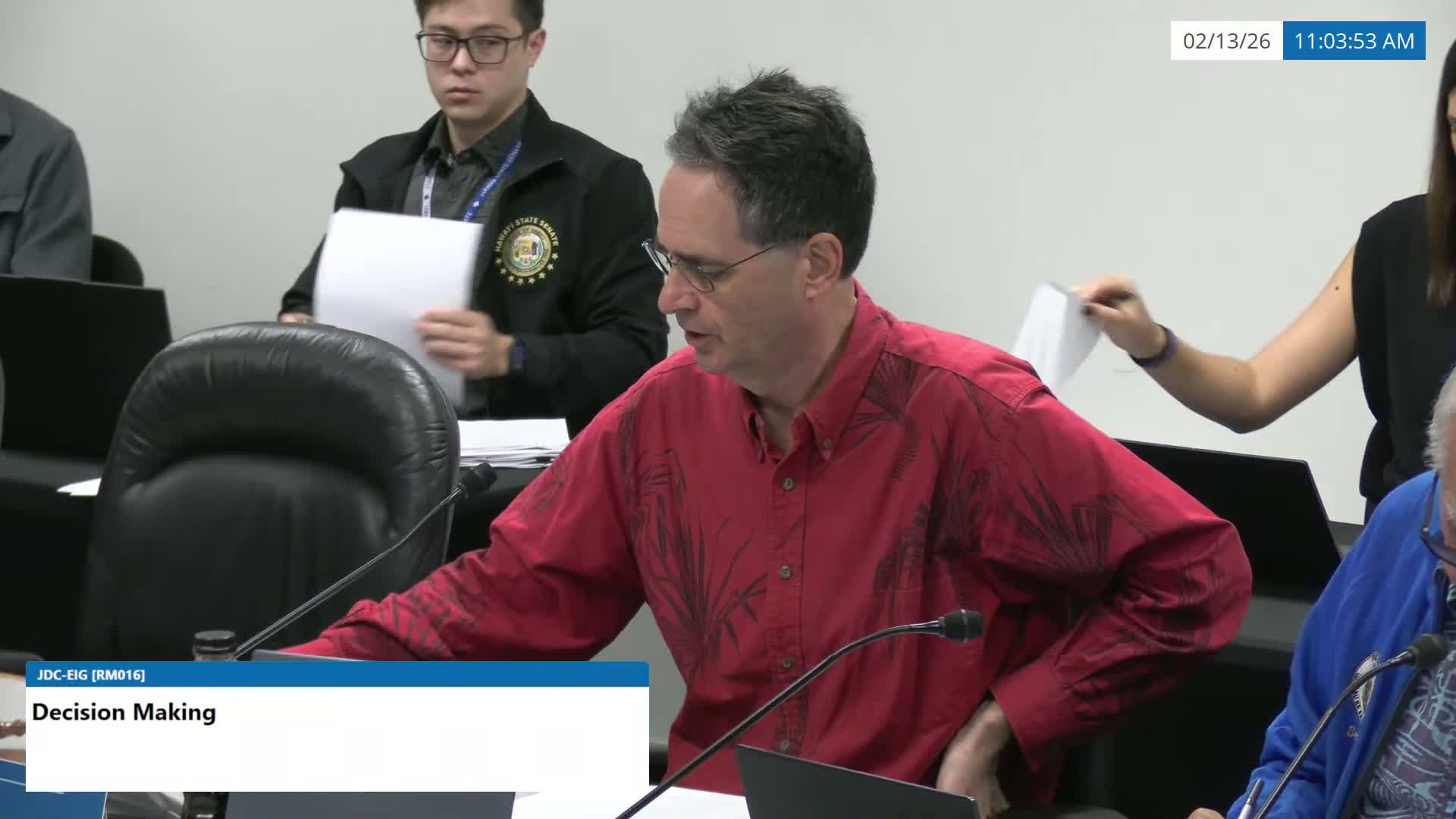
After a long hearing, the Senate Judiciary Committee returned to its 09:00 agenda for decision-making and took action on a series of bills it had heard earlier in the session.
Key committee actions included:
- SB2246 (financial disclosure expansion): Chair recommended and the committee adopted a motion to pass with technical amendments and the Ethics Commission's clarifying language that the requirement applies to board/commission members rather than all employees.
- SB2250 (promotion of controlled substances near homeless facilities): Committee adopted the chair's recommendation to pass with amendments (see article on SB2250 for debate summary).
- SB2325 (juvenile sentence review): Committee voted to pass with amendments that change the initial review timing from 15 to 12 years and place any post-release supervision under parole frameworks.
- SB2418 (paraphernalia repeal): Committee deferred decision-making to allow further consultation between law enforcement and public-health stakeholders.
- SB2447 (campaign-finance statute of limitations): Committee accepted an amendment to preserve a five-year limitation but start the clock at the date of discovery by the Campaign Spending Commission, and voted to pass with those amendments.
- SB2454 (campaign contribution deposit timing): Committee passed the bill with a savings clause and explanatory committee-report language clarifying deposit-date practices.
- SB2466 (employment protection for chief elections officer): Committee passed the bill as is, extending protections after a standard probationary period so the chief may only be terminated for cause.
- SB2480 (open/top-two primary): Committee voted to pass with conforming amendments and set a defective effective date; staff will conform HRS 12-31 accordingly.
- SB2499 (process for filling vacancies): Committee passed the bill as is.
- SB2565 (fixed Supreme Court disposition deadline): Committee passed the bill as is.
- SB2566 (domestic-abuse petition record withholding): Committee passed the bill as is.
- SB2568 (harassment enhancements): Committee deferred to allow more time to consider scope and First Amendment issues.
- SB2661 (nepotism): Committee deferred to allow refinement and clarification of whether legislative employees vs. legislators would be covered; Ethics Commission recommended explicit language if legislators were to be included.
The chair announced follow-up dates for several deferred items and closed the hearing.
What happens next: bills that passed will proceed to the next legislative stage with committee report language and, where applicable, the staff-drafted technical amendments. Deferred items were scheduled for a follow-up decision meeting to resolve drafting concerns.
Key committee actions included:
- SB2246 (financial disclosure expansion): Chair recommended and the committee adopted a motion to pass with technical amendments and the Ethics Commission's clarifying language that the requirement applies to board/commission members rather than all employees.
- SB2250 (promotion of controlled substances near homeless facilities): Committee adopted the chair's recommendation to pass with amendments (see article on SB2250 for debate summary).
- SB2325 (juvenile sentence review): Committee voted to pass with amendments that change the initial review timing from 15 to 12 years and place any post-release supervision under parole frameworks.
- SB2418 (paraphernalia repeal): Committee deferred decision-making to allow further consultation between law enforcement and public-health stakeholders.
- SB2447 (campaign-finance statute of limitations): Committee accepted an amendment to preserve a five-year limitation but start the clock at the date of discovery by the Campaign Spending Commission, and voted to pass with those amendments.
- SB2454 (campaign contribution deposit timing): Committee passed the bill with a savings clause and explanatory committee-report language clarifying deposit-date practices.
- SB2466 (employment protection for chief elections officer): Committee passed the bill as is, extending protections after a standard probationary period so the chief may only be terminated for cause.
- SB2480 (open/top-two primary): Committee voted to pass with conforming amendments and set a defective effective date; staff will conform HRS 12-31 accordingly.
- SB2499 (process for filling vacancies): Committee passed the bill as is.
- SB2565 (fixed Supreme Court disposition deadline): Committee passed the bill as is.
- SB2566 (domestic-abuse petition record withholding): Committee passed the bill as is.
- SB2568 (harassment enhancements): Committee deferred to allow more time to consider scope and First Amendment issues.
- SB2661 (nepotism): Committee deferred to allow refinement and clarification of whether legislative employees vs. legislators would be covered; Ethics Commission recommended explicit language if legislators were to be included.
The chair announced follow-up dates for several deferred items and closed the hearing.
What happens next: bills that passed will proceed to the next legislative stage with committee report language and, where applicable, the staff-drafted technical amendments. Deferred items were scheduled for a follow-up decision meeting to resolve drafting concerns.
View the Full Meeting & All Its Details
This article offers just a summary. Unlock complete video, transcripts, and insights as a Founder Member.
✓
Watch full, unedited meeting videos
✓
Search every word spoken in unlimited transcripts
✓
AI summaries & real-time alerts (all government levels)
✓
Permanent access to expanding government content
30-day money-back guarantee
