Senate Education panel debates warrant rules, data limits in school privacy bill S.227
February 18, 2026 | Education, SENATE, Committees, Legislative , Vermont
This article was created by AI summarizing key points discussed. AI makes mistakes, so for full details and context, please refer to the video of the full meeting. Please report any errors so we can fix them. Report an error »
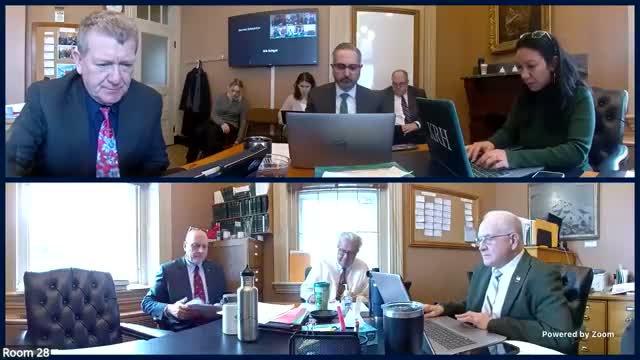
Montpelier — The Senate Education Committee spent its Feb. 18 markup examining S.227, a bill that would restrict school districts from collecting students’ immigration or citizenship information except where state or federal law requires it and would limit when federal immigration authorities may enter nonpublic school areas without judicial authorization.
The committee front-loaded questions about data minimization, with multiple members urging schools to avoid cataloging country-of-origin details unless required. "It was helpful for me to learn. It's not good to write down someone's country or forge it," said an unidentified committee member, arguing less collection reduces harm.
Legal staff and committee members also debated how S.227 would interact with S.209, which limits civil arrests in sensitive spaces. "S.209 would prevent the civil arrest of a person, and for this committee's purposes, at a school," an unidentified speaker summarized during debate. Julio Thompson, assistant attorney general and co-director of the civil rights unit, told the committee he would provide legal guidance and help draft clarifying language: "I'm Julio Thompson, assistant attorney general, co-director of the civil rights unit," he said.
A central drafting question was the statute’s scope: whether to restrict the warrant requirement to federal immigration authorities (as written) or to all law-enforcement officers. Members warned that a broad requirement that all law enforcement obtain a warrant before entering "nonpublic" areas could impede emergency responses. "If you expand the bill to include all law enforcement, this becomes a bigger problem," one committee member said, citing chase and exigency scenarios such as active-shooter responses.
The committee discussed defining "nonpublic area" with concrete examples (classrooms, cafeterias, gymnasiums, medical/medical tents on athletic fields) and debated leaving edge cases to a model policy. Legal staff recommended adding employer-level accountability language so that prohibitions apply to districts "and none of its employees or agents," to deter individual staff from circumventing policy.
Members also proposed that the Attorney General’s office and the Agency of Education produce both a guidance document explaining the types of warrants and a model policy districts could adopt. Thompson and others noted a model policy allows quicker updates and can incorporate reporting mechanisms, anonymous complaint routes, and compliance processes.
The committee made no final vote on S.227 during the session and asked staff to draft revisions addressing definitions, emergency exceptions, and clearer guidance on which entities must follow the law. Committee members also requested input from legal aid organizations and school superintendents on practical implementation.
Next steps: staff will circulate a revised draft with placeholder dates and proposed model-policy responsibilities for the AG’s office and Agency of Education; the committee scheduled follow-up work and asked for additional stakeholder input.
The committee front-loaded questions about data minimization, with multiple members urging schools to avoid cataloging country-of-origin details unless required. "It was helpful for me to learn. It's not good to write down someone's country or forge it," said an unidentified committee member, arguing less collection reduces harm.
Legal staff and committee members also debated how S.227 would interact with S.209, which limits civil arrests in sensitive spaces. "S.209 would prevent the civil arrest of a person, and for this committee's purposes, at a school," an unidentified speaker summarized during debate. Julio Thompson, assistant attorney general and co-director of the civil rights unit, told the committee he would provide legal guidance and help draft clarifying language: "I'm Julio Thompson, assistant attorney general, co-director of the civil rights unit," he said.
A central drafting question was the statute’s scope: whether to restrict the warrant requirement to federal immigration authorities (as written) or to all law-enforcement officers. Members warned that a broad requirement that all law enforcement obtain a warrant before entering "nonpublic" areas could impede emergency responses. "If you expand the bill to include all law enforcement, this becomes a bigger problem," one committee member said, citing chase and exigency scenarios such as active-shooter responses.
The committee discussed defining "nonpublic area" with concrete examples (classrooms, cafeterias, gymnasiums, medical/medical tents on athletic fields) and debated leaving edge cases to a model policy. Legal staff recommended adding employer-level accountability language so that prohibitions apply to districts "and none of its employees or agents," to deter individual staff from circumventing policy.
Members also proposed that the Attorney General’s office and the Agency of Education produce both a guidance document explaining the types of warrants and a model policy districts could adopt. Thompson and others noted a model policy allows quicker updates and can incorporate reporting mechanisms, anonymous complaint routes, and compliance processes.
The committee made no final vote on S.227 during the session and asked staff to draft revisions addressing definitions, emergency exceptions, and clearer guidance on which entities must follow the law. Committee members also requested input from legal aid organizations and school superintendents on practical implementation.
Next steps: staff will circulate a revised draft with placeholder dates and proposed model-policy responsibilities for the AG’s office and Agency of Education; the committee scheduled follow-up work and asked for additional stakeholder input.
Don't Miss a Word: See the Full Meeting!
Go beyond summaries. Unlock every video, transcript, and key insight with a Founder Membership.
✓
Get instant access to full meeting videos
✓
Search and clip any phrase from complete transcripts
✓
Receive AI-powered summaries & custom alerts
✓
Enjoy lifetime, unrestricted access to government data
30-day money-back guarantee
