Laguna Beach outlines $2 million-plus shortfall; staff floats 2% hotel-tax and 1% local sales-tax options
February 20, 2026 | Laguna Beach, Orange County, California
This article was created by AI summarizing key points discussed. AI makes mistakes, so for full details and context, please refer to the video of the full meeting. Please report any errors so we can fix them. Report an error »
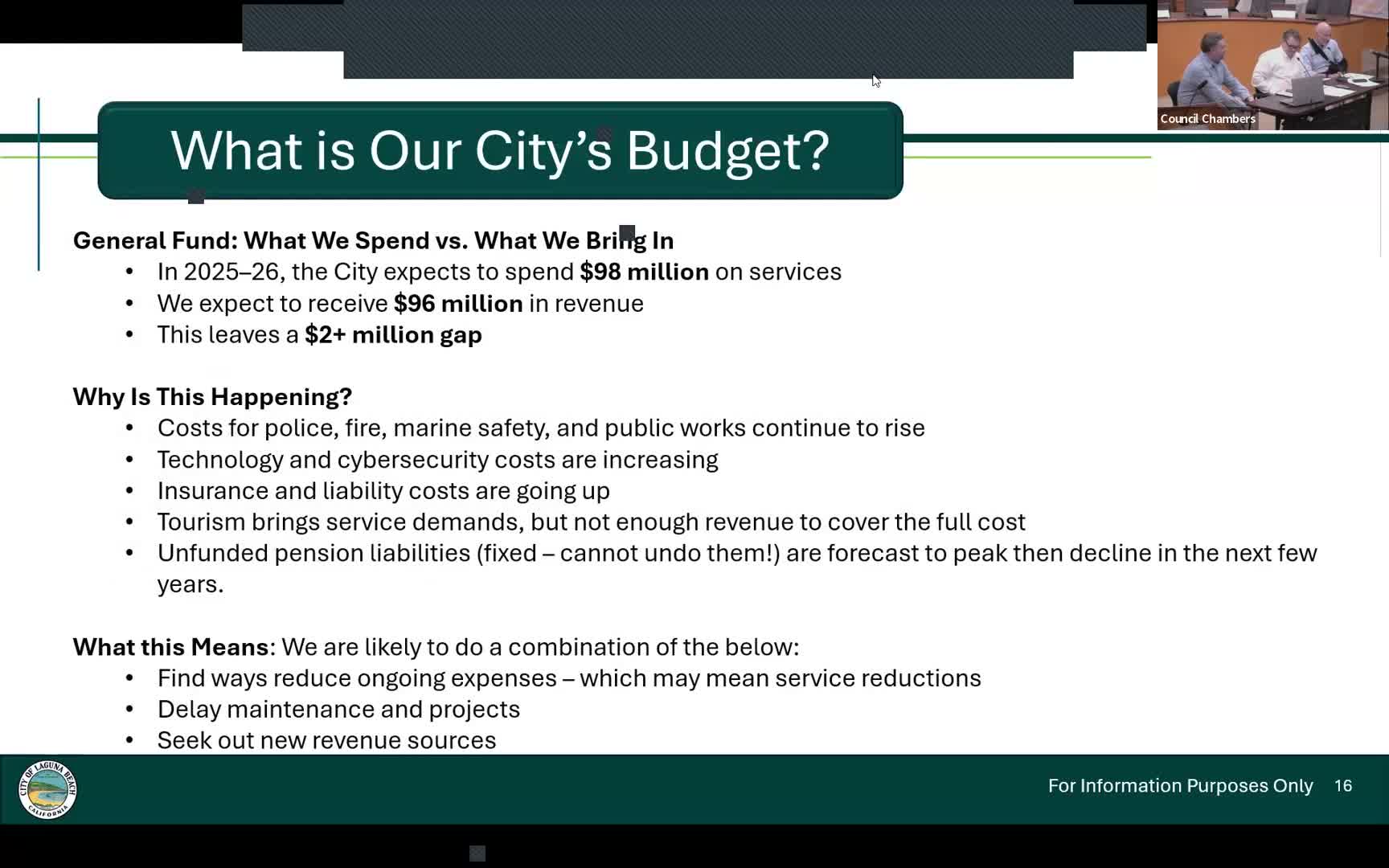
City Manager Dave Kiff said the City of Laguna Beach expects roughly $98 million in general-fund expenditures against about $96 million in general-fund revenues, creating a structural gap the city must close.
Rob Kurinke, a city staff member leading the revenue discussion, described two voter-approval options the council could place on the ballot: a transient-occupancy tax (hotel tax) increase and a locally controlled sales tax increase. "A 2% increase to the TOT would be anticipated to generate about $3,000,000 for the city's general fund," Kurinke said. He added that a sales-tax increase raising the local rate from 7.75% to 8.75% would generate an estimated $7,800,000 annually and, as a voter-approved measure, the city would keep 100% of that incremental revenue.
Kiff framed the choices alongside spending pressures: rising labor and insurance costs, fuel-modification work to reduce wildfire risk (which can cost roughly $900,000 per additional 'pass' in a bad year), and investments in emergency response. He said the most immediate budget-management step will be to pursue about $4 million of operational reductions in the coming budget year and to delay some capital outlays where feasible. "We need ways to reduce our ongoing expenses, which could mean service reductions," Kiff said.
Both the TOT and a local sales tax would require council action to place a measure on the ballot and voter approval. Kurinke emphasized that nothing has been decided and that any measure would be locally controlled and would fund general-fund services such as police, fire, marine safety and street maintenance.
The city also announced a recent federal award of $1,600,000 that will support the South Laguna Fire Station and Laguna Canyon Road improvements; staff said that grant helps but does not close the structural gap.
Next steps: staff will present a more detailed proposed budget in the coming month, including the targeted $4 million in operational reductions and proposals on how and whether to pursue voter-approved revenue measures.
Rob Kurinke, a city staff member leading the revenue discussion, described two voter-approval options the council could place on the ballot: a transient-occupancy tax (hotel tax) increase and a locally controlled sales tax increase. "A 2% increase to the TOT would be anticipated to generate about $3,000,000 for the city's general fund," Kurinke said. He added that a sales-tax increase raising the local rate from 7.75% to 8.75% would generate an estimated $7,800,000 annually and, as a voter-approved measure, the city would keep 100% of that incremental revenue.
Kiff framed the choices alongside spending pressures: rising labor and insurance costs, fuel-modification work to reduce wildfire risk (which can cost roughly $900,000 per additional 'pass' in a bad year), and investments in emergency response. He said the most immediate budget-management step will be to pursue about $4 million of operational reductions in the coming budget year and to delay some capital outlays where feasible. "We need ways to reduce our ongoing expenses, which could mean service reductions," Kiff said.
Both the TOT and a local sales tax would require council action to place a measure on the ballot and voter approval. Kurinke emphasized that nothing has been decided and that any measure would be locally controlled and would fund general-fund services such as police, fire, marine safety and street maintenance.
The city also announced a recent federal award of $1,600,000 that will support the South Laguna Fire Station and Laguna Canyon Road improvements; staff said that grant helps but does not close the structural gap.
Next steps: staff will present a more detailed proposed budget in the coming month, including the targeted $4 million in operational reductions and proposals on how and whether to pursue voter-approved revenue measures.
View the Full Meeting & All Its Details
This article offers just a summary. Unlock complete video, transcripts, and insights as a Founder Member.
✓
Watch full, unedited meeting videos
✓
Search every word spoken in unlimited transcripts
✓
AI summaries & real-time alerts (all government levels)
✓
Permanent access to expanding government content
30-day money-back guarantee
