Beaufort County advisory panel reviews projects, hears bridge, pathway and dirt‑road appeals ahead of proposed sales‑tax referendum
February 19, 2026 | Beaufort County, South Carolina
This article was created by AI summarizing key points discussed. AI makes mistakes, so for full details and context, please refer to the video of the full meeting. Please report any errors so we can fix them. Report an error »
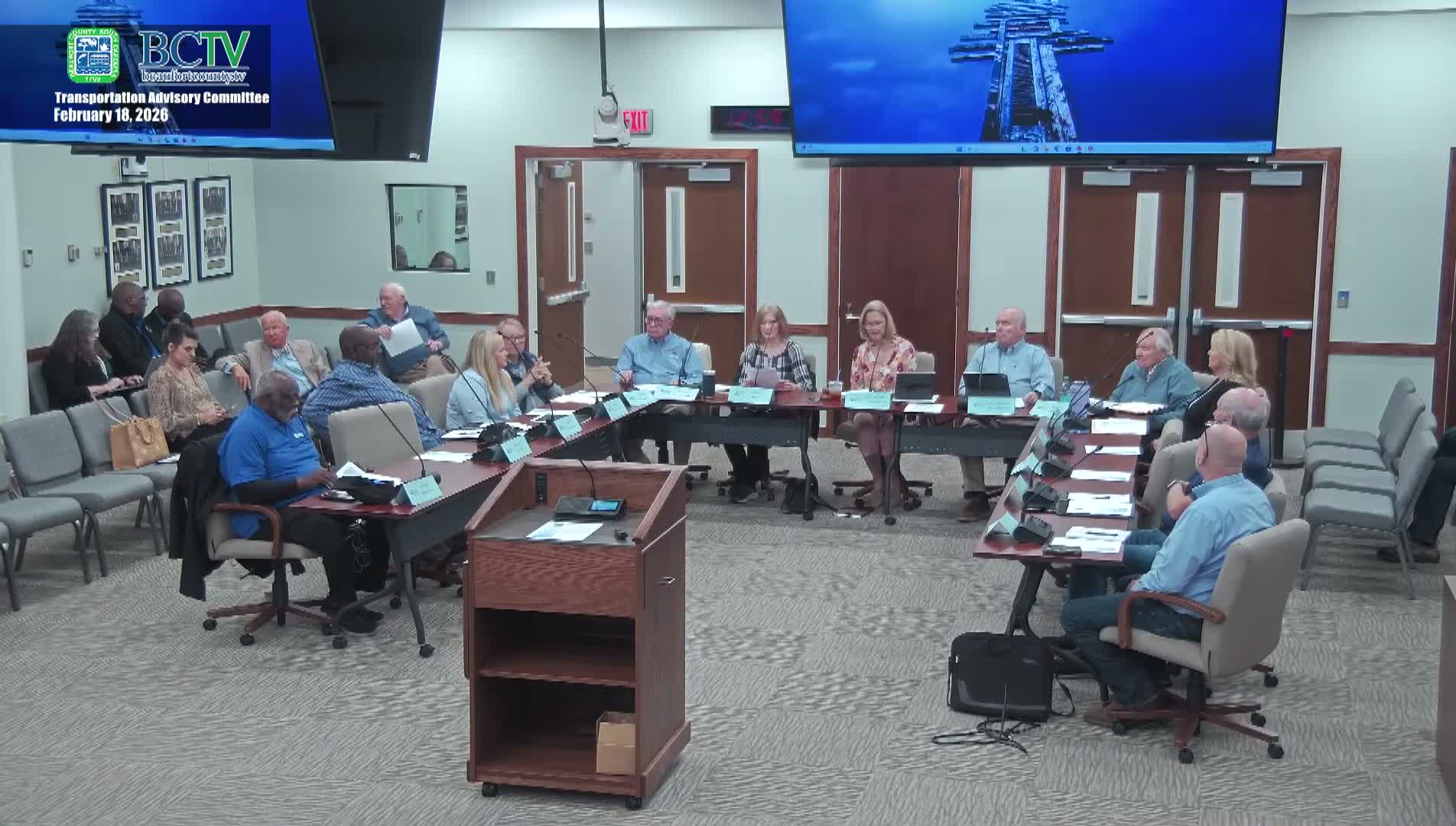
Beaufort County’s Transportation Advisory Committee met Feb. 18 for a detailed briefing on county and regional transportation studies and to collect priorities for a proposed sales‑tax referendum intended to fund roads, safety and multimodal projects.
The committee — chaired by Chairwoman Solca — opened with routine business, approved the meeting agenda and minutes (with three abstentions on the minutes vote), and amended its public schedule to move two working community meetings (April 1 and April 22) to 5:30–7:30 p.m. to make attendance easier for working residents.
During the public comment period, Stu Rodman urged officials to plan for a more robust bridge solution for the Hilton Head corridor, arguing the county’s existing bridges are near the end of their useful life and warning of potential restrictions or shutdowns. "The bridges are coming to the end of their useful life," Rodman said, recommending the eastbound span be built wider (he suggested six lanes) to avoid future capacity shortfalls and to allow reuse of existing structures for alternate crossings. He estimated the main‑bridge work at about $5,060,000,000.
Ray Cipollini called on the committee to include $55,000,000 that was earmarked in a 2024 referendum for bicycle and pedestrian infrastructure, citing the Federal Highway Administration’s Complete Streets policy and the state of South Carolina’s adoption of similar principles in 2021. David Kimball of Sun City asked the committee to consider adding $15,000,000 to acquire easements along Highway 170 (Boundary Street to 278) to prepare that corridor for future trails and connections to the East Coast Greenway.
Beaufort County staff member Brian Stanford summarized the regional planning context, explaining that the Lowcountry Council of Governments (LCOG) and the Lowcountry Area Transportation Study (LATTS/LATS) are updating a 20‑year long‑range plan that feeds into the federally‑funded Transportation Improvement Program (TIP) and the State Transportation Improvement Program (STIP). Stanford said the update will take roughly a year and include public outreach; staff will provide a Dropbox with studies, slide decks and a GIS map of recommended projects.
Stanford reviewed several ongoing studies and candidate corridors, including Bluffton Parkway, a safety action plan for high‑risk intersections, a US‑21 corridor study and SC‑170/278 studies that tie into Jasper County work. He said many studies break recommendations into short‑term (0–5 years), midterm (5–10 years) and long‑term categories and that the county is preparing updated, up‑to‑date cost estimates to avoid reliance on outdated price tags.
On rural needs, Stanford reported the county maintains about 172 dirt roads and that roughly 40 of those have full right‑of‑way and could be paved immediately after design. He committed to providing an inventory of county‑owned dirt roads and a subset that are "shovel‑ready," noting the difference between resurfacing (often funded via the County Transportation Committee) and full paving with right‑of‑way acquisition.
Committee members pressed staff for concrete, digestible materials: a short list of priority projects (Stanford said staff has about 32 candidate projects), maps that visualize where projects sit geographically, and updated cost estimates for different referendum lengths. Several members emphasized a ‘‘big‑rock’’ approach — include one or two major projects (members repeatedly mentioned SC‑170 among others) and then use remaining funds on medium and smaller projects to secure broad public support.
Technical measures under consideration included signal retiming, expanded detection (loops, cameras, radar), and intelligent transportation systems (ITS). Stanford said adaptive signal timing and retiming have shown benefits in parts of the county and that DOT equipment lists and ownership rules could limit uniformity; he offered to provide signal warrants and corridor‑specific guidance.
Members also raised safety and emergency concerns: Cowan/Chowan Creek bridge resiliency, drainage and flood vulnerability (particularly on Wausau and other low‑lying roads), sidewalks near Wheel Branch Early College High School, and use of public‑warning systems tied to signal/camera infrastructure if such items are permissible under state law for transportation referendums.
On accountability, staff said overcollections from Beaufort County’s 2018 penny have been allocated to other referendum projects, that reallocations require council vote and must comply with state rules, and that several 2018 projects remain in design or right‑of‑way while a Depot Road pathway was recently completed.
Next steps: staff will provide committee members with a boiled‑down project list (two‑page lists drawn from larger studies), GIS maps of candidate projects, updated cost estimates (some expected early next week), and copies of the signal‑warrant guidance and relevant study slides. The committee set follow‑up meetings in Port Royal and Bluffton and asked staff to bring DOT and CTC representatives for technical briefings. The committee adjourned with its next meeting scheduled for Feb. 25 at Port Royal Town Hall.
Votes at a glance: the agenda and amended meeting schedule were approved by voice/hand vote; minutes approval carried with three abstentions; the meeting was adjourned by motion and second.
This meeting focused on prioritizing projects to shape a transportation sales‑tax referendum package and on making materials and cost estimates concise and public so the committee and communities can evaluate tradeoffs and support.
The committee — chaired by Chairwoman Solca — opened with routine business, approved the meeting agenda and minutes (with three abstentions on the minutes vote), and amended its public schedule to move two working community meetings (April 1 and April 22) to 5:30–7:30 p.m. to make attendance easier for working residents.
During the public comment period, Stu Rodman urged officials to plan for a more robust bridge solution for the Hilton Head corridor, arguing the county’s existing bridges are near the end of their useful life and warning of potential restrictions or shutdowns. "The bridges are coming to the end of their useful life," Rodman said, recommending the eastbound span be built wider (he suggested six lanes) to avoid future capacity shortfalls and to allow reuse of existing structures for alternate crossings. He estimated the main‑bridge work at about $5,060,000,000.
Ray Cipollini called on the committee to include $55,000,000 that was earmarked in a 2024 referendum for bicycle and pedestrian infrastructure, citing the Federal Highway Administration’s Complete Streets policy and the state of South Carolina’s adoption of similar principles in 2021. David Kimball of Sun City asked the committee to consider adding $15,000,000 to acquire easements along Highway 170 (Boundary Street to 278) to prepare that corridor for future trails and connections to the East Coast Greenway.
Beaufort County staff member Brian Stanford summarized the regional planning context, explaining that the Lowcountry Council of Governments (LCOG) and the Lowcountry Area Transportation Study (LATTS/LATS) are updating a 20‑year long‑range plan that feeds into the federally‑funded Transportation Improvement Program (TIP) and the State Transportation Improvement Program (STIP). Stanford said the update will take roughly a year and include public outreach; staff will provide a Dropbox with studies, slide decks and a GIS map of recommended projects.
Stanford reviewed several ongoing studies and candidate corridors, including Bluffton Parkway, a safety action plan for high‑risk intersections, a US‑21 corridor study and SC‑170/278 studies that tie into Jasper County work. He said many studies break recommendations into short‑term (0–5 years), midterm (5–10 years) and long‑term categories and that the county is preparing updated, up‑to‑date cost estimates to avoid reliance on outdated price tags.
On rural needs, Stanford reported the county maintains about 172 dirt roads and that roughly 40 of those have full right‑of‑way and could be paved immediately after design. He committed to providing an inventory of county‑owned dirt roads and a subset that are "shovel‑ready," noting the difference between resurfacing (often funded via the County Transportation Committee) and full paving with right‑of‑way acquisition.
Committee members pressed staff for concrete, digestible materials: a short list of priority projects (Stanford said staff has about 32 candidate projects), maps that visualize where projects sit geographically, and updated cost estimates for different referendum lengths. Several members emphasized a ‘‘big‑rock’’ approach — include one or two major projects (members repeatedly mentioned SC‑170 among others) and then use remaining funds on medium and smaller projects to secure broad public support.
Technical measures under consideration included signal retiming, expanded detection (loops, cameras, radar), and intelligent transportation systems (ITS). Stanford said adaptive signal timing and retiming have shown benefits in parts of the county and that DOT equipment lists and ownership rules could limit uniformity; he offered to provide signal warrants and corridor‑specific guidance.
Members also raised safety and emergency concerns: Cowan/Chowan Creek bridge resiliency, drainage and flood vulnerability (particularly on Wausau and other low‑lying roads), sidewalks near Wheel Branch Early College High School, and use of public‑warning systems tied to signal/camera infrastructure if such items are permissible under state law for transportation referendums.
On accountability, staff said overcollections from Beaufort County’s 2018 penny have been allocated to other referendum projects, that reallocations require council vote and must comply with state rules, and that several 2018 projects remain in design or right‑of‑way while a Depot Road pathway was recently completed.
Next steps: staff will provide committee members with a boiled‑down project list (two‑page lists drawn from larger studies), GIS maps of candidate projects, updated cost estimates (some expected early next week), and copies of the signal‑warrant guidance and relevant study slides. The committee set follow‑up meetings in Port Royal and Bluffton and asked staff to bring DOT and CTC representatives for technical briefings. The committee adjourned with its next meeting scheduled for Feb. 25 at Port Royal Town Hall.
Votes at a glance: the agenda and amended meeting schedule were approved by voice/hand vote; minutes approval carried with three abstentions; the meeting was adjourned by motion and second.
This meeting focused on prioritizing projects to shape a transportation sales‑tax referendum package and on making materials and cost estimates concise and public so the committee and communities can evaluate tradeoffs and support.
Don't Miss a Word: See the Full Meeting!
Go beyond summaries. Unlock every video, transcript, and key insight with a Founder Membership.
✓
Get instant access to full meeting videos
✓
Search and clip any phrase from complete transcripts
✓
Receive AI-powered summaries & custom alerts
✓
Enjoy lifetime, unrestricted access to government data
30-day money-back guarantee
