Athens planning commission forwards draft rules for recovery housing, asks law director to review
February 19, 2026 | Athens City Council, Athens , Athens County, Ohio
This article was created by AI summarizing key points discussed. AI makes mistakes, so for full details and context, please refer to the video of the full meeting. Please report any errors so we can fix them. Report an error »
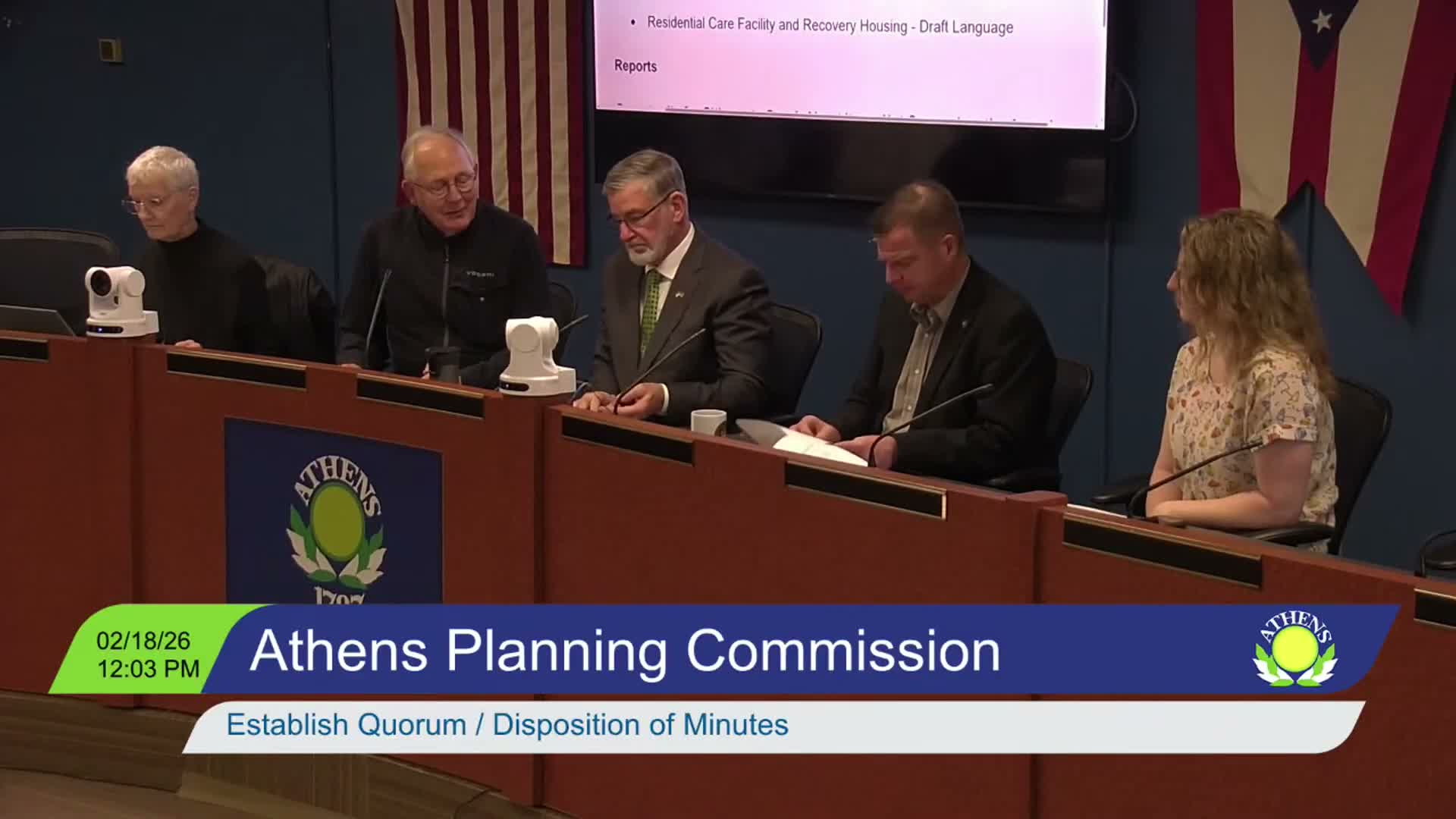
The Athens City Planning Commission on Feb. 4 reviewed proposed revisions to the city zoning code that would define and regulate residential care facilities and recovery housing, add spacing and parking controls, and require rental and use permits before the city acts on any special approvals. After a multi-hour discussion and public testimony, the commission voted to forward the draft to the law director for legal review before scheduling the item as a formal case.
The draft presented by staff member David Riggs would add or amend definitions in Title 23 and add recovery housing to Title 29 rental- and housing-permit provisions. Riggs told commissioners the draft aims to align local rules with state requirements while preserving life-safety and zoning controls: "We would treat recovery housing like other rental permits — they would need a rental permit, inspection and a use permit," he said. The proposal includes a 1,000-foot spacing limit between similar residential care or recovery facilities in certain zones, specific occupancy limits in R1 (no more than three unrelated persons), conditional permitting for facilities housing six to 16 residents in R3, and parking minimums tied to bed counts and public-transit proximity.
Why it matters: the changes are the city's attempt to manage a recent expansion of recovery housing and licensed care providers while balancing neighborhood stability and state law. Commissioners repeatedly referenced state preemption and certification requirements, saying the city must design rules that both protect neighborhoods and are defensible under Ohio Revised Code provisions. Riggs and other staff cited ORC requirements that recovery homes register soon after starting operations, then have an 18-month period to complete state certification.
Public testimony was sharply split. Joy ("Doctor Joy") Jones, who identified herself as an operator and said the houses at 51 Madison and 34 Lorraine are registered, urged the commission to allow her program to continue: "I'm not here for the money. I don't charge them anything. I help them," she said, adding that her group brings clients from across Ohio and has seen positive results using a couples-focused model. Two program residents also spoke of personal change: "It saved my life," one resident said.
Neighborhood speakers urged caution. Jack Stauffer, an Elmwood resident, urged stricter spacing and minimum lot-size rules, cited problems at 51–53 Madison with vehicles blocking a shared driveway and asked that recovery houses be treated as conditionally permitted rather than automatically allowed. Commissioner and council member Alan Swank pressed staff on the practical timeline for state certification, suggesting the commission consider whether certification should be in hand before residents move in rather than rely on a protracted "actively pursuing" clause.
Key details from the draft and discussion: recovery housing parking minimums were proposed at 1 parking space per bed (reducible to 1 per 2 beds if within 1,500 feet of public transit); residential care facility parking at 1 space per 3,000 square feet (with similar transit reduction); rooming-house-type facilities in R3 may require occupancy certificates and sprinklers and would be conditionally permitted, with appeals to the Board of Zoning Appeals for approval; the ORC registration/certification sequence (register within 30 days, certification within 18 months) was cited repeatedly as the state framework governing recovery homes.
What the commission decided: rather than adopt ordinance language on the spot, commissioners voted to forward the draft to the law director for review and counsel on statutory preemption and distance limitations. The chair said counsel "conceivably could say something about the distance as well as she looks at that." The motion passed by voice vote.
Next steps: the commission asked staff to incorporate any legal edits recommended by the law director and to return the item as a formal case for public hearings and a vote. Meanwhile, staff and commissioners signaled interest in separate follow-up work on shared-driveway issues and lot-split triggers that affect on-site access.
Sources and attributions: direct quotes and attributions in this article come from participants at the Feb. 4 Athens City Planning Commission meeting, including David Riggs (staff), Joy Jones (program operator), Sofia Hancock (house manager), Jack Stauffer (resident), Alan Swank (Athens City Council, 4th Ward) and residents who identified themselves as program clients.
The draft presented by staff member David Riggs would add or amend definitions in Title 23 and add recovery housing to Title 29 rental- and housing-permit provisions. Riggs told commissioners the draft aims to align local rules with state requirements while preserving life-safety and zoning controls: "We would treat recovery housing like other rental permits — they would need a rental permit, inspection and a use permit," he said. The proposal includes a 1,000-foot spacing limit between similar residential care or recovery facilities in certain zones, specific occupancy limits in R1 (no more than three unrelated persons), conditional permitting for facilities housing six to 16 residents in R3, and parking minimums tied to bed counts and public-transit proximity.
Why it matters: the changes are the city's attempt to manage a recent expansion of recovery housing and licensed care providers while balancing neighborhood stability and state law. Commissioners repeatedly referenced state preemption and certification requirements, saying the city must design rules that both protect neighborhoods and are defensible under Ohio Revised Code provisions. Riggs and other staff cited ORC requirements that recovery homes register soon after starting operations, then have an 18-month period to complete state certification.
Public testimony was sharply split. Joy ("Doctor Joy") Jones, who identified herself as an operator and said the houses at 51 Madison and 34 Lorraine are registered, urged the commission to allow her program to continue: "I'm not here for the money. I don't charge them anything. I help them," she said, adding that her group brings clients from across Ohio and has seen positive results using a couples-focused model. Two program residents also spoke of personal change: "It saved my life," one resident said.
Neighborhood speakers urged caution. Jack Stauffer, an Elmwood resident, urged stricter spacing and minimum lot-size rules, cited problems at 51–53 Madison with vehicles blocking a shared driveway and asked that recovery houses be treated as conditionally permitted rather than automatically allowed. Commissioner and council member Alan Swank pressed staff on the practical timeline for state certification, suggesting the commission consider whether certification should be in hand before residents move in rather than rely on a protracted "actively pursuing" clause.
Key details from the draft and discussion: recovery housing parking minimums were proposed at 1 parking space per bed (reducible to 1 per 2 beds if within 1,500 feet of public transit); residential care facility parking at 1 space per 3,000 square feet (with similar transit reduction); rooming-house-type facilities in R3 may require occupancy certificates and sprinklers and would be conditionally permitted, with appeals to the Board of Zoning Appeals for approval; the ORC registration/certification sequence (register within 30 days, certification within 18 months) was cited repeatedly as the state framework governing recovery homes.
What the commission decided: rather than adopt ordinance language on the spot, commissioners voted to forward the draft to the law director for review and counsel on statutory preemption and distance limitations. The chair said counsel "conceivably could say something about the distance as well as she looks at that." The motion passed by voice vote.
Next steps: the commission asked staff to incorporate any legal edits recommended by the law director and to return the item as a formal case for public hearings and a vote. Meanwhile, staff and commissioners signaled interest in separate follow-up work on shared-driveway issues and lot-split triggers that affect on-site access.
Sources and attributions: direct quotes and attributions in this article come from participants at the Feb. 4 Athens City Planning Commission meeting, including David Riggs (staff), Joy Jones (program operator), Sofia Hancock (house manager), Jack Stauffer (resident), Alan Swank (Athens City Council, 4th Ward) and residents who identified themselves as program clients.
View the Full Meeting & All Its Details
This article offers just a summary. Unlock complete video, transcripts, and insights as a Founder Member.
✓
Watch full, unedited meeting videos
✓
Search every word spoken in unlimited transcripts
✓
AI summaries & real-time alerts (all government levels)
✓
Permanent access to expanding government content
30-day money-back guarantee
