Fall River ZBA rejects Holy Name Church request to pave 70-space parking lot
February 20, 2026 | Fall River City, Bristol County, Massachusetts
This article was created by AI summarizing key points discussed. AI makes mistakes, so for full details and context, please refer to the video of the full meeting. Please report any errors so we can fix them. Report an error »
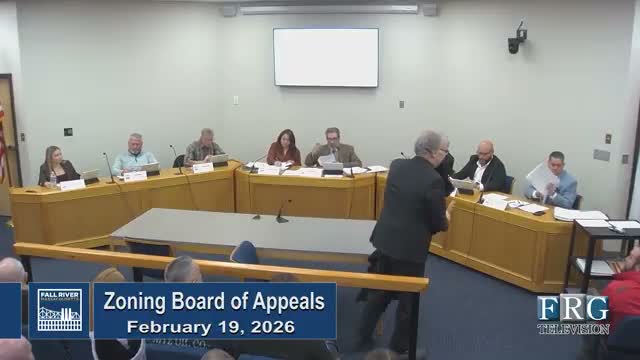
Holy Name Church’s bid to build a 70-space parking lot on its 709 Hanover St. property failed at the Zoning Board of Appeals’ Feb. 19 meeting after the board said the application did not secure the necessary support.
The church’s pastor, Father Riley Williams, opened the presentation saying the project responds to growing parish parking needs and safety concerns, particularly during heavy snow seasons when parishioners must walk blocks to reach services. “The need for this parking lot has become increasingly clear,” Williams told the board. Engineer Matthew Viana of Millstone LLC described a two-part design: a traditional paved lot on Madison Street for roughly 35 spaces and a stacked parking drive aisle on the south side of the church. Viana said the team designed a stormwater system intended to capture and infiltrate all runoff from new impervious surfaces and proposed new plantings and a six-foot PVC fence to screen neighbors.
The board and staff repeatedly emphasized that the only relief before the ZBA was a special permit for increased lot coverage (the neighborhood’s maximum is 25 percent; the church’s existing coverage is above that and the proposal would raise it to roughly the 50–57% range presented). Planning staff noted that if the church used porous asphalt or porous pavers the project would not require zoning relief because porous surfaces are not counted as impervious in the city’s lot-coverage calculation. The church team said they chose a conventional asphalt design coupled with an engineered drainage system and additional screening to address neighbor concerns.
During public comment, parishioners said the lot would improve accessibility and safety, particularly for older residents, and that the plan preserves more green space than comparable projects. Neighbors opposed the project, calling a 70-space lot outsized for a single-family zone and warning of increased traffic, light and noise impacts. Several residents urged alternatives such as shuttle service, porous paving or smaller-scale solutions.
Board members and planning staff cautioned repeatedly that traffic, curb cuts and use exemptions (churches are state-exempt uses) were outside the ZBA’s narrow jurisdiction in this hearing; the board only considered whether the requested increase in lot coverage would be “substantially more detrimental” to the neighborhood than the existing condition. A motion to find the project “not substantially more detrimental” and approve the special permit was made and seconded but failed on the roll call. Chair Joseph Pereira announced that the motion did not carry because it failed to reach the required votes.
Because the board’s action was limited to the zoning standard before it, planning staff noted the applicant can (a) pursue porous pavement to avoid zoning relief, (b) revise the site plan and return, or (c) pursue alternative mitigation measures through the site plan process. The ZBA did not adopt conditions or partial relief at the hearing; the motion before the board was defeated.
The church’s pastor, Father Riley Williams, opened the presentation saying the project responds to growing parish parking needs and safety concerns, particularly during heavy snow seasons when parishioners must walk blocks to reach services. “The need for this parking lot has become increasingly clear,” Williams told the board. Engineer Matthew Viana of Millstone LLC described a two-part design: a traditional paved lot on Madison Street for roughly 35 spaces and a stacked parking drive aisle on the south side of the church. Viana said the team designed a stormwater system intended to capture and infiltrate all runoff from new impervious surfaces and proposed new plantings and a six-foot PVC fence to screen neighbors.
The board and staff repeatedly emphasized that the only relief before the ZBA was a special permit for increased lot coverage (the neighborhood’s maximum is 25 percent; the church’s existing coverage is above that and the proposal would raise it to roughly the 50–57% range presented). Planning staff noted that if the church used porous asphalt or porous pavers the project would not require zoning relief because porous surfaces are not counted as impervious in the city’s lot-coverage calculation. The church team said they chose a conventional asphalt design coupled with an engineered drainage system and additional screening to address neighbor concerns.
During public comment, parishioners said the lot would improve accessibility and safety, particularly for older residents, and that the plan preserves more green space than comparable projects. Neighbors opposed the project, calling a 70-space lot outsized for a single-family zone and warning of increased traffic, light and noise impacts. Several residents urged alternatives such as shuttle service, porous paving or smaller-scale solutions.
Board members and planning staff cautioned repeatedly that traffic, curb cuts and use exemptions (churches are state-exempt uses) were outside the ZBA’s narrow jurisdiction in this hearing; the board only considered whether the requested increase in lot coverage would be “substantially more detrimental” to the neighborhood than the existing condition. A motion to find the project “not substantially more detrimental” and approve the special permit was made and seconded but failed on the roll call. Chair Joseph Pereira announced that the motion did not carry because it failed to reach the required votes.
Because the board’s action was limited to the zoning standard before it, planning staff noted the applicant can (a) pursue porous pavement to avoid zoning relief, (b) revise the site plan and return, or (c) pursue alternative mitigation measures through the site plan process. The ZBA did not adopt conditions or partial relief at the hearing; the motion before the board was defeated.
Don't Miss a Word: See the Full Meeting!
Go beyond summaries. Unlock every video, transcript, and key insight with a Founder Membership.
✓
Get instant access to full meeting videos
✓
Search and clip any phrase from complete transcripts
✓
Receive AI-powered summaries & custom alerts
✓
Enjoy lifetime, unrestricted access to government data
30-day money-back guarantee
