Fall River ZBA: withdrawals, several residential variances approved, and one petition tabled
February 20, 2026 | Fall River City, Bristol County, Massachusetts
This article was created by AI summarizing key points discussed. AI makes mistakes, so for full details and context, please refer to the video of the full meeting. Please report any errors so we can fix them. Report an error »
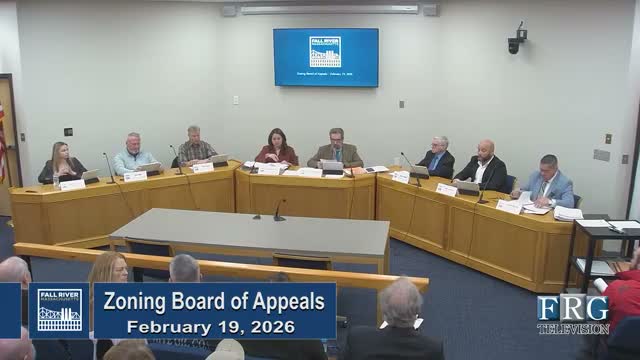
The Fall River Zoning Board of Appeals conducted a packed agenda on Feb. 19 with a mix of procedural items, approvals, denials and tabling motions.
Two petitions on the old-business docket were formally withdrawn without prejudice: the Pellegrini/G Z Homes LLC petition for 57–63 Colfax St. and the Rich Street lot-split petition presented by counsel Gregory Braine. The board accepted both withdrawals following counsel statements that written withdrawals were filed.
The board granted a variance for Ford Auto Repair (30 Bosch St.) to allow on-site stowage of a reduced number of vehicles (the applicant reduced proposed stowage to a maximum of 36 vehicles). The approval included a condition that towed vehicles be stored inside the fenced area and that no towed vehicles be stored outside the fenced enclosure. The board accepted plan revisions including perimeter screening and planting commitments.
In New Business, the board approved a variance for 590 Anthony Street (365 Investments LLC) permitting a new single-family dwelling on a preexisting lot with reduced side-yard setbacks and increased lot coverage to allow two paved parking spaces. Attorney Mark L. Levin explained the lot’s historical nonconforming status and the limited relief requested; the vote carried.
The board approved a two-bedroom single-family variance at Emmett Street (applicants Michael and Jamie Provost) with a condition prohibiting accessory dwelling units (ADUs). The applicant’s counsel said the lot was preexisting nonconforming and that the proposed home is consistent with the block.
The board considered an application to convert an existing six-family building at 913 Rodman St. into eight units with additional ADUs and a parking-waiver request. After extensive discussion about parking, lot coverage and ADU-by-right rules the applicant requested to table the petition to the March 19 meeting to provide revised drawings; the board voted to table the item.
The board also accepted minutes from its Jan. 15 meeting and adjourned. Several follow-up items were left to planning staff and site-plan review processes where technical elements (drainage and curb-cut approvals) are handled.
Two petitions on the old-business docket were formally withdrawn without prejudice: the Pellegrini/G Z Homes LLC petition for 57–63 Colfax St. and the Rich Street lot-split petition presented by counsel Gregory Braine. The board accepted both withdrawals following counsel statements that written withdrawals were filed.
The board granted a variance for Ford Auto Repair (30 Bosch St.) to allow on-site stowage of a reduced number of vehicles (the applicant reduced proposed stowage to a maximum of 36 vehicles). The approval included a condition that towed vehicles be stored inside the fenced area and that no towed vehicles be stored outside the fenced enclosure. The board accepted plan revisions including perimeter screening and planting commitments.
In New Business, the board approved a variance for 590 Anthony Street (365 Investments LLC) permitting a new single-family dwelling on a preexisting lot with reduced side-yard setbacks and increased lot coverage to allow two paved parking spaces. Attorney Mark L. Levin explained the lot’s historical nonconforming status and the limited relief requested; the vote carried.
The board approved a two-bedroom single-family variance at Emmett Street (applicants Michael and Jamie Provost) with a condition prohibiting accessory dwelling units (ADUs). The applicant’s counsel said the lot was preexisting nonconforming and that the proposed home is consistent with the block.
The board considered an application to convert an existing six-family building at 913 Rodman St. into eight units with additional ADUs and a parking-waiver request. After extensive discussion about parking, lot coverage and ADU-by-right rules the applicant requested to table the petition to the March 19 meeting to provide revised drawings; the board voted to table the item.
The board also accepted minutes from its Jan. 15 meeting and adjourned. Several follow-up items were left to planning staff and site-plan review processes where technical elements (drainage and curb-cut approvals) are handled.
View the Full Meeting & All Its Details
This article offers just a summary. Unlock complete video, transcripts, and insights as a Founder Member.
✓
Watch full, unedited meeting videos
✓
Search every word spoken in unlimited transcripts
✓
AI summaries & real-time alerts (all government levels)
✓
Permanent access to expanding government content
30-day money-back guarantee
