Regional I&I program leaders approve batch of sewer‑repair projects; budget projections prompt caution
February 19, 2026 | Clackamas County, Oregon
This article was created by AI summarizing key points discussed. AI makes mistakes, so for full details and context, please refer to the video of the full meeting. Please report any errors so we can fix them. Report an error »
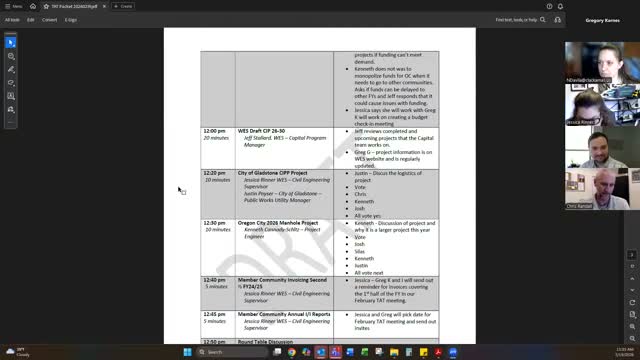
Water Environment Services’ technical advisory team reviewed program spending since 2022, approved a series of member‑city sewer rehabilitation projects for inclusion in the regional inflow‑and‑infiltration (I&I) reduction program, and debated whether planned projects could outpace a roughly $2 million annual planning figure.
All of the member communities have signed the regional IGA amendment and it has been returned to WES, and the amendment is scheduled for the Clackamas County Board of Commissioners consent agenda on March 5, a meeting speaker said. "All of the member communities have signed," the chair reported (SEG 049).
Why it matters: the team summarized what the program has reimbursed since 2022 and presented a capital improvement plan that carries multi‑year obligations; the package of proposals discussed would commit substantial construction dollars across several fiscal years and could concentrate spending in a single member if schedules are not balanced.
The presentation showed rolling invoice totals through the most recent entries: Gladstone about $2.2 million (WES contribution $738,000), Milwaukee roughly $380,000 (WES $125,000), and Oregon City reported the largest expenditures in the packet (figures in the presentation) (SEG 168-176). The presenter cautioned these are invoice totals and rolling estimates.
Budgeting and planning: presenters said the program used a historical average to inform a planning baseline. "We're looking at about 2,000,000 average to spend," one member explained, describing the $2 million figure as a conservative planning number based on prior years' spending (SEG 218). Other members urged more forward‑looking budget projections, noting that several proposals carried construction costs that may push reimbursements above that planning line in particular years (SEG 226-246).
Project approvals: the advisory team voted to include a set of proposed projects in the regional I&I reduction program. Key inclusions and presenter estimates follow (project schedules and costs are as described to the group):
- 2027 manhole rehabilitation project — estimated ~$387,000 to address about 115 manholes, including design and construction services; members raised concerns about contractor low bids and quality (approved by voice/thumbs up) (SEG 302-379).
- Lynn Basin projects (multiple submissions, including Lynn project 3) — initial proposal listed ~4.9M total (4.0M construction, 800k design); presenter made a verbal update to raise the current construction estimate to about $5.6M (total ~ $6.6M) based on updated cost information (SEG 426-436). Schedule estimates showed 90% design underway with construction beginning in 2026–2027 for portions of the work; members voted to include the Lynn project in the regional program (SEG 443-448).
- LAN 4 (Linn 4) — described as a more complex, geologically constrained project inside a geologic hazard overlay that will require a Type 2 land‑use application; projected bidding/award in fall 2028 and construction through 2030; members voted to include it (SEG 451-501, SEG 504-508).
- Lynn 5 and Lynn 6 — Lynn 5 characterized as a straightforward CIPP‑lining project (~2029–2030, estimated total ~$4.0M); Lynn 6 covers landslide‑prone areas and extensive replacements with an estimated total near $6.9M (design $1.2M); both were advanced for inclusion (SEG 511-538, SEG 539-574).
- McLaughlin 2 — coordinated with paving partners to reduce trench‑patching costs; planned design completion summer 2027, construction 2027–2028; estimated total ~$6.1M; advanced for inclusion (SEG 636-669, SEG 671-674).
- Applegate/Berkeley Hills revision — significant scope change from a previously approved project, heavy CIPP lining (~4,600 LF), some bursting, ~90 lateral repairs, and regulatory constraints tied to work in a chartered park and steep slopes; construction planned 2028–2029; advanced for inclusion (SEG 675-720, SEG 729-731).
Cumulative planning estimate and next steps: the presenter estimated roughly $36,000,000 in program spending through 2030 and urged flexibility because projects can slide across fiscal years (SEG 736-741). Members discussed balancing allocations so a single city does not monopolize available funds and asked staff to reconcile individual project timing with the CIP splits before finalizing reimbursements (SEG 921-933, SEG 880-896).
Data collection and resource sharing: team members offered to share flow meters and temporary loggers to help smaller members collect depth and velocity data without hiring external consultants; WES representatives said they have both permanent sites and spares that could help calibration and short‑term deployments (SEG 1047-1061, SEG 1076-1096).
What was not decided: while the IGA amendment will be sent to the Clackamas County Board of Commissioners for signature, the advisory team did not adopt a change to the funding formula or formally reallocate CIP dollars at this meeting; attendees asked staff to provide reconciled year‑by‑year budgeting and to confirm how proposed reimbursements map to the $2 million planning baseline.
The advisory team closed with an agreement that staff will circulate updated budget tables and that the group will reconvene in the summer (likely June) or sooner if needed (SEG 1151-1163).
All of the member communities have signed the regional IGA amendment and it has been returned to WES, and the amendment is scheduled for the Clackamas County Board of Commissioners consent agenda on March 5, a meeting speaker said. "All of the member communities have signed," the chair reported (SEG 049).
Why it matters: the team summarized what the program has reimbursed since 2022 and presented a capital improvement plan that carries multi‑year obligations; the package of proposals discussed would commit substantial construction dollars across several fiscal years and could concentrate spending in a single member if schedules are not balanced.
The presentation showed rolling invoice totals through the most recent entries: Gladstone about $2.2 million (WES contribution $738,000), Milwaukee roughly $380,000 (WES $125,000), and Oregon City reported the largest expenditures in the packet (figures in the presentation) (SEG 168-176). The presenter cautioned these are invoice totals and rolling estimates.
Budgeting and planning: presenters said the program used a historical average to inform a planning baseline. "We're looking at about 2,000,000 average to spend," one member explained, describing the $2 million figure as a conservative planning number based on prior years' spending (SEG 218). Other members urged more forward‑looking budget projections, noting that several proposals carried construction costs that may push reimbursements above that planning line in particular years (SEG 226-246).
Project approvals: the advisory team voted to include a set of proposed projects in the regional I&I reduction program. Key inclusions and presenter estimates follow (project schedules and costs are as described to the group):
- 2027 manhole rehabilitation project — estimated ~$387,000 to address about 115 manholes, including design and construction services; members raised concerns about contractor low bids and quality (approved by voice/thumbs up) (SEG 302-379).
- Lynn Basin projects (multiple submissions, including Lynn project 3) — initial proposal listed ~4.9M total (4.0M construction, 800k design); presenter made a verbal update to raise the current construction estimate to about $5.6M (total ~ $6.6M) based on updated cost information (SEG 426-436). Schedule estimates showed 90% design underway with construction beginning in 2026–2027 for portions of the work; members voted to include the Lynn project in the regional program (SEG 443-448).
- LAN 4 (Linn 4) — described as a more complex, geologically constrained project inside a geologic hazard overlay that will require a Type 2 land‑use application; projected bidding/award in fall 2028 and construction through 2030; members voted to include it (SEG 451-501, SEG 504-508).
- Lynn 5 and Lynn 6 — Lynn 5 characterized as a straightforward CIPP‑lining project (~2029–2030, estimated total ~$4.0M); Lynn 6 covers landslide‑prone areas and extensive replacements with an estimated total near $6.9M (design $1.2M); both were advanced for inclusion (SEG 511-538, SEG 539-574).
- McLaughlin 2 — coordinated with paving partners to reduce trench‑patching costs; planned design completion summer 2027, construction 2027–2028; estimated total ~$6.1M; advanced for inclusion (SEG 636-669, SEG 671-674).
- Applegate/Berkeley Hills revision — significant scope change from a previously approved project, heavy CIPP lining (~4,600 LF), some bursting, ~90 lateral repairs, and regulatory constraints tied to work in a chartered park and steep slopes; construction planned 2028–2029; advanced for inclusion (SEG 675-720, SEG 729-731).
Cumulative planning estimate and next steps: the presenter estimated roughly $36,000,000 in program spending through 2030 and urged flexibility because projects can slide across fiscal years (SEG 736-741). Members discussed balancing allocations so a single city does not monopolize available funds and asked staff to reconcile individual project timing with the CIP splits before finalizing reimbursements (SEG 921-933, SEG 880-896).
Data collection and resource sharing: team members offered to share flow meters and temporary loggers to help smaller members collect depth and velocity data without hiring external consultants; WES representatives said they have both permanent sites and spares that could help calibration and short‑term deployments (SEG 1047-1061, SEG 1076-1096).
What was not decided: while the IGA amendment will be sent to the Clackamas County Board of Commissioners for signature, the advisory team did not adopt a change to the funding formula or formally reallocate CIP dollars at this meeting; attendees asked staff to provide reconciled year‑by‑year budgeting and to confirm how proposed reimbursements map to the $2 million planning baseline.
The advisory team closed with an agreement that staff will circulate updated budget tables and that the group will reconvene in the summer (likely June) or sooner if needed (SEG 1151-1163).
View the Full Meeting & All Its Details
This article offers just a summary. Unlock complete video, transcripts, and insights as a Founder Member.
✓
Watch full, unedited meeting videos
✓
Search every word spoken in unlimited transcripts
✓
AI summaries & real-time alerts (all government levels)
✓
Permanent access to expanding government content
30-day money-back guarantee
