Whitefish Planning Commission approves retaining-wall variance at 526 Scott Avenue after neighbor objections
February 20, 2026 | Whitefish, Flathead County, Montana
This article was created by AI summarizing key points discussed. AI makes mistakes, so for full details and context, please refer to the video of the full meeting. Please report any errors so we can fix them. Report an error »
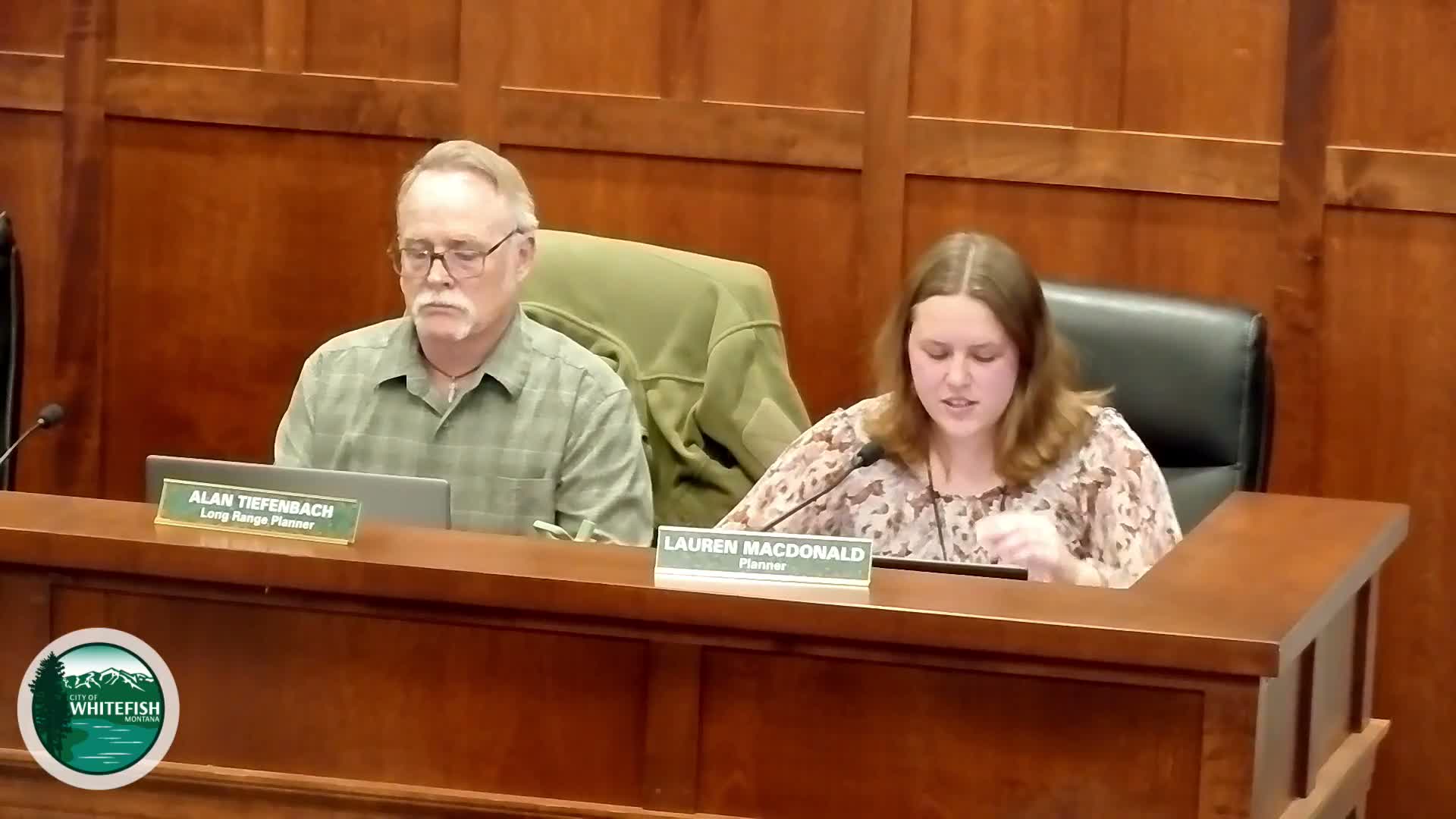
The Whitefish Planning Commission voted Feb. 19 to approve a zoning variance allowing a retaining wall constructed near 526 Scott Avenue to remain as built. The commission considered a staff report that said the wall exceeds four feet measured from the downhill side and sits at the south property line, but that strict application of setback requirements would prevent reasonable use of the lot.
Planner Lauren McDonald outlined the staff recommendation, saying the proposal “is a retaining wall that exceeds 4 feet in height at its tallest point, and from it was measured at completion, from the downhill grade” and that staff found the application met the zoning variance criteria because the lot’s configuration and topography create a hardship (Lauren McDonald). McDonald told the commission the prior wall encroached onto the neighbor’s land and that relocation onto the applicant’s property and installation of a French drain improved runoff mitigation compared with the older, nonconforming wall.
The applicants’ attorney, Camisha Satel, said the owners acted to protect the house after a neighboring owner removed a portion of the old retaining wall and that the homeowners hired engineers and professionals to address structural risk. “They have an engineering report that supports that … they needed to do something or else they could potentially have structural damage to their home,” Satel said (Camisha Satel).
Contractor Doug Adams, who built the wall, described construction details and said he installed drainage behind the wall: “So the drainage has been greatly improved from what it was” and the work was nearly complete when a stop-work order was issued (Doug Adams). Adams told commissioners the homeowner had asked city staff whether permits were needed and was told none were required, which led to confusion.
The neighbor to the south, Rebecca Norton, opposed the variance and urged commissioners to deny it until an engineering report and formal drainage plan are submitted. Norton said the previous wall was located on her property, that she removed the encroaching portion, and that the record before the commission lacked the typical plans and engineering one would expect before approving a change that could affect adjacent properties: “The reason I’m in opposition to this variance is because I’m not sure that the city will come back in to give them a building permit,” Norton said (Rebecca Norton).
Commission discussion focused on a legal separation the staff described between land-use variances and building-permit review: zoning findings consider adverse impacts in the context of the zoning code (setback and height criteria), while structural integrity and stormwater control are evaluated by the building official under the building-permit process. Staff said building inspectors did an initial site visit after the stop-work order and that the building department would determine whether a permit and additional engineering are required.
Commissioner (S2) moved to approve the retaining-wall height and setback variance for WZV-26-01 at 526 Scott Avenue, citing the staff findings and conditions of approval; Commissioner (S3) seconded (motion text read at the hearing). The chair called the vote and announced the motion carried. The transcript records the commission’s approval but does not include a numerical roll-call tally.
What happens next: approval of the variance does not substitute for any building permits or further inspections. If building officials determine a permit and remediation are required, the property owner could be asked to complete corrective measures or face enforcement remedies available under the building code and city ordinance, including stop-work orders and, if necessary, civil enforcement actions, the staff said.
The commission’s action was procedural and limited to the zoning setback/height variance. Questions about long-term structural adequacy and detailed stormwater mitigation will be addressed during the building-permit review and inspection process, according to staff.
The commission then moved on to a separate agenda item: the public hearing on the Vision Whitefish 2045 Community Plan.
Planner Lauren McDonald outlined the staff recommendation, saying the proposal “is a retaining wall that exceeds 4 feet in height at its tallest point, and from it was measured at completion, from the downhill grade” and that staff found the application met the zoning variance criteria because the lot’s configuration and topography create a hardship (Lauren McDonald). McDonald told the commission the prior wall encroached onto the neighbor’s land and that relocation onto the applicant’s property and installation of a French drain improved runoff mitigation compared with the older, nonconforming wall.
The applicants’ attorney, Camisha Satel, said the owners acted to protect the house after a neighboring owner removed a portion of the old retaining wall and that the homeowners hired engineers and professionals to address structural risk. “They have an engineering report that supports that … they needed to do something or else they could potentially have structural damage to their home,” Satel said (Camisha Satel).
Contractor Doug Adams, who built the wall, described construction details and said he installed drainage behind the wall: “So the drainage has been greatly improved from what it was” and the work was nearly complete when a stop-work order was issued (Doug Adams). Adams told commissioners the homeowner had asked city staff whether permits were needed and was told none were required, which led to confusion.
The neighbor to the south, Rebecca Norton, opposed the variance and urged commissioners to deny it until an engineering report and formal drainage plan are submitted. Norton said the previous wall was located on her property, that she removed the encroaching portion, and that the record before the commission lacked the typical plans and engineering one would expect before approving a change that could affect adjacent properties: “The reason I’m in opposition to this variance is because I’m not sure that the city will come back in to give them a building permit,” Norton said (Rebecca Norton).
Commission discussion focused on a legal separation the staff described between land-use variances and building-permit review: zoning findings consider adverse impacts in the context of the zoning code (setback and height criteria), while structural integrity and stormwater control are evaluated by the building official under the building-permit process. Staff said building inspectors did an initial site visit after the stop-work order and that the building department would determine whether a permit and additional engineering are required.
Commissioner (S2) moved to approve the retaining-wall height and setback variance for WZV-26-01 at 526 Scott Avenue, citing the staff findings and conditions of approval; Commissioner (S3) seconded (motion text read at the hearing). The chair called the vote and announced the motion carried. The transcript records the commission’s approval but does not include a numerical roll-call tally.
What happens next: approval of the variance does not substitute for any building permits or further inspections. If building officials determine a permit and remediation are required, the property owner could be asked to complete corrective measures or face enforcement remedies available under the building code and city ordinance, including stop-work orders and, if necessary, civil enforcement actions, the staff said.
The commission’s action was procedural and limited to the zoning setback/height variance. Questions about long-term structural adequacy and detailed stormwater mitigation will be addressed during the building-permit review and inspection process, according to staff.
The commission then moved on to a separate agenda item: the public hearing on the Vision Whitefish 2045 Community Plan.
Don't Miss a Word: See the Full Meeting!
Go beyond summaries. Unlock every video, transcript, and key insight with a Founder Membership.
✓
Get instant access to full meeting videos
✓
Search and clip any phrase from complete transcripts
✓
Receive AI-powered summaries & custom alerts
✓
Enjoy lifetime, unrestricted access to government data
30-day money-back guarantee
