‘Vision Whitefish 2045’ draws hours of public comment as commission presses staff for clearer maps and place-type edits
February 20, 2026 | Whitefish, Flathead County, Montana
This article was created by AI summarizing key points discussed. AI makes mistakes, so for full details and context, please refer to the video of the full meeting. Please report any errors so we can fix them. Report an error »
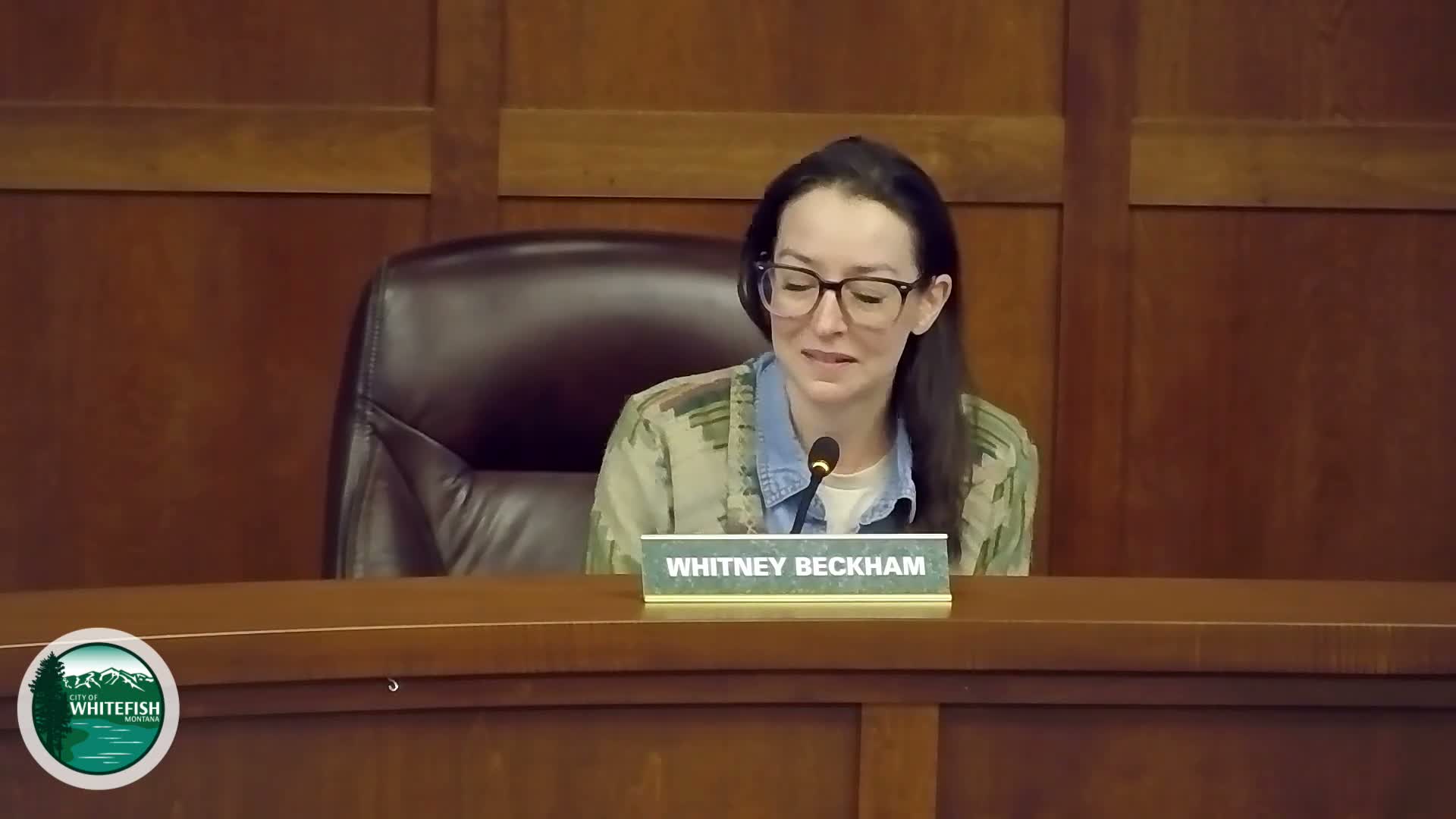
Whitefish planners presented a draft Vision Whitefish 2045 community plan on Feb. 19 and opened a lengthy public hearing that highlighted sharp differences over housing, density and how the city should direct growth.
Alan Tiefenthaler, the city planner leading the project, described the plan as a two-part document: a concise community plan with goals and objectives and an extensive resource document that provides background data and technical appendices. Tiefenthaler emphasized the Montana Land Use Planning Act (MLUPA) requirements that shaped the draft and summarized staff’s approach to population and housing projections: a roughly 3,000–5,000 additional residents over 20 years and an estimated need of about 2,071 housing units by 2045 based on state and consultant analyses (Alan Tiefenthaler). He told the commission the plan intentionally presents “place types” (form‑based descriptions) rather than a purely use‑based future land‑use map.
The meeting became a forum for contrasting views. Many residents and organizations urged the commission to plan for more housing within a walkable radius of downtown and to restore mixed‑use language the staff said some redlines had removed. Leonette Galaz, a renter and community organizer, told commissioners, “The only way that I can stay in this community is if there’s affordable housing in this community” (Leonette Galaz). Keegan Siebenholler of ShelterWF urged the commission to focus growth where infrastructure supports it and asked the commission to adopt a mobility‑oriented downtown strategy to capture a majority of new housing within a mile of downtown (Keegan Siebenholler). Student and business speakers echoed calls for more housing types (missing‑middle housing like triplexes and fourplexes) near core services to reduce sprawl and commuting.
Other speakers urged caution. Several residents asked the commission not to downzone parts of historic neighborhoods and to preserve “neighborhood character.” Rebecca Norton, speaking earlier on the retaining‑wall item, worried that procedural shortcuts exposed neighbors to risk; Rhonda Fitzgerald and others flagged affordability and the need to tie new housing to affordability requirements. Commenters also debated the plan’s treatment of economy and tourism—some urged explicit diversification away from tourism while others warned against removing tourism language.
A recurring technical issue was a state law change requiring local plans to allow 60‑foot buildings in certain downtown residential configurations. Commissioners and staff noted that the statute applies only to full‑time residential in qualifying downtown zones and does not automatically apply to short‑term rental or nonresidential development. The requirement prompted questions about where taller buildings might be allowed and which zones would be subject to the limit.
Commissioners worked through goals and objectives in the land‑use chapter. The commission edited some language (for example, adopting “preserve and enhance” community character language and substituting “resilient materials” for “high quality materials” in design objectives) and added explicit language to support year‑round residents alongside workforce housing. During place‑type review staff and consultants flagged several map “edge” areas where the place‑type label did not match existing zoning or built character (examples raised for review included portions of the Highway 93 corridor, areas north of River Lakes Parkway and pockets near Ash Street and Mountain Park Drive).
The commission paused a detailed place‑type adoption pending staff corrections to the map. Consultants agreed to produce an updated set of place‑type maps and supporting layers (existing zoning, wetlands, building‑age data) and to circulate the revised map before the next session; the commission scheduled follow‑up work sessions and asked staff to post relevant materials. The process will continue at the planning commission’s next meetings with additional work sessions planned before the council receives a recommendation.
Why it matters: the Vision Whitefish 2045 plan will guide where housing and services are encouraged across the city for the next two decades. Key unresolved choices—whether and where to encourage missing‑middle housing, whether to reintroduce mixed‑use policy language, how to interpret the state’s 60‑foot residential mandate, and how to reconcile place types with current zoning—will shape future zoning updates, infrastructure priorities and the city’s ability to meet stated housing needs.
Next steps: staff and consultants will refine the place‑type map and provide updated layers (zoning, wetlands, building age) to the commission for review before the next hearing session; the commission plans to continue land‑use deliberations and then forward a recommendation to the city council.
Alan Tiefenthaler, the city planner leading the project, described the plan as a two-part document: a concise community plan with goals and objectives and an extensive resource document that provides background data and technical appendices. Tiefenthaler emphasized the Montana Land Use Planning Act (MLUPA) requirements that shaped the draft and summarized staff’s approach to population and housing projections: a roughly 3,000–5,000 additional residents over 20 years and an estimated need of about 2,071 housing units by 2045 based on state and consultant analyses (Alan Tiefenthaler). He told the commission the plan intentionally presents “place types” (form‑based descriptions) rather than a purely use‑based future land‑use map.
The meeting became a forum for contrasting views. Many residents and organizations urged the commission to plan for more housing within a walkable radius of downtown and to restore mixed‑use language the staff said some redlines had removed. Leonette Galaz, a renter and community organizer, told commissioners, “The only way that I can stay in this community is if there’s affordable housing in this community” (Leonette Galaz). Keegan Siebenholler of ShelterWF urged the commission to focus growth where infrastructure supports it and asked the commission to adopt a mobility‑oriented downtown strategy to capture a majority of new housing within a mile of downtown (Keegan Siebenholler). Student and business speakers echoed calls for more housing types (missing‑middle housing like triplexes and fourplexes) near core services to reduce sprawl and commuting.
Other speakers urged caution. Several residents asked the commission not to downzone parts of historic neighborhoods and to preserve “neighborhood character.” Rebecca Norton, speaking earlier on the retaining‑wall item, worried that procedural shortcuts exposed neighbors to risk; Rhonda Fitzgerald and others flagged affordability and the need to tie new housing to affordability requirements. Commenters also debated the plan’s treatment of economy and tourism—some urged explicit diversification away from tourism while others warned against removing tourism language.
A recurring technical issue was a state law change requiring local plans to allow 60‑foot buildings in certain downtown residential configurations. Commissioners and staff noted that the statute applies only to full‑time residential in qualifying downtown zones and does not automatically apply to short‑term rental or nonresidential development. The requirement prompted questions about where taller buildings might be allowed and which zones would be subject to the limit.
Commissioners worked through goals and objectives in the land‑use chapter. The commission edited some language (for example, adopting “preserve and enhance” community character language and substituting “resilient materials” for “high quality materials” in design objectives) and added explicit language to support year‑round residents alongside workforce housing. During place‑type review staff and consultants flagged several map “edge” areas where the place‑type label did not match existing zoning or built character (examples raised for review included portions of the Highway 93 corridor, areas north of River Lakes Parkway and pockets near Ash Street and Mountain Park Drive).
The commission paused a detailed place‑type adoption pending staff corrections to the map. Consultants agreed to produce an updated set of place‑type maps and supporting layers (existing zoning, wetlands, building‑age data) and to circulate the revised map before the next session; the commission scheduled follow‑up work sessions and asked staff to post relevant materials. The process will continue at the planning commission’s next meetings with additional work sessions planned before the council receives a recommendation.
Why it matters: the Vision Whitefish 2045 plan will guide where housing and services are encouraged across the city for the next two decades. Key unresolved choices—whether and where to encourage missing‑middle housing, whether to reintroduce mixed‑use policy language, how to interpret the state’s 60‑foot residential mandate, and how to reconcile place types with current zoning—will shape future zoning updates, infrastructure priorities and the city’s ability to meet stated housing needs.
Next steps: staff and consultants will refine the place‑type map and provide updated layers (zoning, wetlands, building age) to the commission for review before the next hearing session; the commission plans to continue land‑use deliberations and then forward a recommendation to the city council.
View the Full Meeting & All Its Details
This article offers just a summary. Unlock complete video, transcripts, and insights as a Founder Member.
✓
Watch full, unedited meeting videos
✓
Search every word spoken in unlimited transcripts
✓
AI summaries & real-time alerts (all government levels)
✓
Permanent access to expanding government content
30-day money-back guarantee
