House Ways & Means hears technical concerns on nonhomestead residential tax classification
February 19, 2026 | Ways & Means, HOUSE OF REPRESENTATIVES, Committees, Legislative , Vermont
This article was created by AI summarizing key points discussed. AI makes mistakes, so for full details and context, please refer to the video of the full meeting. Please report any errors so we can fix them. Report an error »
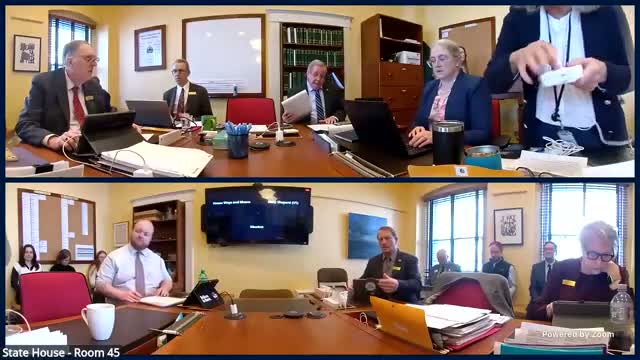
The House Ways & Means Committee on Feb. 19 took up a proposal to create a new nonhomestead residential tax classification, with the Department of Taxes urging clarifications and an eased rollout.
Jake Feldman of the Department of Taxes, who spoke for the department, told the committee that staff had only recently received draft 2.2 and were testifying primarily to draft 2.1. He said the department supports a distinct definition for "employee housing" — dwellings provided by employers to house employees — and that the committee should treat that as a long‑term rental, not a second home. "If UVMMC has some housing that they're providing to their employees as part of working... we think that should be taxed as a long‑term rental," Feldman said.
The department recommended excluding larger commercial apartment buildings (five or more units) from the initial phase, arguing that identifying and apportioning short‑term rental units within larger buildings would impose heavy new workloads on town staff and landlords. Feldman said landlords would need to provide apartment numbers and square footage for apportioning, and towns’ record systems may not currently store that per‑unit information.
Feldman also asked the committee to reconsider a statutory 100% penalty in the draft, saying the language is ambiguous and could be interpreted as doubling taxes owed. "Fraud is really hard to prove," he warned, recommending lighter penalties on early noncompliance and reserving the heaviest sanctions for demonstrated fraud.
On timing, department staff urged that the new dwelling‑use attestation form begin in tax year 2028, not 2027, to allow outreach, form and IT development, and cleaner data collection. Feldman said collecting in 2027 would likely produce low‑quality data and confuse taxpayers; "without these other things in place, the data collected in 2027 would not be particularly high quality," he said.
The committee also pressed technical questions about apportioning land value for mixed‑use parcels. Feldman noted the choice between allocating by total square feet or finished square feet could materially change tax outcomes and create potential loopholes; he gave the example of a large indoor equestrian facility that could skew nonresidential land apportionment.
Several representatives asked whether the department’s timing advice was politically motivated by Act 73; Feldman replied that beyond politics there were fiscal and operational reasons to align the new classification with other Act 73 components so changes in revenue and rates could be synchronized.
The department indicated it will send updated language and recommended that the committee phase in penalties, clarify apportionment methods for mixed‑use parcels, and allow an extra year for municipalities and the tax department to build outreach and IT systems before forms are required.
The hearing continued with stakeholder testimony on implementation details and municipal capacity.
Jake Feldman of the Department of Taxes, who spoke for the department, told the committee that staff had only recently received draft 2.2 and were testifying primarily to draft 2.1. He said the department supports a distinct definition for "employee housing" — dwellings provided by employers to house employees — and that the committee should treat that as a long‑term rental, not a second home. "If UVMMC has some housing that they're providing to their employees as part of working... we think that should be taxed as a long‑term rental," Feldman said.
The department recommended excluding larger commercial apartment buildings (five or more units) from the initial phase, arguing that identifying and apportioning short‑term rental units within larger buildings would impose heavy new workloads on town staff and landlords. Feldman said landlords would need to provide apartment numbers and square footage for apportioning, and towns’ record systems may not currently store that per‑unit information.
Feldman also asked the committee to reconsider a statutory 100% penalty in the draft, saying the language is ambiguous and could be interpreted as doubling taxes owed. "Fraud is really hard to prove," he warned, recommending lighter penalties on early noncompliance and reserving the heaviest sanctions for demonstrated fraud.
On timing, department staff urged that the new dwelling‑use attestation form begin in tax year 2028, not 2027, to allow outreach, form and IT development, and cleaner data collection. Feldman said collecting in 2027 would likely produce low‑quality data and confuse taxpayers; "without these other things in place, the data collected in 2027 would not be particularly high quality," he said.
The committee also pressed technical questions about apportioning land value for mixed‑use parcels. Feldman noted the choice between allocating by total square feet or finished square feet could materially change tax outcomes and create potential loopholes; he gave the example of a large indoor equestrian facility that could skew nonresidential land apportionment.
Several representatives asked whether the department’s timing advice was politically motivated by Act 73; Feldman replied that beyond politics there were fiscal and operational reasons to align the new classification with other Act 73 components so changes in revenue and rates could be synchronized.
The department indicated it will send updated language and recommended that the committee phase in penalties, clarify apportionment methods for mixed‑use parcels, and allow an extra year for municipalities and the tax department to build outreach and IT systems before forms are required.
The hearing continued with stakeholder testimony on implementation details and municipal capacity.
View the Full Meeting & All Its Details
This article offers just a summary. Unlock complete video, transcripts, and insights as a Founder Member.
✓
Watch full, unedited meeting videos
✓
Search every word spoken in unlimited transcripts
✓
AI summaries & real-time alerts (all government levels)
✓
Permanent access to expanding government content
30-day money-back guarantee
