House passes SB 113 to shift administrative oversight of Behavior Analyst board to ADMH with ADRS collaboration
February 20, 2026 | House, Alabama Legislative Sessions, Alabama
This article was created by AI summarizing key points discussed. AI makes mistakes, so for full details and context, please refer to the video of the full meeting. Please report any errors so we can fix them. Report an error »
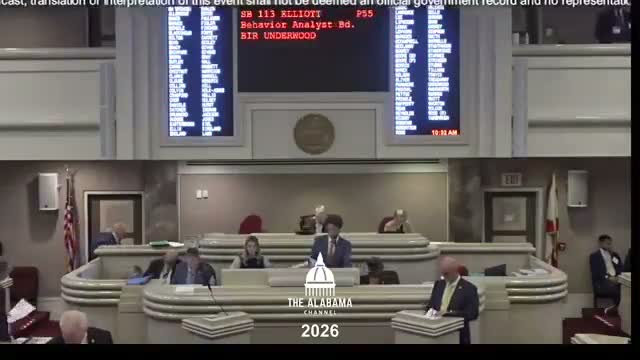
The Alabama House on the floor passed Senate Bill 113 on a recorded vote after adopting a substitute amendment that adds the Department of Rehabilitation Services as a collaborating agency while placing the board’s administrative functions under the Alabama Department of Mental Health (ADMH).
Lawmakers spent more than an hour on the bill’s background, including repeated findings from audits that the independent board had no executive director at times, failed to comply with the Open Meetings Act, allowed sensitive records to be mishandled, and left consumer complaints unresolved for long periods. The sponsor told members the legislative fix preserves licensing requirements and service delivery while centralizing administrative duties to improve oversight and responsiveness.
Representative Halsey, sponsor of the substitute amendment, said the amendment clarifies definitions and interagency roles. "Autism spectrum disorder is a neurological and developmental disorder that affects how people interact with others, communicate, learn, and behave," Halsey said as she walked members through the revised statutory language and technical renumbering the amendment makes.
Members pressed whether placing autism-related oversight under ADMH could reduce access or subject matter expertise. Several lawmakers argued autism services are distinct from other mental-health services and asked how parental concerns and service continuity would be protected. Representative Bracey objected to the timing and scale of the late substitute, saying members and constituents had not had adequate time to vet the changes. "This is not a small amendment. This is an entire substitute," Bracey said, urging fuller review and clearer public communication.
The sponsor and amendment backers repeatedly said the measure does not alter how licensed behavior analysts are certified or billed in statute. "How individuals are licensed in this act are unchanged and is coded in the statute not subject to discretion," the sponsor said, adding that ADMH would provide administrative infrastructure — an executive director, financial and legal services, IT and office support — while the advisory board retains the role of conducting hearings.
The House adopted Representative Halsey’s substitute by recorded vote on the floor and later gave final passage to SB 113 as amended; the clerk announced the final tally as 92 ayes and the bill passed.
Why it matters: The change moves the board out of independent administration and into an executive-department administrative structure intended to address repeated audit findings and shorten complaint resolution timelines. Supporters said the reorganization will improve administrative reliability without changing clinicians’ licensure standards; critics warned about process speed and potential service confusion for families.
What’s next: With House passage as amended, SB 113 will return to the Senate for any concurrence on the amendment or be enrolled to the governor if procedural steps are complete.
Lawmakers spent more than an hour on the bill’s background, including repeated findings from audits that the independent board had no executive director at times, failed to comply with the Open Meetings Act, allowed sensitive records to be mishandled, and left consumer complaints unresolved for long periods. The sponsor told members the legislative fix preserves licensing requirements and service delivery while centralizing administrative duties to improve oversight and responsiveness.
Representative Halsey, sponsor of the substitute amendment, said the amendment clarifies definitions and interagency roles. "Autism spectrum disorder is a neurological and developmental disorder that affects how people interact with others, communicate, learn, and behave," Halsey said as she walked members through the revised statutory language and technical renumbering the amendment makes.
Members pressed whether placing autism-related oversight under ADMH could reduce access or subject matter expertise. Several lawmakers argued autism services are distinct from other mental-health services and asked how parental concerns and service continuity would be protected. Representative Bracey objected to the timing and scale of the late substitute, saying members and constituents had not had adequate time to vet the changes. "This is not a small amendment. This is an entire substitute," Bracey said, urging fuller review and clearer public communication.
The sponsor and amendment backers repeatedly said the measure does not alter how licensed behavior analysts are certified or billed in statute. "How individuals are licensed in this act are unchanged and is coded in the statute not subject to discretion," the sponsor said, adding that ADMH would provide administrative infrastructure — an executive director, financial and legal services, IT and office support — while the advisory board retains the role of conducting hearings.
The House adopted Representative Halsey’s substitute by recorded vote on the floor and later gave final passage to SB 113 as amended; the clerk announced the final tally as 92 ayes and the bill passed.
Why it matters: The change moves the board out of independent administration and into an executive-department administrative structure intended to address repeated audit findings and shorten complaint resolution timelines. Supporters said the reorganization will improve administrative reliability without changing clinicians’ licensure standards; critics warned about process speed and potential service confusion for families.
What’s next: With House passage as amended, SB 113 will return to the Senate for any concurrence on the amendment or be enrolled to the governor if procedural steps are complete.
Don't Miss a Word: See the Full Meeting!
Go beyond summaries. Unlock every video, transcript, and key insight with a Founder Membership.
✓
Get instant access to full meeting videos
✓
Search and clip any phrase from complete transcripts
✓
Receive AI-powered summaries & custom alerts
✓
Enjoy lifetime, unrestricted access to government data
30-day money-back guarantee
