Council's criminal justice hearing spotlights plans to restore jail programming and expand reentry supports
February 20, 2026 | New York City Council, New York City, New York County, New York
This article was created by AI summarizing key points discussed. AI makes mistakes, so for full details and context, please refer to the video of the full meeting. Please report any errors so we can fix them. Report an error »
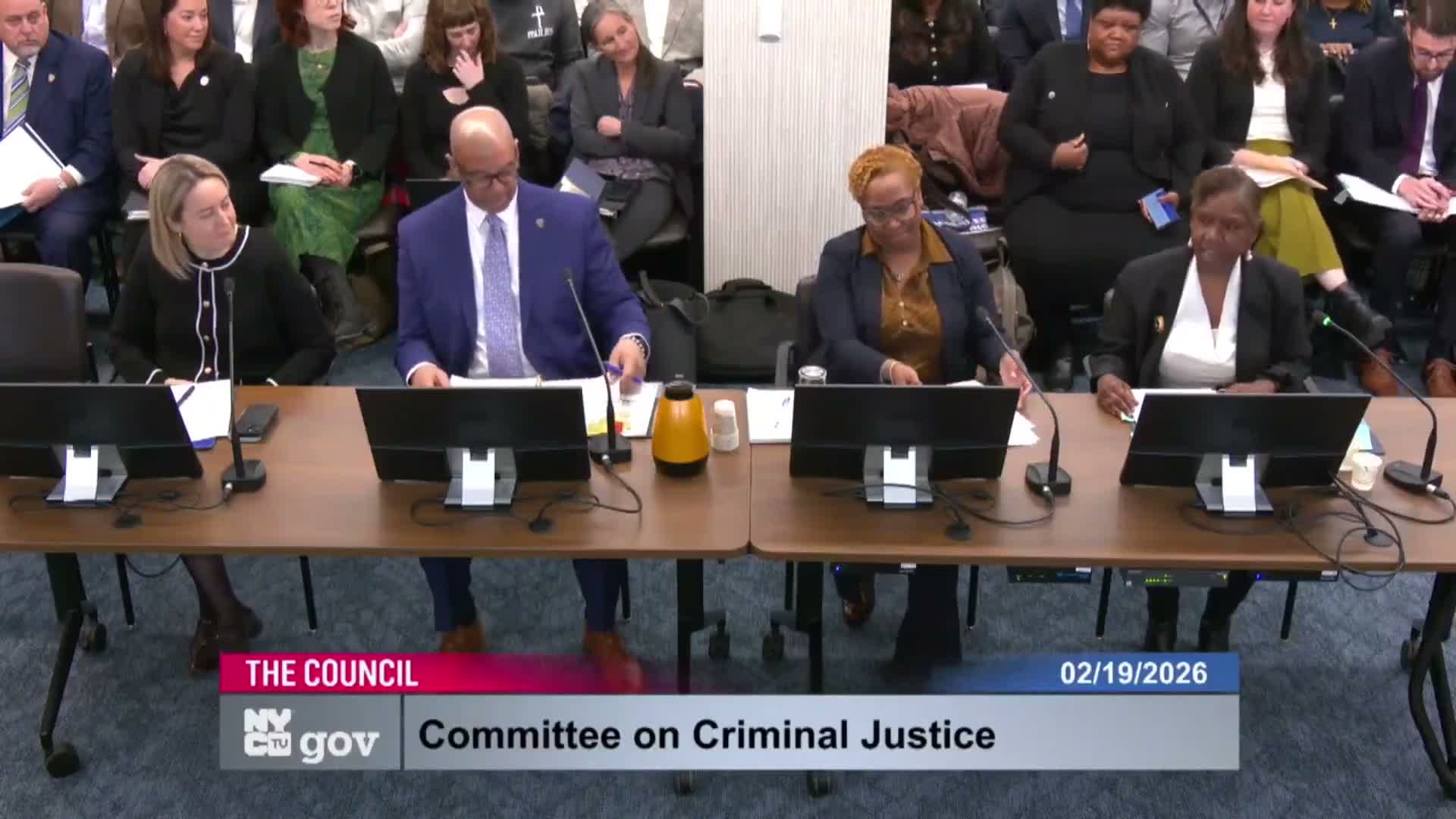
Council members heard detailed testimony on Wednesday about how the city plans to rebuild and expand programming designed to reduce recidivism and improve reentry outcomes.
Chair Silvina Brooks Powers opened the Committee on Criminal Justice hearing by describing the agenda: agencies would report on jail programming and reentry and respond to a bill, Intro. 246, that would require the Department of Correction to return unused commissary funds to people before release.
Deanna Logan, director of the mayor's office of criminal justice (MACJ), framed the policy rationale: "Public health is public safety," she said, and described recent system-level data showing the jail population rose to about 6,836 since 2022. Logan and MACJ staff stressed that many people in custody have complex behavioral-health and housing needs and that the city's transitional housing program is funded for 1,000 beds with roughly 800 online.
Newly appointed Department of Correction Commissioner Stanley Richards described a strategy built on four pillars: safe, humane jails; stronger partnerships; population reduction tied to a continuum of care; and preparation for borough-based jails. "Safety is fundamental. Without safety, nothing else works," Richards said, adding that change will take years and must be measured honestly.
Sharron Goodwin, the new commissioner of the Department of Probation, said probation must pair accountability with services and evidence-based supports such as cognitive behavioral interventions and workforce programs. "People can change," Goodwin said, and her department is evaluating programs, recruitment and stakeholder engagement to strengthen outcomes.
Agency witnesses described operational gaps that affect programming. DOC and MACJ staff said they are bringing nonprofit providers back to Rikers after contract re‑instatements: the Osborne Association, Fortune Society, Fedcap and PD Green were named as contractors for trauma-informed care, substance-misuse services, transportation and supplemental education. DOC staff said providers have begun onboarding and that a sober living community recently opened on Rikers.
Correctional Health Services said it submits supportive-housing referrals to HRA for people with serious mental illness but faces placement obstacles because discharge dates are often unknown and the supply of housing does not meet demand. "Our applications are, almost universally, deemed appropriate," Jeanette Merrill of Correctional Health Services said, noting that securing units is the bottleneck.
Committee members pressed agencies on compliance with legal mandates: the five-hour daily out-of-cell programming requirement and Local Law 42 (which restricts solitary for people under 22 and requires trauma-informed programming). DOC staff said they are reassessing how the five hours are defined and how metrics should capture both quantity and quality of programming. On education, DOC described coordination with the Department of Education to identify and escort school-eligible young adults and noted persistent staffing and classroom-space constraints in certain housing units.
Witnesses also reported practical supports that affect reentry outcomes: DOC said about 88% of people have access to tablets that host educational content and that tablets average roughly two hours of use per day; MACJ said its transitional housing pipeline continues to expand but that siting and community acceptance remain challenges.
Public testimony emphasized workforce and reentry partnerships. Probation officers' union leaders, reentry nonprofits and people with lived experience urged the council to invest in hiring and retention, expand warm handoffs to community providers, ensure access to identification and housing, and implement evidence-based programs that have measurable impacts on recidivism.
The hearing included discussion of Intro. 246 (Hudson), which would require the Department of Correction to return unused commissary funds in cash before release and ban fees for returns. DOC's general counsel, Jim Conroy, told the committee that roughly 70% of commissary accounts have under $100 and that the department wants to improve messaging and technical processes so funds are returned more reliably.
No formal vote was taken during the hearing. Committee members dismissed the panel and signaled plans for follow-up oversight and additional rounds of questions.
Looking ahead, agencies said they will continue implementing the borough-based jail transition, refine definitions and measurement of the five-hour programming standard, expand partnerships with community providers, and work with the council on operational details such as commissary refunds, cell-door repairs and education staffing.
Chair Silvina Brooks Powers opened the Committee on Criminal Justice hearing by describing the agenda: agencies would report on jail programming and reentry and respond to a bill, Intro. 246, that would require the Department of Correction to return unused commissary funds to people before release.
Deanna Logan, director of the mayor's office of criminal justice (MACJ), framed the policy rationale: "Public health is public safety," she said, and described recent system-level data showing the jail population rose to about 6,836 since 2022. Logan and MACJ staff stressed that many people in custody have complex behavioral-health and housing needs and that the city's transitional housing program is funded for 1,000 beds with roughly 800 online.
Newly appointed Department of Correction Commissioner Stanley Richards described a strategy built on four pillars: safe, humane jails; stronger partnerships; population reduction tied to a continuum of care; and preparation for borough-based jails. "Safety is fundamental. Without safety, nothing else works," Richards said, adding that change will take years and must be measured honestly.
Sharron Goodwin, the new commissioner of the Department of Probation, said probation must pair accountability with services and evidence-based supports such as cognitive behavioral interventions and workforce programs. "People can change," Goodwin said, and her department is evaluating programs, recruitment and stakeholder engagement to strengthen outcomes.
Agency witnesses described operational gaps that affect programming. DOC and MACJ staff said they are bringing nonprofit providers back to Rikers after contract re‑instatements: the Osborne Association, Fortune Society, Fedcap and PD Green were named as contractors for trauma-informed care, substance-misuse services, transportation and supplemental education. DOC staff said providers have begun onboarding and that a sober living community recently opened on Rikers.
Correctional Health Services said it submits supportive-housing referrals to HRA for people with serious mental illness but faces placement obstacles because discharge dates are often unknown and the supply of housing does not meet demand. "Our applications are, almost universally, deemed appropriate," Jeanette Merrill of Correctional Health Services said, noting that securing units is the bottleneck.
Committee members pressed agencies on compliance with legal mandates: the five-hour daily out-of-cell programming requirement and Local Law 42 (which restricts solitary for people under 22 and requires trauma-informed programming). DOC staff said they are reassessing how the five hours are defined and how metrics should capture both quantity and quality of programming. On education, DOC described coordination with the Department of Education to identify and escort school-eligible young adults and noted persistent staffing and classroom-space constraints in certain housing units.
Witnesses also reported practical supports that affect reentry outcomes: DOC said about 88% of people have access to tablets that host educational content and that tablets average roughly two hours of use per day; MACJ said its transitional housing pipeline continues to expand but that siting and community acceptance remain challenges.
Public testimony emphasized workforce and reentry partnerships. Probation officers' union leaders, reentry nonprofits and people with lived experience urged the council to invest in hiring and retention, expand warm handoffs to community providers, ensure access to identification and housing, and implement evidence-based programs that have measurable impacts on recidivism.
The hearing included discussion of Intro. 246 (Hudson), which would require the Department of Correction to return unused commissary funds in cash before release and ban fees for returns. DOC's general counsel, Jim Conroy, told the committee that roughly 70% of commissary accounts have under $100 and that the department wants to improve messaging and technical processes so funds are returned more reliably.
No formal vote was taken during the hearing. Committee members dismissed the panel and signaled plans for follow-up oversight and additional rounds of questions.
Looking ahead, agencies said they will continue implementing the borough-based jail transition, refine definitions and measurement of the five-hour programming standard, expand partnerships with community providers, and work with the council on operational details such as commissary refunds, cell-door repairs and education staffing.
View the Full Meeting & All Its Details
This article offers just a summary. Unlock complete video, transcripts, and insights as a Founder Member.
✓
Watch full, unedited meeting videos
✓
Search every word spoken in unlimited transcripts
✓
AI summaries & real-time alerts (all government levels)
✓
Permanent access to expanding government content
30-day money-back guarantee
