GCSD members warn of big cost for force-main replacement as finance committee presses for clearer reporting
February 19, 2026 | Half Moon Bay, Half Moon Bay City, San Mateo County, California
This article was created by AI summarizing key points discussed. AI makes mistakes, so for full details and context, please refer to the video of the full meeting. Please report any errors so we can fix them. Report an error »
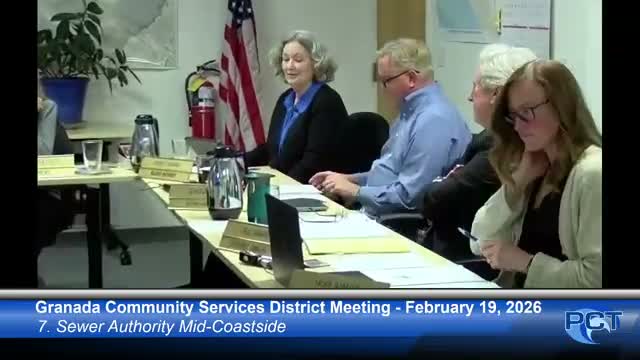
The Granada Community Services District (GCSD) discussed looming infrastructure costs at its Feb. 19 meeting after the finance committee flagged years of unbudgeted spending and presented an approach to shore up oversight.
Finance committee members told the board that unplanned capitalized work and other carryover projects have eroded funds set aside for the proposed force-main replacement. The committee recommended adding a $400,000 equipment line in the treatment budget to cover recurring capitalizable fixes and begin monthly line-item reporting so the full board can track spending against specific projects.
Committee presenters said the Monterra/Montero force main has experienced multiple leaks in the last year and will need replacement. A design-build firm will provide a maximum “not-to-exceed” price in May; staff and committee members estimated the full build and related management costs could approach $12–13 million. Member agencies previously allocated about $6.5 million toward the project, and staff proposed proceeding now with roughly $3.5 million of the identified needs while planning a midyear budget adjustment to cover the remainder.
Board members and finance committee speakers emphasized that past budgets included long lists of projects that then stretched across several years, sometimes with cost estimates that grew two to three times. The committee said past financial reporting made it hard for board members to see cumulative spending on older projects; it recommended monthly reporting on each infrastructure line so the board can follow expenditures as they occur.
Officials said there are two paths if the May design-build price is unacceptable: proceed to a public competitive bid process, which would add months to the schedule, or negotiate with the design-build firm while showing demonstrable progress on the project to preserve existing regulatory deadlines. Staff noted that any significant delay could require re-opening negotiations with funding partners and potentially trigger fee-revisit processes under Proposition 218 for sewer rates.
The finance committee’s presentation also suggested reallocating some project funding over the next two fiscal years and staging decisions so member agencies can manage the cash flow. The board did not take a final financing vote at the Feb. 19 meeting; members said they expect more detailed cost and contract information when the design-build firm submits its not-to-exceed number in May.
Next steps: staff will request the design-build firm’s maximum price in May, continue monthly infrastructure reporting to the board, and prepare options for a midyear budget adjustment if the contract price requires additional funding.
Finance committee members told the board that unplanned capitalized work and other carryover projects have eroded funds set aside for the proposed force-main replacement. The committee recommended adding a $400,000 equipment line in the treatment budget to cover recurring capitalizable fixes and begin monthly line-item reporting so the full board can track spending against specific projects.
Committee presenters said the Monterra/Montero force main has experienced multiple leaks in the last year and will need replacement. A design-build firm will provide a maximum “not-to-exceed” price in May; staff and committee members estimated the full build and related management costs could approach $12–13 million. Member agencies previously allocated about $6.5 million toward the project, and staff proposed proceeding now with roughly $3.5 million of the identified needs while planning a midyear budget adjustment to cover the remainder.
Board members and finance committee speakers emphasized that past budgets included long lists of projects that then stretched across several years, sometimes with cost estimates that grew two to three times. The committee said past financial reporting made it hard for board members to see cumulative spending on older projects; it recommended monthly reporting on each infrastructure line so the board can follow expenditures as they occur.
Officials said there are two paths if the May design-build price is unacceptable: proceed to a public competitive bid process, which would add months to the schedule, or negotiate with the design-build firm while showing demonstrable progress on the project to preserve existing regulatory deadlines. Staff noted that any significant delay could require re-opening negotiations with funding partners and potentially trigger fee-revisit processes under Proposition 218 for sewer rates.
The finance committee’s presentation also suggested reallocating some project funding over the next two fiscal years and staging decisions so member agencies can manage the cash flow. The board did not take a final financing vote at the Feb. 19 meeting; members said they expect more detailed cost and contract information when the design-build firm submits its not-to-exceed number in May.
Next steps: staff will request the design-build firm’s maximum price in May, continue monthly infrastructure reporting to the board, and prepare options for a midyear budget adjustment if the contract price requires additional funding.
View the Full Meeting & All Its Details
This article offers just a summary. Unlock complete video, transcripts, and insights as a Founder Member.
✓
Watch full, unedited meeting videos
✓
Search every word spoken in unlimited transcripts
✓
AI summaries & real-time alerts (all government levels)
✓
Permanent access to expanding government content
30-day money-back guarantee
