Historic zoning panel gives mixed feedback on large addition at 1803 Clinch Avenue; commissioners press for masonry and clearer elevations
February 19, 2026 | Knox County, Tennessee
This article was created by AI summarizing key points discussed. AI makes mistakes, so for full details and context, please refer to the video of the full meeting. Please report any errors so we can fix them. Report an error »
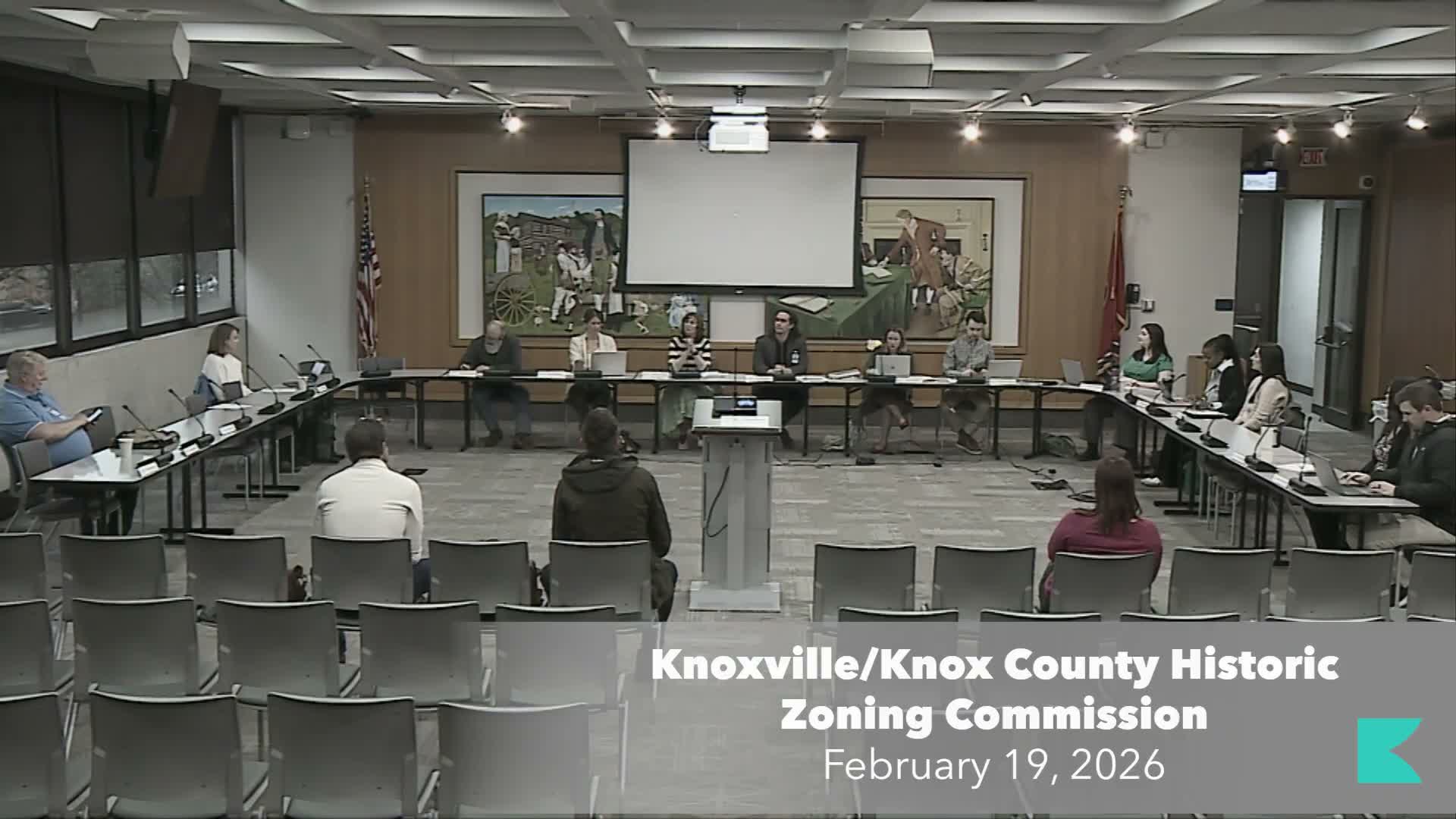
Logan Higgins, a project representative, presented three design options Feb. 19 for a new secondary structure behind a historic Fort Sanders house at 1803 Clinch Avenue, saying the existing house is "in phenomenal shape" and the owner seeks more usable square footage while preserving the primary structure. Higgins described options that step back a third floor and use either a reflective glass facade, lap siding, or a full brick screen that would conceal parking accessed from the alley and provide six parking spaces.
Commissioners and staff pressed the applicant for clearer, contextual drawings and raised repeated concerns about materials and massing. An unidentified staff member said the guidelines are primarily concerned with "height, scale and massing" and cautioned that "major modifications would return to the commission." Several commissioners said they preferred masonry to a mirrored material meant to make the third floor less visible. One commissioner said they "would rather see the masonry and stand up to the big building behind you rather than acquiesce to the big building's material." Another noted that, while edge conditions can provide flexibility, additions should still read as subordinate to the historic structure.
Panel members requested a street elevation showing the addition in context with neighboring buildings and asked that the applicant refine fenestration and alignment so new openings better match the immediate block. Commissioners also discussed siding reveal (4‑inch reveal recommended by staff for fiber‑cement lap siding), porch articulation, and whether arches shown in some options fit the block context. Several commissioners encouraged the team to prioritize clarity in window openings and align the brick screen wall with neighboring rhythms.
Higgins and members of the design team indicated they would provide revised drawings that include street elevations and additional context photos; they also said they were willing to consider a fully masonry option for the upper stories. Because the session was a nonbinding workshop, commissioners did not take a formal vote. The panel closed by asking the applicant to return with the requested clarifications and more detailed elevations for formal review.
Next procedural step: applicant to prepare and submit street elevation, contextual photos and revised drawings for staff review and likely return to the commission for a formal certificate of appropriateness application.
Commissioners and staff pressed the applicant for clearer, contextual drawings and raised repeated concerns about materials and massing. An unidentified staff member said the guidelines are primarily concerned with "height, scale and massing" and cautioned that "major modifications would return to the commission." Several commissioners said they preferred masonry to a mirrored material meant to make the third floor less visible. One commissioner said they "would rather see the masonry and stand up to the big building behind you rather than acquiesce to the big building's material." Another noted that, while edge conditions can provide flexibility, additions should still read as subordinate to the historic structure.
Panel members requested a street elevation showing the addition in context with neighboring buildings and asked that the applicant refine fenestration and alignment so new openings better match the immediate block. Commissioners also discussed siding reveal (4‑inch reveal recommended by staff for fiber‑cement lap siding), porch articulation, and whether arches shown in some options fit the block context. Several commissioners encouraged the team to prioritize clarity in window openings and align the brick screen wall with neighboring rhythms.
Higgins and members of the design team indicated they would provide revised drawings that include street elevations and additional context photos; they also said they were willing to consider a fully masonry option for the upper stories. Because the session was a nonbinding workshop, commissioners did not take a formal vote. The panel closed by asking the applicant to return with the requested clarifications and more detailed elevations for formal review.
Next procedural step: applicant to prepare and submit street elevation, contextual photos and revised drawings for staff review and likely return to the commission for a formal certificate of appropriateness application.
View the Full Meeting & All Its Details
This article offers just a summary. Unlock complete video, transcripts, and insights as a Founder Member.
✓
Watch full, unedited meeting videos
✓
Search every word spoken in unlimited transcripts
✓
AI summaries & real-time alerts (all government levels)
✓
Permanent access to expanding government content
30-day money-back guarantee
