Senate committee hears bill to preserve state coverage of preventive services and vaccines
February 19, 2026 | Legislative Sessions, Washington
This article was created by AI summarizing key points discussed. AI makes mistakes, so for full details and context, please refer to the video of the full meeting. Please report any errors so we can fix them. Report an error »
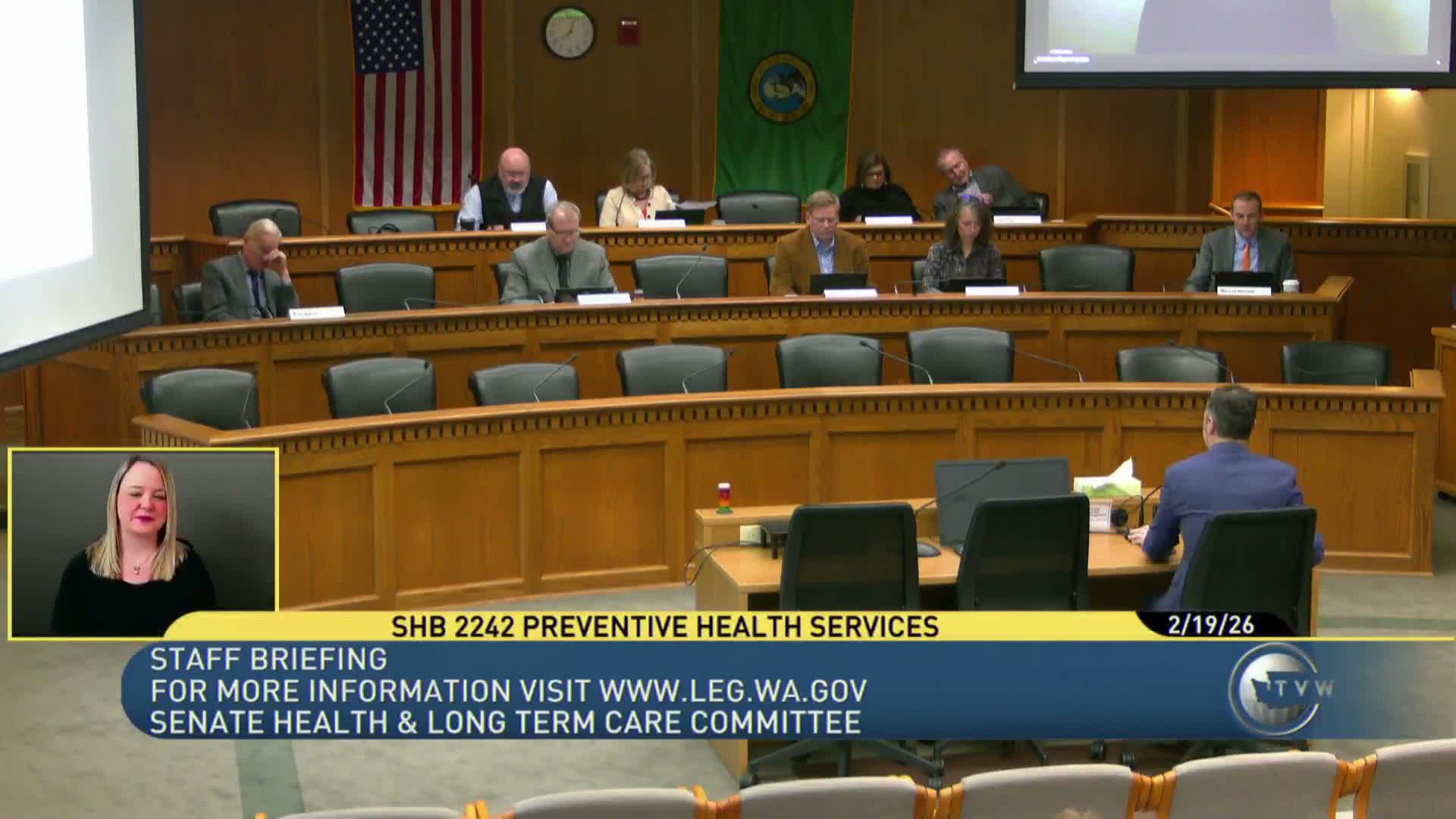
The Senate Health and Long‑Term Care Committee on Feb. 19 heard engrossed substitute House Bill 2,242, a measure intended to preserve Washington residents’ access to preventive services and vaccines if federal recommendations change.
Committee staff briefed members that the bill would tie state coverage requirements for preventive services to the U.S. Preventive Services Task Force and HRSA as those bodies existed on June 30, 2025, allow the Office of the Insurance Commissioner to update coverage rules after that date only by rulemaking that remains at least as favorable to enrollees, and require the Department of Health to consider ACIP and other experts when issuing immunization recommendations. The bill also directs JLARC to review the law by Nov. 15, 2032, to assess access and vaccine purchasing cost‑effectiveness.
Dennis Worsham, Secretary of Health, told the committee the bill would not create new vaccine mandates or change consent laws and said policymakers were seeing a rise in vaccine‑preventable disease; he said, "As of yesterday, there is 24 confirmed cases of measles here in the state of Washington," arguing the measure would keep immunizations available and affordable.
Caitlin Safard, senior health policy adviser to the governor, said the bill gives Washington flexibility to set state recommendations rather than automatically following federal changes and helps avoid confusion when ACIP meets. Jane Beyer of the Office of the Insurance Commissioner said her office supports the bill to prevent gaps in no‑cost coverage that could otherwise leave consumers paying out of pocket and to preserve access to federal discounted vaccine pricing.
Opponents included remote witness Bob Reynolds of Informed Choice Washington, who said the bill would politicize public‑health recommendations and raised concerns about trade‑group influence on the Department of Health process. Public‑health officials and clinicians, including Jay Miller (Tacoma‑Pierce County health officer), testified in support, saying transparent, state‑level recommendations can better reflect local epidemiology.
The committee recorded hundreds of public sign‑ins on the measure; testimony closed and the committee paused public hearings to go into an executive session later in the agenda. No final floor action on HB 2,242 occurred during the Feb. 19 public hearing.
Committee staff briefed members that the bill would tie state coverage requirements for preventive services to the U.S. Preventive Services Task Force and HRSA as those bodies existed on June 30, 2025, allow the Office of the Insurance Commissioner to update coverage rules after that date only by rulemaking that remains at least as favorable to enrollees, and require the Department of Health to consider ACIP and other experts when issuing immunization recommendations. The bill also directs JLARC to review the law by Nov. 15, 2032, to assess access and vaccine purchasing cost‑effectiveness.
Dennis Worsham, Secretary of Health, told the committee the bill would not create new vaccine mandates or change consent laws and said policymakers were seeing a rise in vaccine‑preventable disease; he said, "As of yesterday, there is 24 confirmed cases of measles here in the state of Washington," arguing the measure would keep immunizations available and affordable.
Caitlin Safard, senior health policy adviser to the governor, said the bill gives Washington flexibility to set state recommendations rather than automatically following federal changes and helps avoid confusion when ACIP meets. Jane Beyer of the Office of the Insurance Commissioner said her office supports the bill to prevent gaps in no‑cost coverage that could otherwise leave consumers paying out of pocket and to preserve access to federal discounted vaccine pricing.
Opponents included remote witness Bob Reynolds of Informed Choice Washington, who said the bill would politicize public‑health recommendations and raised concerns about trade‑group influence on the Department of Health process. Public‑health officials and clinicians, including Jay Miller (Tacoma‑Pierce County health officer), testified in support, saying transparent, state‑level recommendations can better reflect local epidemiology.
The committee recorded hundreds of public sign‑ins on the measure; testimony closed and the committee paused public hearings to go into an executive session later in the agenda. No final floor action on HB 2,242 occurred during the Feb. 19 public hearing.
View the Full Meeting & All Its Details
This article offers just a summary. Unlock complete video, transcripts, and insights as a Founder Member.
✓
Watch full, unedited meeting videos
✓
Search every word spoken in unlimited transcripts
✓
AI summaries & real-time alerts (all government levels)
✓
Permanent access to expanding government content
30-day money-back guarantee
