Bill to let students buy or receive surplus school tech at reduced cost draws strong public support
February 19, 2026 | Legislative Sessions, Washington
This article was created by AI summarizing key points discussed. AI makes mistakes, so for full details and context, please refer to the video of the full meeting. Please report any errors so we can fix them. Report an error »
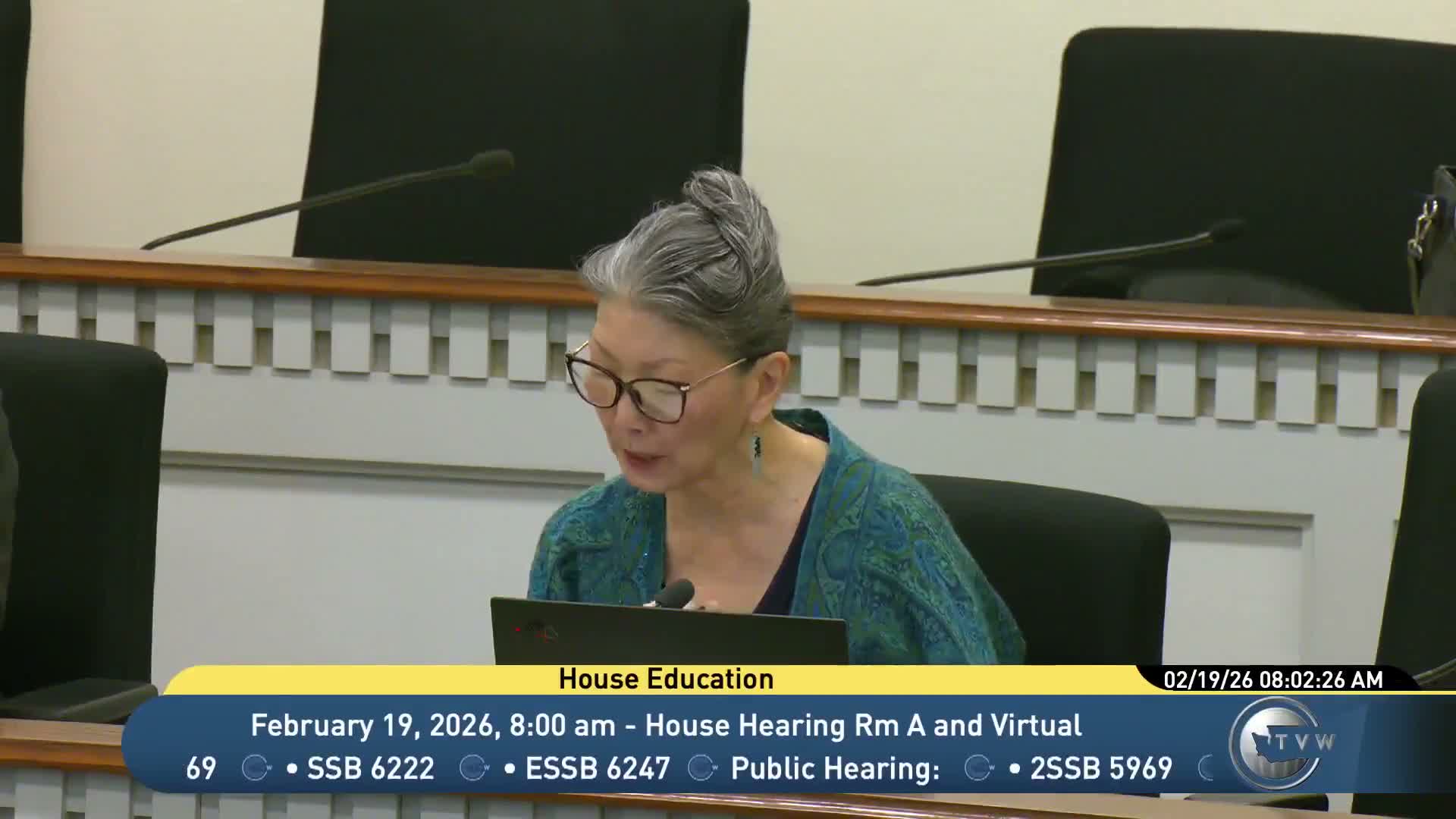
The House Education Committee heard testimony on substitute Senate Bill 6,222, which would exempt school districts and educational service districts from typical public‑notice requirements when they sell or grant surplus technology hardware to public school students, and would prioritize low‑income students for free grants.
Ethan Moreno, nonpartisan staff, explained the bill permits districts and ESDs to sell surplus computers, laptops and other devices at a depreciated cost to public school students or grant devices at no cost to students from low‑income families. The bill requires transfers of ownership to be recorded in an agreement specifying any cost and establishes definitions for qualifying items and beneficiaries.
State Senator Victoria Hunt, the bill's sponsor, told the committee the measure responded to constituent requests from the Issaquah School District and aims to help students keep devices they used in school for post‑school pursuits such as work and college. "Many students when they leave the school system just don't have access to the same computers or the same technology that they have really gotten used to using during the school year," Hunt said, arguing the bill prioritizes low‑income students and preserves existing transfer practices between districts.
Advocates framed the bill both as an equity measure and as a waste‑reduction policy. Heather Trim of 0 Waste Washington said schools often have closets full of repairable devices and argued reuse reduces the carbon footprint associated with manufacturing. "We are sending 400,000 laptops or computers to the landfill or equivalent right now every year," Trim said, urging support for the bill because it would extend device life and reduce waste.
Martin Tierney, chief of finance and operations for the Issaquah School District, supported the bill as a practical way to maximize public investment and prioritize equitable access: districts could sell devices at depreciated cost or grant them at no cost to low‑income students, with documentation to protect transparency.
The chair closed the public hearing after Vice Chair Shavers read the sign‑in totals recorded in the hearing record (transcript readout: "243 pro, 1 con, 0 other"). No formal committee action was taken at the hearing; committee staff were asked to provide any necessary comparisons with companion House legislation and clarifications on implementation details.
Next steps: The committee will consider amendments before executive session; no final vote was recorded during the hearing.
Ethan Moreno, nonpartisan staff, explained the bill permits districts and ESDs to sell surplus computers, laptops and other devices at a depreciated cost to public school students or grant devices at no cost to students from low‑income families. The bill requires transfers of ownership to be recorded in an agreement specifying any cost and establishes definitions for qualifying items and beneficiaries.
State Senator Victoria Hunt, the bill's sponsor, told the committee the measure responded to constituent requests from the Issaquah School District and aims to help students keep devices they used in school for post‑school pursuits such as work and college. "Many students when they leave the school system just don't have access to the same computers or the same technology that they have really gotten used to using during the school year," Hunt said, arguing the bill prioritizes low‑income students and preserves existing transfer practices between districts.
Advocates framed the bill both as an equity measure and as a waste‑reduction policy. Heather Trim of 0 Waste Washington said schools often have closets full of repairable devices and argued reuse reduces the carbon footprint associated with manufacturing. "We are sending 400,000 laptops or computers to the landfill or equivalent right now every year," Trim said, urging support for the bill because it would extend device life and reduce waste.
Martin Tierney, chief of finance and operations for the Issaquah School District, supported the bill as a practical way to maximize public investment and prioritize equitable access: districts could sell devices at depreciated cost or grant them at no cost to low‑income students, with documentation to protect transparency.
The chair closed the public hearing after Vice Chair Shavers read the sign‑in totals recorded in the hearing record (transcript readout: "243 pro, 1 con, 0 other"). No formal committee action was taken at the hearing; committee staff were asked to provide any necessary comparisons with companion House legislation and clarifications on implementation details.
Next steps: The committee will consider amendments before executive session; no final vote was recorded during the hearing.
View the Full Meeting & All Its Details
This article offers just a summary. Unlock complete video, transcripts, and insights as a Founder Member.
✓
Watch full, unedited meeting videos
✓
Search every word spoken in unlimited transcripts
✓
AI summaries & real-time alerts (all government levels)
✓
Permanent access to expanding government content
30-day money-back guarantee
