Senate committee advances amended bill tightening rules for marriages of 16–17-year-olds
February 19, 2026 | 2026 Legislature SD, South Dakota
This article was created by AI summarizing key points discussed. AI makes mistakes, so for full details and context, please refer to the video of the full meeting. Please report any errors so we can fix them. Report an error »
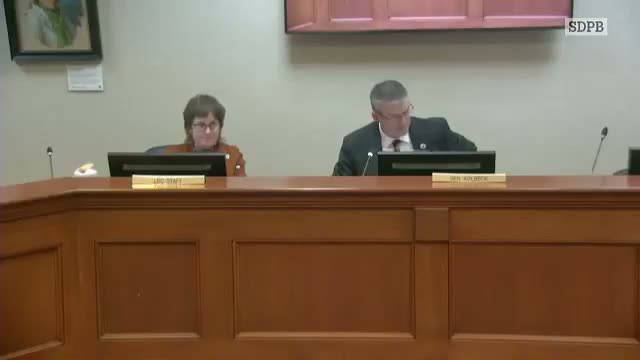
Senator Tom Pyschke, sponsor of Senate Bill 159, told the Senate Judiciary Committee on Feb. 19 the bill “makes 18 the clear and consistent legal standard for marriage in our state,” while preserving a narrow, supervised pathway for 16- and 17-year-olds.
Pyschke said the measure closes what he described as a loophole that currently allows minors to marry “with minimal oversight” and replaces it with “stronger safeguards” including private judicial interviews, written findings about coercion and safety, a 30-day waiting period and a parental-consent requirement. “This bill strengthens our laws, protects vulnerable minors, and aligns our state with a growing national commitment to safeguarding children,” he said.
Opponents — including survivor-advocacy groups and direct-service providers testifying online and in the room — said those safeguards are inadequate. Michelle Hanash, director of policy and women’s programs at a survivor-founded nonprofit, urged lawmakers to “end child marriage” rather than create a judicial-review pathway. “Even with all the safeguards in the world, the judicial process still puts the onus on a terrified minor to tell the court that they are being forced to marry,” she said.
Kendall Evans of Unchained at Last and Becca Powell of Enchanted at Last told the committee that parental consent often equates to parental coercion, and that the proposed 10-year age gap in earlier drafts would not address the principal power imbalance between minors and their parents. Patty Duffy, register of deeds for Stanley County, testified about administrative and recordkeeping questions in the bill’s current language, including whether court orders must be retained permanently and how clerks should verify parental identity.
During committee debate, lawmakers described the measure as a compromise between an absolute ban (no exceptions) and the status quo. Senator Hulse moved an amendment (1-59A) that tightened the proposed age-gap cap to four years; the committee adopted the amendment by recorded vote and later voted to send SB159A to the Senate floor 5–2.
What’s next: SB159A will go to the full Senate for further debate and a floor vote. Committee discussion indicated sponsors are open to technical fixes on recordkeeping and implementation details before floor consideration.
Pyschke said the measure closes what he described as a loophole that currently allows minors to marry “with minimal oversight” and replaces it with “stronger safeguards” including private judicial interviews, written findings about coercion and safety, a 30-day waiting period and a parental-consent requirement. “This bill strengthens our laws, protects vulnerable minors, and aligns our state with a growing national commitment to safeguarding children,” he said.
Opponents — including survivor-advocacy groups and direct-service providers testifying online and in the room — said those safeguards are inadequate. Michelle Hanash, director of policy and women’s programs at a survivor-founded nonprofit, urged lawmakers to “end child marriage” rather than create a judicial-review pathway. “Even with all the safeguards in the world, the judicial process still puts the onus on a terrified minor to tell the court that they are being forced to marry,” she said.
Kendall Evans of Unchained at Last and Becca Powell of Enchanted at Last told the committee that parental consent often equates to parental coercion, and that the proposed 10-year age gap in earlier drafts would not address the principal power imbalance between minors and their parents. Patty Duffy, register of deeds for Stanley County, testified about administrative and recordkeeping questions in the bill’s current language, including whether court orders must be retained permanently and how clerks should verify parental identity.
During committee debate, lawmakers described the measure as a compromise between an absolute ban (no exceptions) and the status quo. Senator Hulse moved an amendment (1-59A) that tightened the proposed age-gap cap to four years; the committee adopted the amendment by recorded vote and later voted to send SB159A to the Senate floor 5–2.
What’s next: SB159A will go to the full Senate for further debate and a floor vote. Committee discussion indicated sponsors are open to technical fixes on recordkeeping and implementation details before floor consideration.
View the Full Meeting & All Its Details
This article offers just a summary. Unlock complete video, transcripts, and insights as a Founder Member.
✓
Watch full, unedited meeting videos
✓
Search every word spoken in unlimited transcripts
✓
AI summaries & real-time alerts (all government levels)
✓
Permanent access to expanding government content
30-day money-back guarantee
