Senate committee hears bill to impose permit review timelines on utilities and special districts
February 19, 2026 | Legislative Sessions, Washington
This article was created by AI summarizing key points discussed. AI makes mistakes, so for full details and context, please refer to the video of the full meeting. Please report any errors so we can fix them. Report an error »
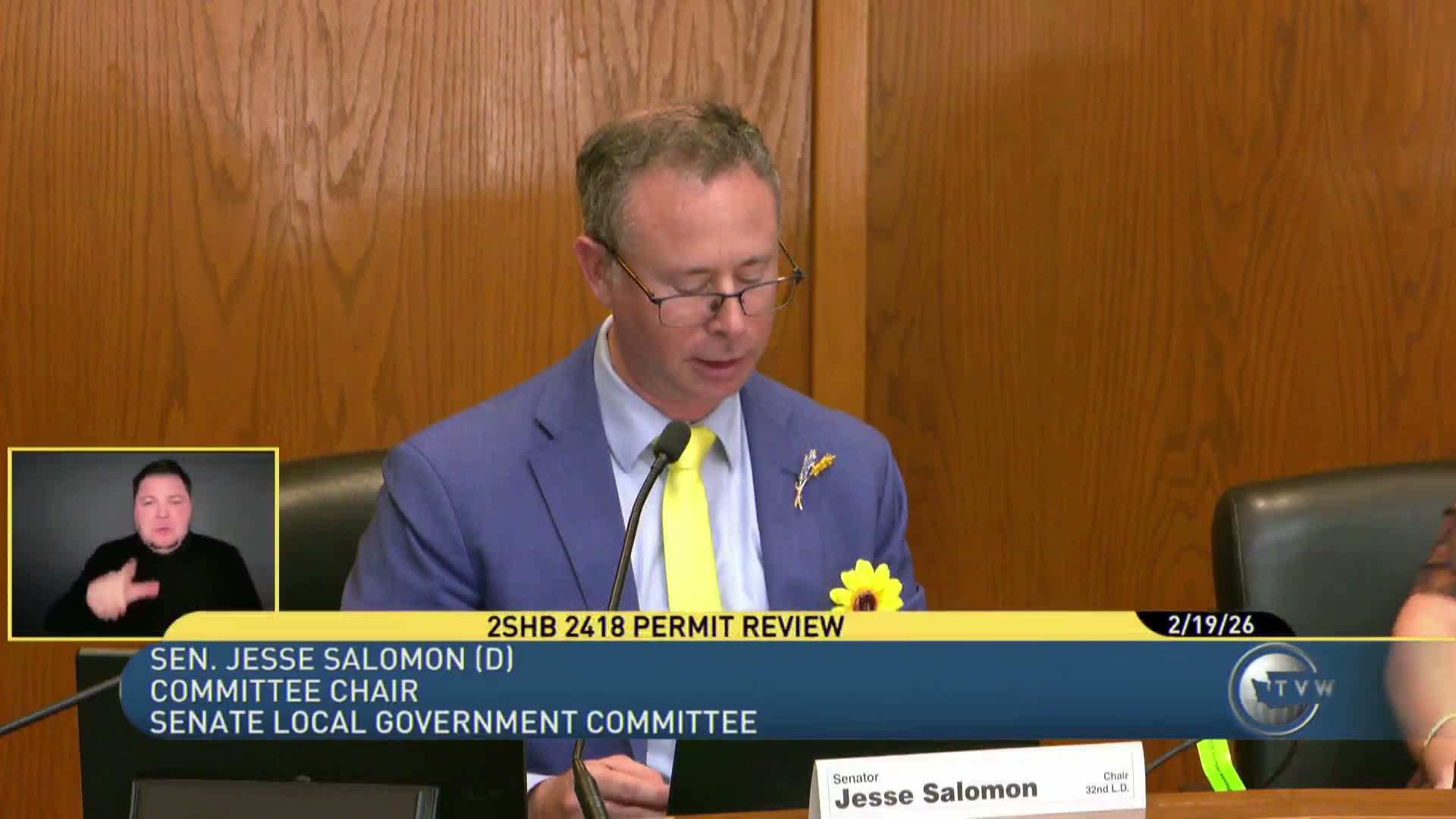
The Senate Local Government Committee on Monday took testimony on House Bill 2418, a proposal to tighten permit review timelines by applying procedural completeness standards and shot‑clock requirements to special purpose districts, public utility districts and other non‑municipal agencies.
Committee staff Karen Epps summarized the engrossed second substitute, saying the bill would require local governments to determine whether a project permit application is procedurally complete within 28 days, make certain time periods excluded from the statutory deadlines, allow applicants to agree in writing to waive review deadlines, and require specific refund penalties in some situations. Epps said the bill would also require local governments to designate a permit responsible official for residential project permit applications and provide a single point of contact for each project; that designation must be reflected in development regulations by 06/30/2027.
Rep. Durer, the bill sponsor, said the measure grew from a study tour and stakeholder meetings and is aimed at “predictability, speed and accountability.” He said the bill would make outside permitting entities subject to timelines, create single‑decision authority for applicants, and allow applicants to waive deadlines late in the process to avoid permit denials. “Having other permitting agencies be subject to timelines as well…because right now you can get your city permit, but if you're still waiting around for other permits, that doesn't help,” the sponsor said.
Supporters including Alex Hurd of the Master Builders Association and Jesse Simpson of the Housing Development Consortium said permitting is frequently slow and fragmented and that the bill’s procedural‑completeness approach and single point of contact would reduce surprise delays. Hurd told the committee the industry seeks “predictability, speed and accountability” and urged flexibility in how jurisdictions implement a single point of contact.
Opponents or cautious supporters representing special purpose water and sewer districts and some counties asked for technical clarifications. Devin Gomboski of the Washington Association of Sewer and Water Districts said districts need clear standards for what constitutes a complete referral and asked that timelines restart when an application materially changes; he also favored business days rather than calendar days for certain deadlines. Curtis Steinhauer of the Washington State Association of Counties said the requirement to amend development regulations by 2027 would be a meaningful change for some jurisdictions and requested either alignment with regular update cycles or legislative funding for the work.
Mayor Ryan Walters of Anacortes and other practitioners recommended specific drafting edits, including clarifying the authority of the permit responsible official and excluding the time required to prepare an environmental impact statement from the permit review clock.
Staff told the committee that the bill passed the House and that updated fiscal notes have been requested; no committee vote on final passage was recorded in the hearing transcript. Earlier in the session, the committee voted to waive the five‑day notice rule so both HB 2418 and HB 2451 could be considered at the same hearing.
The committee took public and remote testimony and left the record open as questions about fiscal impacts, timeline calculations (business vs calendar days), and precise drafting of the permit responsible official remained under discussion. The committee adjourned without recording a committee vote on the merits of the bill.
Committee staff Karen Epps summarized the engrossed second substitute, saying the bill would require local governments to determine whether a project permit application is procedurally complete within 28 days, make certain time periods excluded from the statutory deadlines, allow applicants to agree in writing to waive review deadlines, and require specific refund penalties in some situations. Epps said the bill would also require local governments to designate a permit responsible official for residential project permit applications and provide a single point of contact for each project; that designation must be reflected in development regulations by 06/30/2027.
Rep. Durer, the bill sponsor, said the measure grew from a study tour and stakeholder meetings and is aimed at “predictability, speed and accountability.” He said the bill would make outside permitting entities subject to timelines, create single‑decision authority for applicants, and allow applicants to waive deadlines late in the process to avoid permit denials. “Having other permitting agencies be subject to timelines as well…because right now you can get your city permit, but if you're still waiting around for other permits, that doesn't help,” the sponsor said.
Supporters including Alex Hurd of the Master Builders Association and Jesse Simpson of the Housing Development Consortium said permitting is frequently slow and fragmented and that the bill’s procedural‑completeness approach and single point of contact would reduce surprise delays. Hurd told the committee the industry seeks “predictability, speed and accountability” and urged flexibility in how jurisdictions implement a single point of contact.
Opponents or cautious supporters representing special purpose water and sewer districts and some counties asked for technical clarifications. Devin Gomboski of the Washington Association of Sewer and Water Districts said districts need clear standards for what constitutes a complete referral and asked that timelines restart when an application materially changes; he also favored business days rather than calendar days for certain deadlines. Curtis Steinhauer of the Washington State Association of Counties said the requirement to amend development regulations by 2027 would be a meaningful change for some jurisdictions and requested either alignment with regular update cycles or legislative funding for the work.
Mayor Ryan Walters of Anacortes and other practitioners recommended specific drafting edits, including clarifying the authority of the permit responsible official and excluding the time required to prepare an environmental impact statement from the permit review clock.
Staff told the committee that the bill passed the House and that updated fiscal notes have been requested; no committee vote on final passage was recorded in the hearing transcript. Earlier in the session, the committee voted to waive the five‑day notice rule so both HB 2418 and HB 2451 could be considered at the same hearing.
The committee took public and remote testimony and left the record open as questions about fiscal impacts, timeline calculations (business vs calendar days), and precise drafting of the permit responsible official remained under discussion. The committee adjourned without recording a committee vote on the merits of the bill.
View the Full Meeting & All Its Details
This article offers just a summary. Unlock complete video, transcripts, and insights as a Founder Member.
✓
Watch full, unedited meeting videos
✓
Search every word spoken in unlimited transcripts
✓
AI summaries & real-time alerts (all government levels)
✓
Permanent access to expanding government content
30-day money-back guarantee
