Committee hears negotiated changes to tax‑increment financing law, focusing on transparency and mitigation
February 19, 2026 | Legislative Sessions, Washington
This article was created by AI summarizing key points discussed. AI makes mistakes, so for full details and context, please refer to the video of the full meeting. Please report any errors so we can fix them. Report an error »
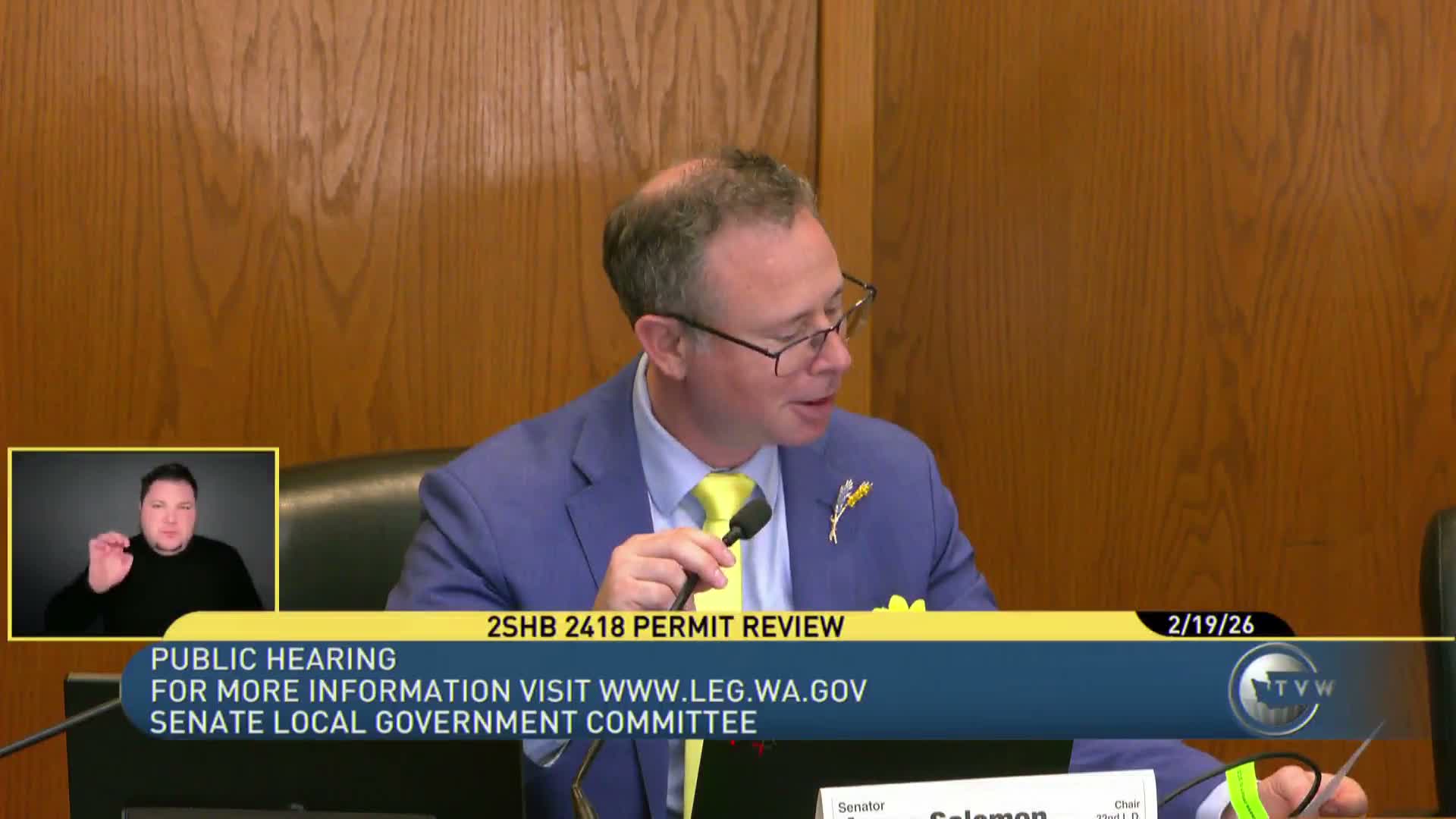
The Senate Local Government Committee heard public testimony on House Bill 2451, which makes multiple changes to Washington’s local tax increment financing program after stakeholder negotiations following the 2021 enactment of TIF authority.
Staff summarized the bill’s principal revisions: an upper limit on assessed valuation for an increment area (adjusted annually by CPI), a 25‑year sunset measured from the first year of tax allocation revenue or earlier if obligations are retired, expanded notice and public engagement requirements (180 days’ written notice and two public hearings), strengthened project‑analysis content (including revenue impact estimates for each affected taxing district), added eligible public improvements (including fire and life safety facilities), a requirement that mitigation be negotiated with impacted taxing districts, and a staged dispute resolution process that includes mediation and arbitration when negotiations fail. The bill also contains an emergency clause and an effective date of 06/02/2026, and staff said the engrossed bill passed the House and a new fiscal note had been requested.
Supporters at the hearing described the bill as a carefully negotiated compromise. Sean Egan of the Port of Tacoma said the measure improves taxpayer transparency and includes a “hold harmless” provision; Dylan Doty of the Washington Fire Chiefs Association emphasized the negotiated participation framework to make sure fire and EMS needs are identified up front; Candace Bach of the Association of Washington Cities said the bill preserves the TIF tool while addressing partner concerns; and Travis Dutton of the Washington State Association of Counties said counties supported the bill but remain concerned about cumulative impacts in counties that host many taxing districts and would like future conversations about opt‑out options.
Committee members asked how the bill would apply in scenarios where development occurs in unincorporated urban growth areas, who would sponsor a TIF area in those cases, and how the bill’s “but for” analysis would be applied. Witnesses answered that a county could sponsor TIF for development in such areas and described the “but for” test as a qualitative, documented analysis showing why the development would not occur without the TIF investment.
The committee took testimony from local governments and stakeholder groups and adjourned after hearing both bills; no final committee vote on HB 2451 was recorded in the transcript.
Staff summarized the bill’s principal revisions: an upper limit on assessed valuation for an increment area (adjusted annually by CPI), a 25‑year sunset measured from the first year of tax allocation revenue or earlier if obligations are retired, expanded notice and public engagement requirements (180 days’ written notice and two public hearings), strengthened project‑analysis content (including revenue impact estimates for each affected taxing district), added eligible public improvements (including fire and life safety facilities), a requirement that mitigation be negotiated with impacted taxing districts, and a staged dispute resolution process that includes mediation and arbitration when negotiations fail. The bill also contains an emergency clause and an effective date of 06/02/2026, and staff said the engrossed bill passed the House and a new fiscal note had been requested.
Supporters at the hearing described the bill as a carefully negotiated compromise. Sean Egan of the Port of Tacoma said the measure improves taxpayer transparency and includes a “hold harmless” provision; Dylan Doty of the Washington Fire Chiefs Association emphasized the negotiated participation framework to make sure fire and EMS needs are identified up front; Candace Bach of the Association of Washington Cities said the bill preserves the TIF tool while addressing partner concerns; and Travis Dutton of the Washington State Association of Counties said counties supported the bill but remain concerned about cumulative impacts in counties that host many taxing districts and would like future conversations about opt‑out options.
Committee members asked how the bill would apply in scenarios where development occurs in unincorporated urban growth areas, who would sponsor a TIF area in those cases, and how the bill’s “but for” analysis would be applied. Witnesses answered that a county could sponsor TIF for development in such areas and described the “but for” test as a qualitative, documented analysis showing why the development would not occur without the TIF investment.
The committee took testimony from local governments and stakeholder groups and adjourned after hearing both bills; no final committee vote on HB 2451 was recorded in the transcript.
View the Full Meeting & All Its Details
This article offers just a summary. Unlock complete video, transcripts, and insights as a Founder Member.
✓
Watch full, unedited meeting videos
✓
Search every word spoken in unlimited transcripts
✓
AI summaries & real-time alerts (all government levels)
✓
Permanent access to expanding government content
30-day money-back guarantee
